
Block 3,543,405 is the number every Zcash node operator has circled. That is the mainnet activation height that Zebra 7.0.0, now the only node software that matters for Zcash, schedules for NU7, and it should arrive around November 5. When it does, Zcash will produce a block every 25 seconds instead of every 75, and almost every headline about it will say the network just got three times faster.
That description is accurate for the stopwatch and misleading for almost everything else. Tripling the block count while keeping the coin supply fixed changes what each block is worth to miners, what each confirmation is worth to exchanges, and who gets paid for keeping the chain honest.
What Changes at Block 3,543,405
The upgrade bundles several changes that were settled through the September coinholder vote, in which Zcash's shielded-only NU7 ballot drew nearly 2.4 million ZEC. The details, from crypto.news's breakdown of ZIP 218 and its companions:
- Block spacing falls from 75 to 25 seconds. Orchard throughput rises from roughly 2.9 to 6.6 transactions per second for two-action transactions.
- The per-block subsidy shrinks to match. Daily ZEC issuance stays unchanged, which means each block pays roughly a third of what it used to.
- Halvings survive. Coinholders representing 2,375,932 ZEC voted to keep them, against about 22,385 ZEC for a smooth issuance curve.
- A Network Sustainability Mechanism takes a cut of fees. At least 60% of transaction fees are removed from circulation and returned later through future block subsidies, starting in February 2031, with the remaining 40% going to miners.
- Version 4 transactions are switched off. That makes the original Sprout pool unspendable, though it holds under 23,000 ZEC and accounts for less than 0.1% of volume.
Wallets should barely notice. Full nodes, indexers and block explorers are another matter, and the legacy zcashd client is deprecated outright, so operators who have not moved to Zebra 7.0.0 will find themselves on the wrong side of the fork.
Faster Blocks, Cheaper Confirmations
Here is the part the speed headlines skip. Proof-of-work security is measured in work, and difficulty adjusts so that each 25-second block carries roughly a third of the work of a 75-second block. An exchange that credits a ZEC deposit after a fixed number of confirmations faces an awkward choice on November 5. Keep the same count and deposits arrive three times faster, with each one protected by a third of the hashpower it used to have. Triple the count to keep the same protection, and users wait exactly as long as before.
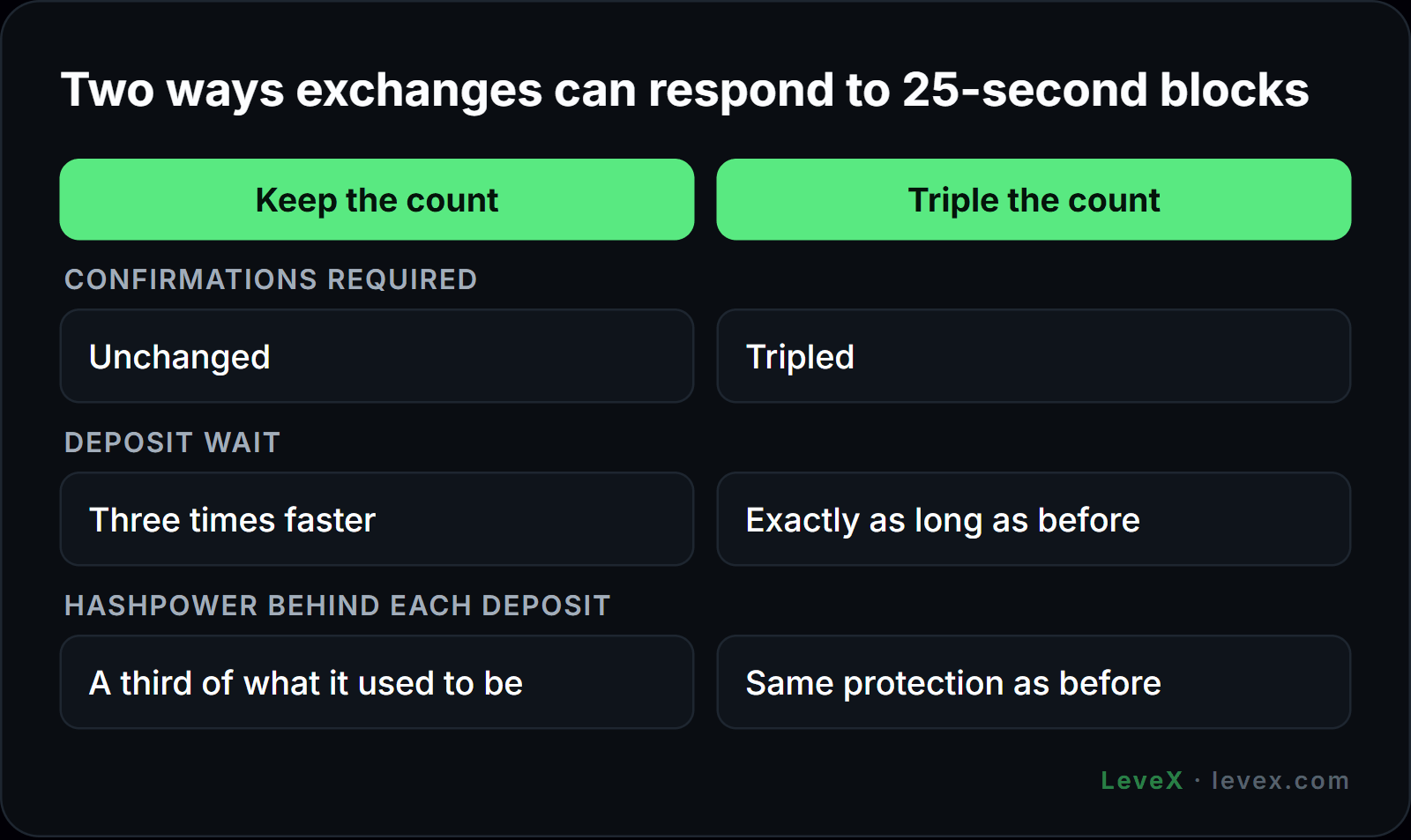
Which option the industry picks will tell you more about NU7's real-world speed than any throughput figure.
Miners face a quieter squeeze. The draft specification estimates a theoretical stale rate near 3.26% at 25-second spacing, and a 99-node devnet with 2 MB blocks measured 4.86%. Stale blocks are wasted work, and they hurt small, poorly connected miners more than large pools sitting close to the rest of the network. A per-block reward cut to a third, combined with a higher orphan rate, nudges hashpower toward the operators best placed to absorb both. Nobody designed it that way, and it is still the predictable result. The fee burn, meanwhile, is mostly symbolic for now, since Zcash fees are tiny next to the block subsidy, so the NSM matters more as a 2031 promise than as a 2026 supply event.
The LeveX Take
NU7 is a payments upgrade being priced like a supply upgrade. ZEC ran to around $1,485 in mid-September when the vote passed, and it sat near $1,227 on November 3 after a 7% bounce, still down almost 6% on the week, per Motley Fool's November 3 market wrap. The coin count and the issuance schedule come through the fork untouched. What actually moves is Zcash's case as a usable private payment rail, and the evidence for that case will show up slowly, in exchange confirmation policies and shielded transaction counts, over the months that follow activation day. Markets that bought the vote often sell the activation, and anyone who remembers how Bitcoin's 2024 halving played out has seen a widely known date get priced before it arrives.
That leaves a trader with two views that can both be right on different timelines. A known activation date invites a short, sharp reaction in either direction, while the payment-rail thesis, if you hold it, plays out over months. Multi-Trade lets those views live side by side on the ZEC perpetual as separate positions, so a small tactical short sized for a sell-the-news move around block 3,543,405 can sit next to a lower-leverage core long, each with its own exit. The useful discipline is deciding in advance what kills each one: a clean activation with exchanges keeping their confirmation counts unchanged weakens the payments story, and a quiet day with no orphan spike weakens the short.
Watching the Fork in Real Time
The first hours after activation are where the evidence lives. Watch the measured stale rate against the 3.26% estimate, and watch which exchanges announce new ZEC confirmation requirements, since that is where the speed claim meets risk management. The earlier Ironwood upgrade is a reminder that Zcash upgrades tend to be judged months later by usage, long after the price has moved on.
ZEC trades on LeveX as a perpetual futures contract, and Bitcoin is available on spot for anyone who wants the proof-of-work benchmark Zcash borrowed its design from. The Crypto in a Minute series explains block times, confirmations and stale blocks in short reads.