
"Markets are moving to 24/7 access and settlement is moving to real-time, always-on rails." That was Nigel Khakoo, Ripple's SVP of trading and markets, on October 26, as Aviva Investors put a tokenized share class of its £22 billion Sterling Liquidity Fund onto the XRP Ledger. The quote is accurate about the rails. The question XRP holders keep asking, and most of the coverage skipped, is how much of that traffic ever turns into demand for the token that runs the ledger.
What Aviva Actually Put On-Chain
The £22 billion figure describes the whole fund, an Ireland-domiciled money market fund that has been buying short-term sterling debt since 2002. The on-chain part is a "digital twin" share class representing ownership on the ledger while the portfolio stays exactly where it was, with BNY Mellon as custodian of the underlying assets. Aviva seeded it with £50 million of its own money, and across this class and the U.S. dollar version launched on July 29, its tokenized holdings now exceed £86 million, according to crypto.news. Komainu handles custody and Licuido runs the tokenization layer.
That is a real institutional commitment, and a modest one. It sits beside earlier XRPL deals such as JPMorgan's settlement work on the ledger, and in a week when JPMorgan's own tokenized money market funds expanded to Solana. Asset managers are spreading share classes across several chains at once, which makes each individual ledger one venue among many.
The Busy Week That Wasn't Quite
The same weekend produced a headline about daily XRP Ledger transactions jumping 1,717% to a six-month high. The number is true and a bit theatrical. The underlying data shows 3.72 million transactions on October 25, measured against an unusually thin 204,582 the day before, while the 30-day average sits around 2.5 million. Against the average, activity was up about 48%, a healthy reading that the percentage-of-a-trough headline inflates into a moonshot.
Meanwhile XRP fell about 13% in October to around $1.30. Rising network activity next to a falling price is the pattern this article is really about.
Where the Value Actually Accrues
The fee side
Every XRPL transaction burns a small fee, with a standard minimum of 10 drops, or 0.00001 XRP. A million fund-share transfers at that rate destroy 10 XRP, roughly $13. Even at many multiples of the minimum, institutional settlement on this ledger is a rounding error for supply.
The reserve side
Reserves are the more interesting lever. Each XRPL account must hold a 1 XRP base reserve plus 0.2 XRP for every object it owns, including the trust line needed to hold a token like a fund share, as the XRPL documentation on reserves sets out. Run a generous scenario where 100,000 investor wallets each hold one tokenized share class. That locks about 120,000 XRP, around $156,000 at current prices.
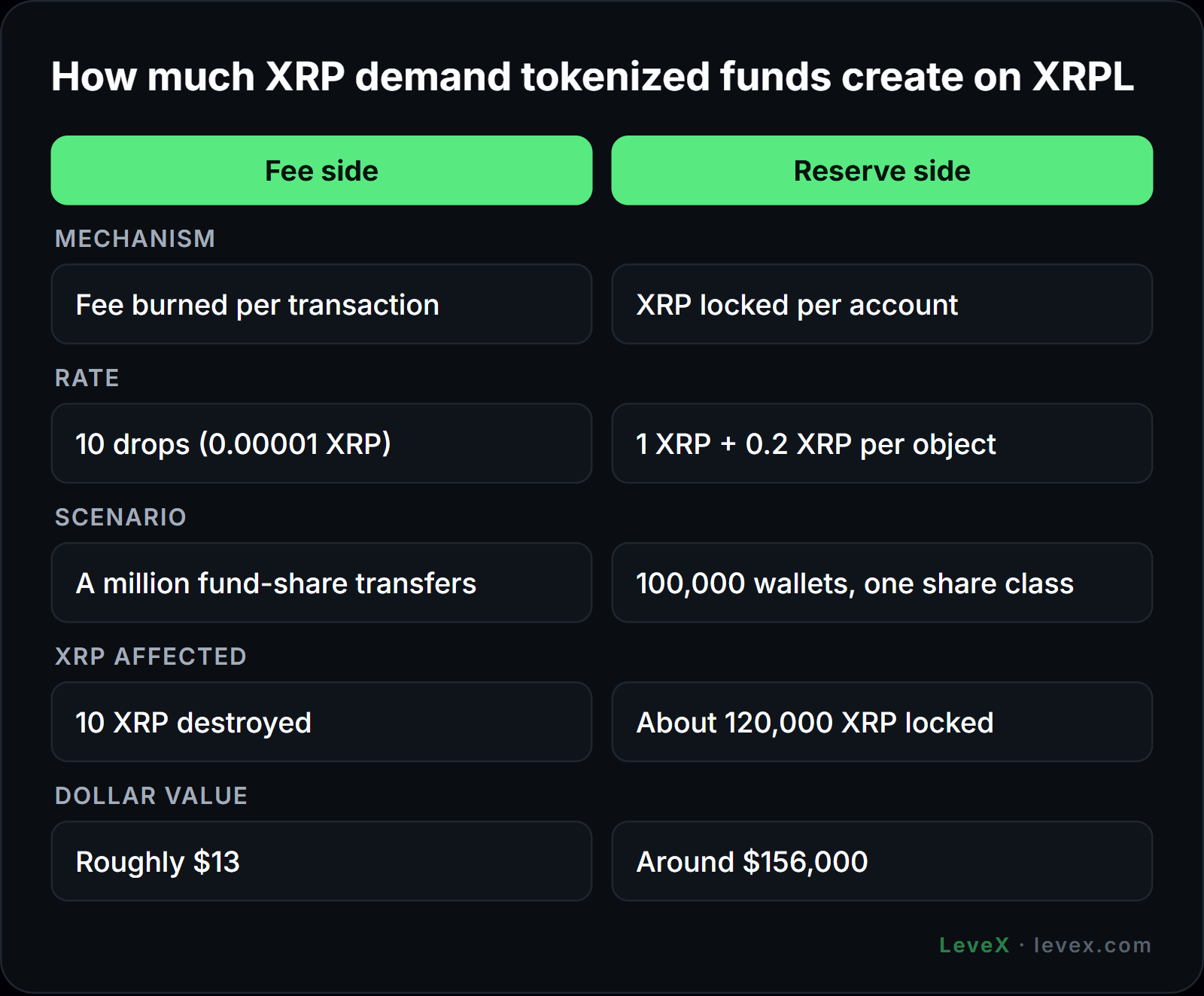
The arithmetic is blunt: tokenized funds can grow by billions on the XRP Ledger while barely moving demand for XRP.
That gap explains the price action better than any conspiracy about suppression. The ledger is succeeding at the job it was built for, which is cheap, final settlement, and cheapness is precisely what keeps the token's cut so thin. The paths where XRP itself captures value run through liquidity, as a bridge asset in cross-currency payments, as a pair in the ledger's native DEX and AMM pools, or as collateral, and none of the recent fund launches mention XRP in any of those roles.
The LeveX Take
XRP now trades on two clocks running at different speeds. The slow clock is adoption: each new share class, each bank pilot and each settlement deal adds a little to the case that the ledger will matter in a tokenized financial system, and that case compounds over years. The fast clock is everything else, from Fed decisions and oil prices to headline spikes that fade within a session, and October's 13% slide shows which clock is in charge week to week. Traders who treat every institutional announcement as a near-term price catalyst are mixing the two and getting chopped by the fast one.
On LeveX, Multi-Trade lets a trader hold both clocks on the same XRPUSDT contract. A small, low-leverage long can carry the multi-year adoption view untouched, while a separate short is opened and closed around the fast-clock moves, such as the fade that tends to follow a hyped announcement or a risk-off macro week. Because the legs stay separate, closing the tactical short never disturbs the core view, and a bad week on the fast clock no longer forces a decision about the slow one. The cost is attention, since two legs mean two sets of stops and funding payments to manage.
The Metric That Would Change the Story
The signal worth waiting for is XRP showing up inside these products: tokenized fund shares trading against XRP in the ledger's AMM pools, or settlement flows that route through XRP as a bridge instead of stablecoins and bank money. Until that happens, institutional wins on the XRP Ledger are good news for the network and a slow, indirect story for the token.
To trade either clock, XRP is available on LeveX spot and perpetual futures, and Crypto in a Minute breaks down tokenization, reserves and ledger economics in short reads.