
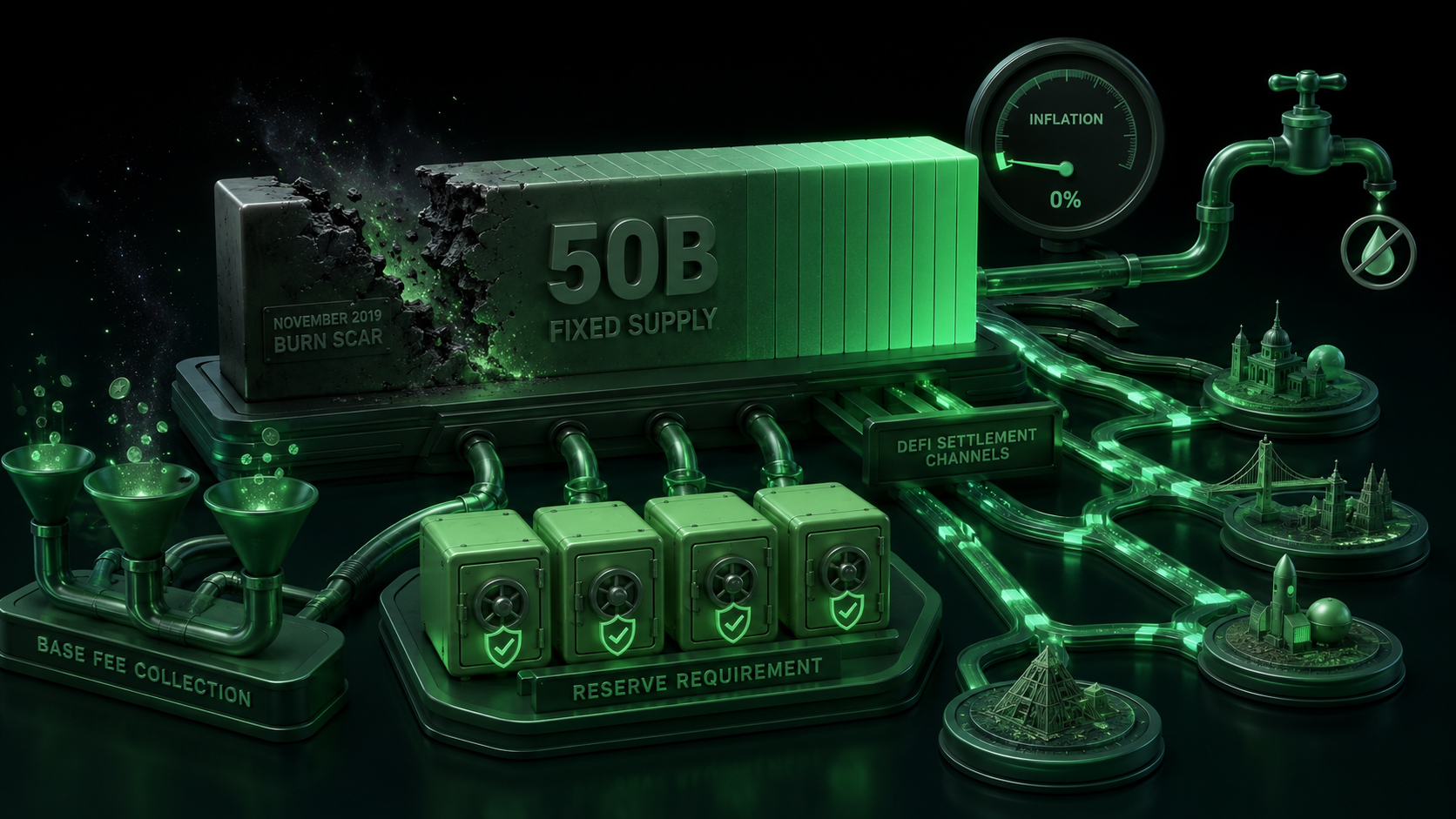
XLM Tokenomics: Fixed Supply, Inflation Removal, and Stellar's Network Economy
Understanding Stellar tokenomics requires looking at a network that fundamentally restructured its economics in 2019. Unlike many tokens with ongoing issuance mechanisms, XLM operates with a hard-capped supply of 50 billion tokens, no annual inflation, and a fee system that locks capital in network participation. These choices shape how traders, developers, and institutions interact with Stellar.
The 50 Billion Supply Ceiling
When the Stellar network launched in 2014, the Stellar Development Foundation (SDF) created 100 billion XLM tokens with a 1% annual inflation rate. That model lasted five years. In October 2019, the SDF removed the inflation mechanism entirely. One month later, in November 2019, they burned 55 billion XLM, roughly half the supply, by permanently removing tokens from circulation and reducing the network's total to 50 billion.
This was not a speculative burn designed to pump price. The SDF publicly stated that the 1% inflation was not driving ecosystem growth and that holders were better served by a fixed supply that mirrored Bitcoin's scarcity model.
| Supply Metric | Amount |
|---|---|
| Total Fixed Supply | 50.001786892 billion XLM |
| Circulating Supply (Apr 2026) | ~31-32 billion XLM |
| Tokens Permanently Removed (Nov 2019) | 55 billion XLM |
| Annual Inflation Rate | 0% |
The remaining circulating supply includes tokens held by the SDF (for ecosystem incentives and development), institutional partners, and active market participants. Because supply is fixed and the network has no inflation, any XLM lost to incorrect addresses, forgotten private keys, or unrecoverable smart contract interactions is gone forever, making the effective circulating supply slightly deflationary over time.
How Inflation Removal Reshaped XLM's Economics
The 2019 inflation removal was one of the clearest votes of confidence in a fixed-supply model before Stellar's Soroban smart contract platform existed. Why? Because the SDF acknowledged that issuing new tokens annually wasn't motivating developers to build on Stellar. Developers didn't need constant new rewards; they needed tools, stability, and a network they could trust.
Removing inflation had three immediate effects:
First, it shifted incentive structures away from "earn new tokens" toward "use the existing network and transaction fees." Second, it aligned XLM with the growing institutional appetite for digital assets with transparent, predictable supply caps. Third, it removed a long-term dilution pressure that might have discouraged long-term hodlers and serious traders from building positions.
According to data on CoinGecko, XLM's post-burn price action over the following years showed the network focusing on utility over token supply management. The burn itself was not a price pump. It was a reset: the SDF telling the market that Stellar's value would come from adoption, not from monetary policy gimmicks.
Locking XLM: Base Fees and Reserve Requirements
Every transaction on Stellar requires XLM. Not as a gas token, exactly, but as a mechanism for commitment and spam prevention. This is where tokenomics intersects with lived network experience.
Base Fee
The base fee on Stellar is 0.00001 XLM per operation, one of the lowest transaction costs in crypto. This translates to fractions of a cent for most trades and transfers. The fee is deterministic, doesn't spike wildly during congestion, and is calculated using a VCG auction model. When network usage is below capacity, you pay the minimum. During heavy activity, fees increase but predictably.
For traders, this cost is negligible. For institutions processing millions of transactions, the cumulative effect matters. A typical payment operation (sending lumens from one account to another) costs 100 stroops (0.00001 XLM). A multi-asset transfer or path payment costs more operations, multiplying the fee accordingly.
Reserve Requirements and Account Balances
Here's where XLM's tokenomics create interesting liquidity dynamics. Stellar requires every account to maintain a minimum balance. The formula is simple: 2 base reserves + (number of entries × 1 base reserve). Currently, one base reserve is 0.5 XLM. A new account with no trustlines or offers must hold at least 1 XLM. Each trustline (a record that you hold a specific asset issued by another party) or offer (a standing trade order) requires an additional 0.5 XLM.
This design accomplishes two things. First, it prevents spam by making it expensive to create thousands of throwaway accounts. Second, it locks a portion of XLM supply in accounts, reducing the freely tradable circulating supply. If an account holds 100 trustlines, it must lock 50 XLM in reserve, unavailable for trading or transfer.
For DeFi protocols and trading bots, this reserve system is a real operational cost. For individual traders, it's manageable: a typical account with a handful of trading pairs might lock 2-3 XLM in reserves, hardly a barrier to entry.
XLM's Role in Bridge Payments and Network Utility
Supply and fee structures are abstract until you understand what people actually use Stellar for. The primary use case is path payments, sending value across borders and currencies efficiently. XLM functions as the bridge currency in these payments.
Imagine you're in Nigeria and want to send USD to Canada. A traditional bank charges 10-25 USD. On Stellar, an institution in Nigeria can convert NGN to XLM, route XLM across the network to an institution in Canada, and convert XLM to CAD. The entire transaction settles in seconds and costs fractions of a cent. This is why partnerships with Stellar Anchors (regulated entities that convert traditional currency to blockchain-based equivalents) are critical to the network's utility thesis.
Recent developments have expanded this foundation. Franklin Templeton, Paxos, and other institutions are issuing USDC and other stablecoins on Stellar. The network has become the preferred infrastructure for tokenizing real-world assets, with over $757 million in RWA tokenization deployed by Q1 2025. Each of these use cases relies on a fixed XLM supply and predictable fees.
When considering Stellar USDC payments or stablecoin settlement, the underlying XLM tokenomics provide the guarantee that fees won't suddenly spike and that new supply won't dilute the value proposition of holding reserves.
Comparing XLM to Other Networks and Looking Forward
It's worth situating Stellar in the broader context. Bitcoin, with its 21 million cap, is the canonical fixed-supply digital asset. Stellar's 50 billion supply and zero inflation put it in the same category philosophically: scarcity by design, not accident. Ethereum, by contrast, operates with no cap and ongoing issuance, though with deflationary mechanisms through burning.
If you're evaluating where XLM fits in your trading thesis, the tokenomics question connects directly to XLM price prediction models. Some analysts argue that fixed supply plus growing adoption of Stellar for RWA settlement creates a bullish long-term setup. For comparison, see how Stellar compares to XRP, which operates with 100 billion XRP and no maximum supply. The tokenomics differences are material: Stellar's transparency about burned supply and zero future inflation contrasts with XRP's concentration of founder-held tokens.
XLM tokenomics tell a story of deliberate design. A 50 billion fixed supply locked in a transparent ledger, a fee structure measured in microfractions, and reserve requirements that tie utility to token holding create an integrated system. The burn of 55 billion tokens in November 2019 signaled the SDF's commitment: we will not inflate our way to success.
The removal of the 1% annual inflation was equally significant. According to Messari research on Stellar, the network's growth in institutional partnerships, Soroban smart contracts, and RWA tokenization validates this bet. The fixed supply has not hampered adoption; if anything, it has attracted the institutions and traders who care most about predictability.
For traders building positions in XLM or exploring the best Stellar wallets for holding XLM, understanding these tokenomics is foundational. It explains why the network doesn't spike fees during congestion, why reserve requirements matter for account design, and why long-term narratives around scarcity and institutional adoption carry real weight. Real-world asset tokenization has exploded. Payment flows have grown. The fixed supply has enabled the kind of long-term commitment from institutions that markets require.
Start trading XLM on LeveX spot markets or explore XLM perpetual futures on LeveX. To deepen your understanding of Stellar's broader ecosystem, explore more token guides in Crypto in a Minute.