
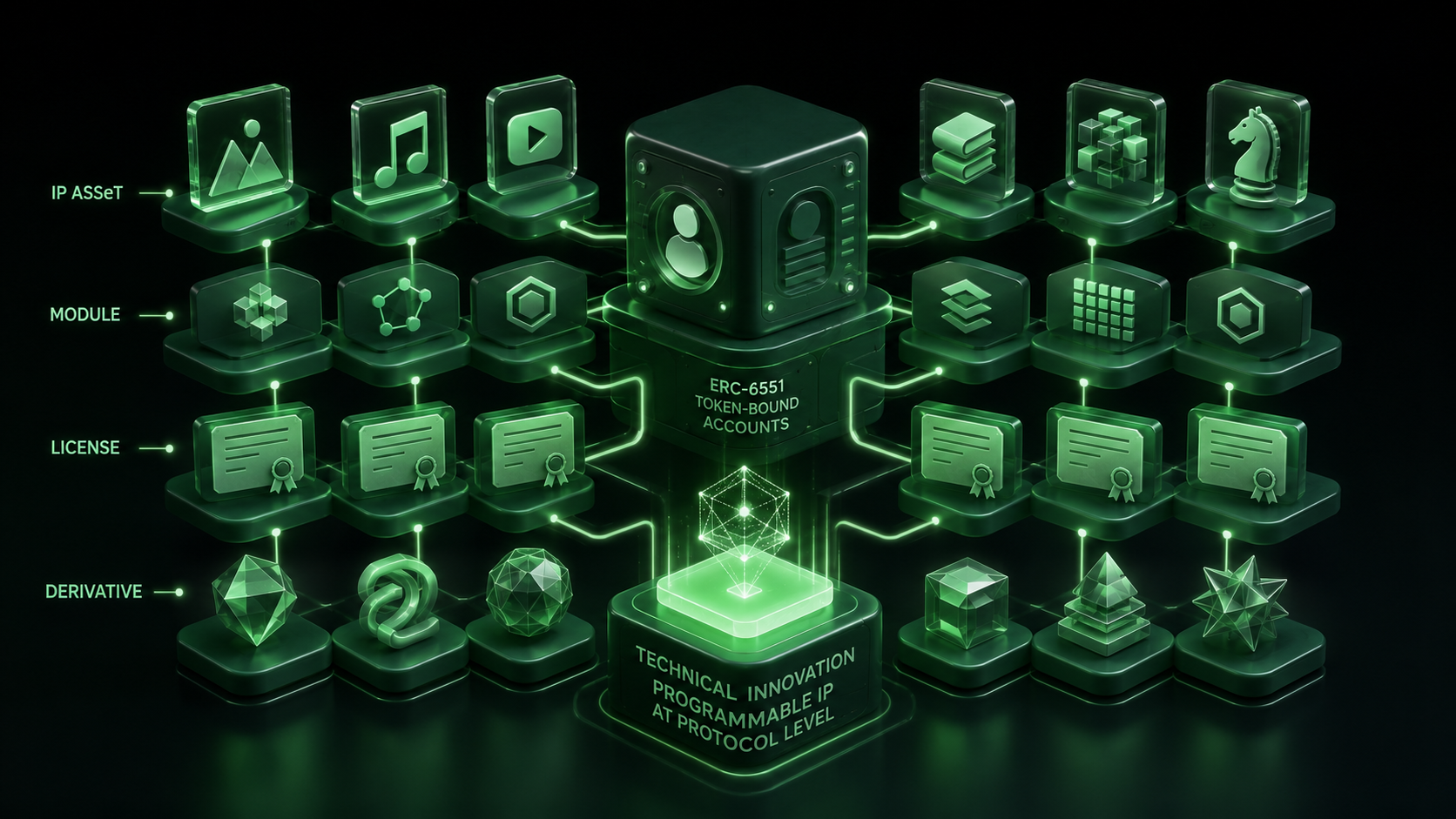
The Proof-of-Creativity protocol transforms intellectual property from static legal documents into programmable blockchain assets. Natively embedded within Story Protocol's Layer 1 network, this smart contract framework enables permissionless licensing, automated royalty distribution, and decentralized dispute resolution without intermediaries.
Understanding the technical architecture reveals why Story has positioned itself as infrastructure for the $61 trillion IP asset class, particularly as AI-generated content accelerates demand for automated rights management.
Core Architecture: Assets and Accounts
The Proof-of-Creativity protocol operates through two foundational components that work in tandem to make intellectual property programmable.
IP Assets represent tokenized intellectual property as ERC-721 NFTs recorded in a Global IP Asset Registry. Creators can register existing NFTs as IP Assets or mint new ones specifically representing off-chain works like music, artwork, or datasets. Each registration creates an immutable on-chain record establishing provenance and ownership.
IP Accounts provide the programmable layer. When an IP Asset registers, the protocol deploys an associated IP Account using a modified ERC-6551 implementation (Token Bound Account). This separate smart contract bound to the IP Asset serves two critical functions: storing comprehensive IP-related data including metadata, licenses, and royalty configurations, and facilitating interactions with the protocol's module system.
The IP Account's address becomes the IP Asset's unique identifier (ipId), creating a direct mapping between the tokenized representation and its operational capabilities. This architecture enables IP to take autonomous actions through encoded function calls.
The Module System
Modules are customizable smart contracts that extend IP Account functionality, transforming static assets into dynamic, interactive entities. Three core modules drive primary protocol operations.
Licensing Module
The Licensing Module empowers IP holders to create and manage license agreements programmatically. Creators define terms through License Templates specifying usage rights, commercial permissions, derivative work allowances, and associated fees.
When licensing terms attach to an IP Asset, third parties can mint License Tokens (ERC-721 NFTs) granting usage rights under those predefined conditions. This mechanism enables scalable one-to-many licensing without individual negotiations. A musician could set terms once, and thousands of content creators could obtain licenses instantly by minting tokens.
The module integrates with the Programmable IP License, an off-chain legal contract that provides real-world enforceability. The PIL functions similarly to Y Combinator's SAFE template for startups, offering standardized legal language that maps to on-chain parameters.
Royalty Module
Revenue distribution across the intellectual property graph happens automatically through the Royalty Module. When derivative works generate income, predefined percentages route to parent assets through Royalty Vaults.
Consider a scenario where Artist A creates original artwork, Artist B creates a derivative with a 10% royalty to A, and Brand C licenses B's derivative commercially. When C generates revenue, the Royalty Module automatically splits payments: B receives their share, and A receives 10% of B's allocation. This cascading distribution works across unlimited derivative chains.
Royalty Tokens (ERC-20) enable fractional ownership of revenue streams, connecting directly to IPFi applications where IP income can be traded, collateralized, or bundled into financial products.
Dispute Module
The Dispute Module provides on-chain arbitration for infringement claims and licensing violations. Currently integrated with UMA's optimistic oracle, the system allows users to raise disputes, stake tokens on outcomes, and receive binding resolutions.
When disputes arise, arbitrators evaluate evidence and impose penalties if violations occur. This mechanism reduces reliance on traditional courts while maintaining enforceability through economic incentives. Invalid claims cost challengers their stakes, discouraging frivolous disputes.
Graph-Based IP Relationships
Story's IP Core structures assets as graph-based entities where nodes represent individual works and edges encode economic and legal relationships. This architecture enables critical capabilities unavailable in traditional IP systems.
Provenance Tracking: The graph records every derivative relationship, creating an immutable history from original creation through endless remixes and adaptations. When AI models train on registered datasets or generate derivative content, the lineage remains traceable.
Composability: Derivative works inherit revenue streams and licensing terms from parent assets automatically. Complex IP networks with hundreds of interconnected works can operate with consistent rules propagating through the entire graph.
Efficient Traversals: Native graph operations within the IP Core enable computationally efficient queries across relationship networks. Finding all derivatives of an original work, calculating cumulative royalty obligations, or identifying licensing conflicts happens at blockchain speed rather than through expensive off-chain computation.
Registry Infrastructure
Three primary registries track global protocol state:
| Registry | Function | Data Stored |
|---|---|---|
| IP Asset Registry | Universal ledger for all registered IP | Ownership, metadata URIs, registration timestamps |
| License Registry | License terms and token mappings | Template configurations, minted licenses, term parameters |
| Module Registry | Approved module contracts | Verified modules, version history, access permissions |
The registry architecture ensures consistency across the network while enabling permissionless registration. Anyone can register IP without gatekeepers, though off-chain entities monitor registrations, validate identities, and provide attestations that strengthen legal standing.
Technical Implementation Details
Proof-of-Creativity smart contracts written in Solidity deploy natively on Story Network. The protocol's execute() function within IP Accounts enables calling arbitrary modules through encoded bytes data, providing extensibility for future functionality without requiring asset migration.
Token Standards Used:
- ERC-721: IP Assets, License Tokens
- ERC-20: Royalty Tokens, revenue distribution
- Modified ERC-6551: IP Accounts (Token Bound Accounts)
Consensus Layer: Story employs CometBFT (evolved from Tendermint's Byzantine Fault Tolerant consensus) providing instant finality crucial for licensing agreements. Once recorded, IP transactions cannot be reversed, ensuring legal enforceability of on-chain terms.
The network combines EVM compatibility with Cosmos SDK optimization, enabling developers to deploy existing Solidity applications while accessing native IP primitives. This hybrid approach differentiates Story from Ethereum-based alternatives that lack purpose-built IP infrastructure.
Off-Chain Synchronization
The protocol extends beyond pure on-chain operations through the Offchain Synchronization Core, bridging blockchain-native IP with traditional legal frameworks.
Oracle Integration: External data providers verify off-chain events like physical merchandise sales, streaming royalties, or traditional licensing payments. These attestations trigger on-chain royalty distributions based on real-world revenue.
Identity Verification: Off-chain entities validate IP holder identities, strengthening legal claims and enabling Know Your Customer compliance where required by jurisdiction.
Story Orchestration Service (SOS): This framework coordinates complex multi-step IP operations spanning on-chain and off-chain components, ensuring atomic execution of elaborate licensing arrangements.
AI Integration Capabilities
The Proof-of-Creativity protocol addresses AI's unique position as both consumer and producer of intellectual property.
AI models training on registered datasets can obtain licenses programmatically, with terms verified before training begins. Royalties accumulate automatically as models generate commercial value from licensed data.
AI-generated content can register as derivative works, establishing provenance linking outputs to training inputs. This capability proves essential as regulators worldwide grapple with AI copyright questions.
Autonomous AI agents operating within Story's ecosystem can license, create derivatives, and manage IP portfolios without human intervention, settling transactions in IP tokens as the native settlement currency.
Practical Implications for Creators
The technical architecture translates into concrete benefits for IP holders:
Registration Speed: Traditional IP registration involves lawyers, filing fees, and weeks of processing. Story Protocol registration completes in seconds with minimal gas costs.
Licensing Automation: Setting terms once enables unlimited licenses without renegotiation. The protocol handles permission verification, payment collection, and rights tracking automatically.
Revenue Transparency: On-chain royalty flows eliminate disputes about sales reporting. Creators see exactly what derivative works earn and receive payment in real-time rather than quarterly statements.
Dispute Efficiency: Arbitration through staking mechanisms resolves conflicts faster and cheaper than traditional litigation while maintaining binding outcomes.
Building on Proof-of-Creativity
Developers access the protocol through TypeScript and React SDKs, with comprehensive documentation covering integration patterns. StoryKit provides white-label UI components for embedding IP functionality into applications without building from scratch.
The modular architecture supports custom modules beyond core licensing, royalty, and dispute functions. Projects can implement specialized logic for particular IP types, industry-specific requirements, or novel financial instruments built on IP primitives.
The Technical Foundation for Programmable IP
Story Protocol's Proof-of-Creativity represents infrastructure-level innovation rather than application-layer convenience. By embedding IP management directly into blockchain smart contracts, the protocol enables automation, transparency, and composability impossible in traditional systems.
The combination of ERC-6551 IP Accounts, purpose-built modules, and graph-based relationship tracking creates a foundation where intellectual property operates as first-class programmable assets. For IP token price dynamics, protocol adoption driving transaction volume directly influences token utility and network value.
Trade IP tokens on LeveX spot markets or access leveraged exposure through futures contracts. For foundational blockchain concepts and project analysis, explore our Crypto in a Minute educational series.