
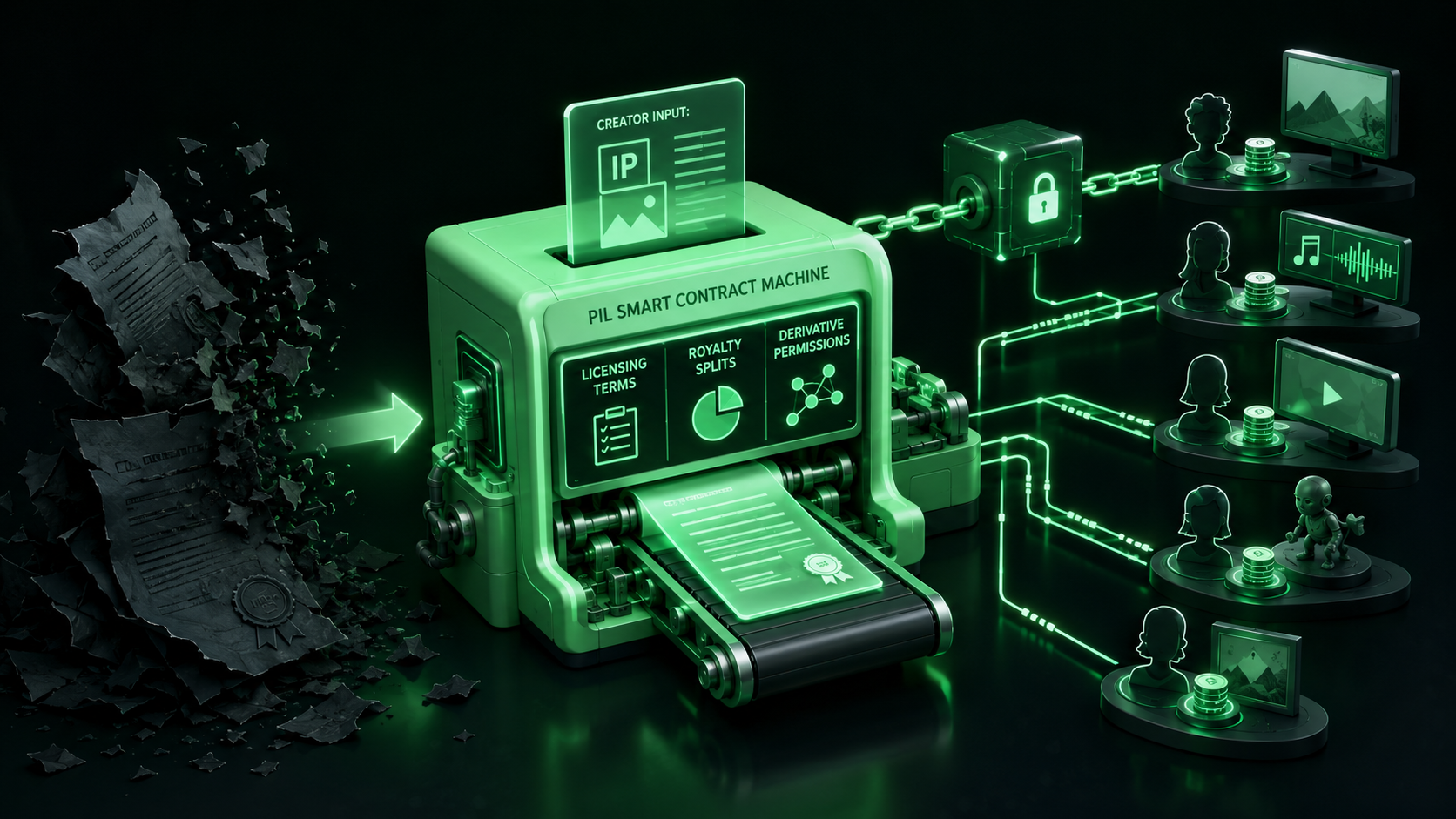
Traditional intellectual property licensing requires lawyers, lengthy negotiations, and contracts that vary wildly between industries. Story Protocol addresses this friction with the Programmable IP License (PIL), a universal framework that embeds licensing terms directly into smart contracts. The PIL bridges legal agreements and blockchain code, enabling creators to set permissions, royalties, and usage rights that execute automatically without intermediaries.
Think of the PIL as the "Y Combinator SAFE" for intellectual property. Just as the SAFE agreement standardized early-stage startup investment, the PIL standardizes how creative works get licensed on-chain. This innovation unlocks the $60+ trillion intellectual property market for permissionless transactions while maintaining legal enforceability in traditional courts.
What is the Programmable IP License?
The PIL is a legal document based on US copyright law that has been mapped to on-chain parameters. According to Story's official documentation, it serves as a "License Template" where traditional legal terms like "Commercial Use" and "Derivatives Allowed" become enforceable through smart contracts.
The architecture mirrors how stablecoins work. USDC connects traditional banking to crypto by backing each token with one US dollar. Similarly, the PIL connects real-world intellectual property to its blockchain representation (called an IP Asset), providing legal backstop while enabling on-chain automation. As Learn Story explains, the PIL is "to intellectual property what fiat is to USDC," creating a bridge between traditional legal systems and programmable smart contracts.
Story's legal team, including experts Ghaith Mahmood and Heather Liu, developed the PIL after finding that existing frameworks like Creative Commons, Arweave's licenses, and A16Z's "Can't Be Evil" licenses weren't robust enough for the emerging on-chain creative economy. The result is a framework flexible enough to handle everything from social media remixes to Hollywood-grade collaborative storytelling.
PIL Parameters and Configuration
Creators configure their PIL through a set of parameters that define exactly how their intellectual property can be used.
| Parameter | Description | Example Setting |
|---|---|---|
| commercialUse | Can others profit from your work? | true/false |
| mintingFee | Cost to obtain a license | 1 $WIP token |
| derivativesAllowed | Can others create remixes? | true/false |
| derivativesAttribution | Must remixers credit you? | true/false |
| commercialRevShare | Percentage of derivative revenue owed | 10-50% |
| expiration | How long the license lasts | Perpetual or specific date |
| transferable | Can licenses be resold? | true/false |
Additional parameters handle edge cases that traditional licenses struggle with. Territory tags specify geographic restrictions (global by default). Channel tags define permitted distribution methods like television, video games, or physical products. Content standards can prohibit hate speech or restrict age-inappropriate usage. The irrevocable tag locks in rights permanently, preventing the creator from rescinding the license later.
These parameters get stored on-chain as a struct within Story's smart contracts, while longer descriptive terms link to off-chain JSON files hosted on GitHub. This hybrid approach balances blockchain efficiency with the detailed language required for legal enforceability.
Three Pre-Configured License Types
To simplify onboarding, the PIL offers three standard configurations that cover most common use cases.
Non-Commercial Social Remixing
This license allows unlimited free remixing while tracking all derivative works and requiring attribution. Creators maintain visibility into how their work spreads across the internet without monetizing it directly. Commercial use of any kind remains prohibited.
Similar to TikTok's default content sharing, this configuration suits creators who want maximum reach and cultural impact over immediate revenue. The license is pre-registered as licenseTermsId = 1 on Story's protocol, making it the simplest option to implement.
Commercial Use
Creators set an upfront minting fee that others pay to use the work commercially. Licensees can display or publish across any medium, but cannot create derivative works or resell the original. This model works for stock photography, music licensing, and similar use cases where the original work gets used as-is.
The fee structure provides immediate monetization without ongoing royalty tracking complexity. Attribution requirements remain customizable based on creator preferences.
Commercial Remix
The most flexible option combines upfront fees with ongoing revenue sharing. Others pay to create and commercialize derivative works, with a percentage of all downstream revenue flowing back to the original creator automatically through Story's Royalty Module.
This configuration enables the "IP LEGOs" vision where creative works build upon each other in an interconnected economy. A musician could license a beat under these terms, earning both the initial fee and a cut of every song that samples it, every video that features it, and every advertisement that incorporates it, all without manual tracking or collection.
How PIL Enforcement Works
The PIL achieves its "code is law" functionality through tight integration with Story's modular protocol architecture.
When someone wants to license an IP Asset, they interact with the Licensing Module smart contract and pay any required fees. The contract mints a License Token representing their rights, which can itself be transferred or traded. This "liquid licensing" transforms static legal agreements into dynamic on-chain assets.
The Royalty Module handles revenue distribution automatically. When a derivative work generates income, the smart contract calculates what percentage flows upstream to parent IP holders based on the PIL terms. These payments happen on-chain in real-time, eliminating months-long delays common in traditional royalty collection.
For disputes, Story integrates with on-chain arbitration systems. Flagged assets cannot generate new licenses, link to parent works, or claim royalties until resolution. The off-chain legal document ensures enforceability extends beyond blockchain, providing grounds for traditional legal action when necessary.
Real-World Applications
The PIL enables licensing models previously impractical due to transaction costs and enforcement challenges.
AI Training Data
AI companies need vast datasets to train models, but licensing millions of works through traditional contracts is impossible. With PIL, data owners can set blanket terms allowing AI training use for a per-work fee and revenue share. Story's partnership with Poseidon demonstrates this use case for medical record licensing.
Music and Entertainment
The entertainment industry's complex royalty structures become manageable through PIL's automated revenue sharing. Story's collaboration with Barunson (producers of Parasite) explores how fans could legally remix films and share revenue with original creators.
NFT Collections
Existing NFT projects can register collections on Story and attach PIL terms, adding legal clarity to works that previously existed in regulatory gray areas. The PIL defines exactly what NFT holders can and cannot do with their digital assets.
Implications for IP Token Value
PIL adoption directly impacts the IP token's investment thesis. Every license minting, royalty payment, and dispute resolution requires IP tokens for gas fees. As the licensing economy grows, token utility increases correspondingly.
The 0.01% quarterly token burn from transaction fees creates deflationary pressure proportional to network activity. Token holders can also participate in network staking to secure the protocol while earning rewards. More importantly, successful PIL adoption validates Story's core value proposition, potentially attracting institutional capital seeking exposure to on-chain intellectual property infrastructure.
Creators who understand PIL mechanics can position themselves advantageously within this emerging economy, capturing value that currently flows to intermediaries like record labels, publishing houses, and licensing agencies.
Limitations and Considerations
Despite its innovations, the PIL faces challenges creators should understand.
Jurisdictional Uncertainty: While based on US copyright law and the Berne Convention, enforcement in non-US jurisdictions remains untested.
Technical Complexity: Configuring optimal PIL terms requires understanding both legal implications and smart contract mechanics. Incorrect settings could grant broader rights than intended.
Immutability Trade-offs: On-chain terms cannot be easily modified. Creators must carefully consider long-term implications before attaching PIL terms.
Adoption Dependencies: PIL value depends on ecosystem adoption. A perfectly configured license means little if no one uses Story Protocol to discover and license the work.
Working with Programmable IP
The PIL represents a fundamental shift in how intellectual property moves through the economy. By encoding licensing terms in smart contracts, Story Protocol removes friction that has historically prevented small creators from monetizing their work and limited how creative works build upon each other.
For creators, the PIL offers unprecedented control over how their work gets used, remixed, and monetized across the internet. For businesses, it provides standardized licensing infrastructure that scales from individual transactions to enterprise-level IP portfolios. For the broader creative economy, it promises a future where value flows automatically to original creators regardless of how many derivatives their work inspires.
Trade IP tokens on LeveX spot markets to gain exposure to Story Protocol's growth, or use futures contracts for leveraged positions on licensing infrastructure adoption. Explore our Crypto in a Minute guides for more on emerging blockchain use cases transforming traditional industries.