
Sixty-three million SOL, roughly 14.4% of the network's staked supply, has now signalled support for a proposal package that takes money directly out of the pockets of the people doing the signalling. The threshold to force a formal stake-weighted vote is 15%, about 65.16 million SOL, and the window closes on August 18.
Coverage of SGP-0003 has settled on a single frame: supply goes down, price goes up. That frame is doing a lot of work to avoid asking who pays for the supply cut.
What the Package Actually Does
SGP-0003 bundles two changes that cleared the initial governance support phase on August 4 and moved into discussion.
SIMD-0550 doubles the annual disinflation rate from 15% to 30%, which eliminates an estimated $1.5 billion in future SOL issuance and drags the terminal 1.5% inflation floor forward to the first half of 2029, three years ahead of schedule. SIMD-0553 introduces resource-based fees that would lift daily SOL burns from around $47,000 to as much as $650,000.
Almost every write-up led with the burn number, because a 14x increase in anything is a satisfying headline. Run the arithmetic and the burn is the smaller story by a wide margin: $650,000 a day annualises to roughly $237 million, against $1.5 billion of issuance that simply never happens. The change that matters is the one expressed as an absence.
An absence of what, exactly? Block rewards. Newly minted SOL paid to validators and, through them, to delegators. Lower issuance means a lower staking yield, which is the mechanism by which the supply cut is funded.
The Bill Arrives With a Second Invoice Attached
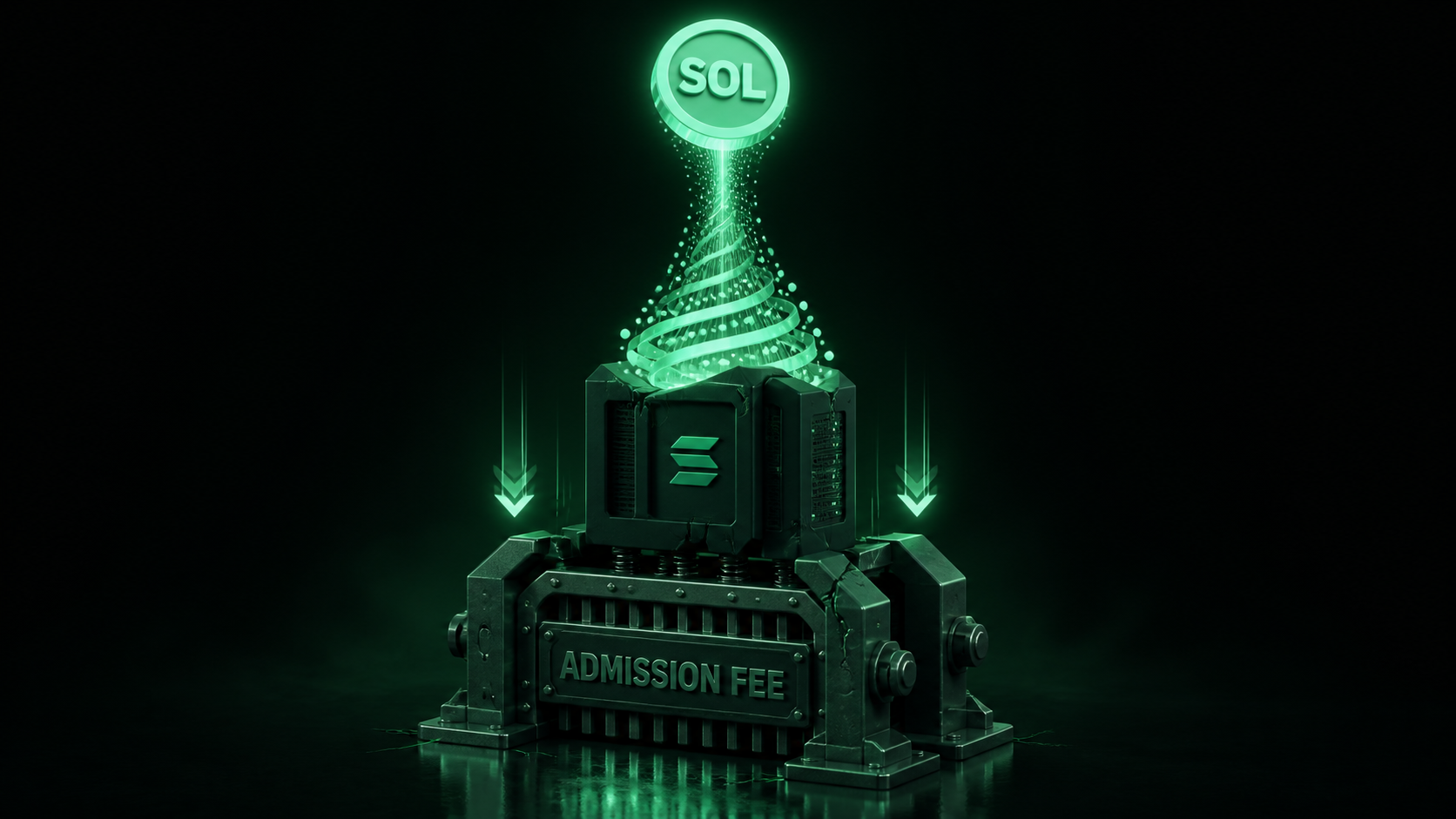
Here is the part that has been reported separately and never joined up. While the emissions vote proceeds, Solana is preparing to activate Alpenglow, the consensus overhaul that targets finality of around a tenth of a second. Activation is gated on the Validator Admission Ticket, defined in SIMD-0357, which charges validators 1.6 SOL per epoch for the right to vote under the new system.
Solana runs roughly 180 epochs a year. That is about 290 SOL annually, somewhere near $21,000 at early-August prices, as a fixed operating cost per validator. The ticket is charged to the validator and is explicitly not deducted from delegator rewards, which sounds generous until you notice it means the operator absorbs all of it.
Initial participation under Alpenglow is capped at approximately 2,000 validators, selected by stake weight.
A fixed fee, a falling revenue line, and admission by stake size, all landing in the same quarter. That combination is the most consequential thing happening on Solana right now, and it has been covered as three unrelated items.
| Change | Effect on a small validator | Effect on a large validator |
|---|---|---|
| SIMD-0550 emissions cut | Revenue falls proportionally | Revenue falls proportionally |
| SIMD-0357 admission ticket | Fixed cost, large share of margin | Fixed cost, rounding error |
| Alpenglow stake-weighted cap | Admission uncertain | Admission effectively assured |
Fixed costs levied against a shrinking revenue stream is how industries consolidate. It happened to Bitcoin mining after the 2024 halving, when the operators who survived were the ones with the lowest marginal power cost and the balance sheet to wait. The mechanism here differs in its details and is identical in its direction.
Nobody Can Tell You When Any of This Happens
The other thing the bullish framing obscures is that there is no date to trade.
The signalling window on SGP-0003 closes August 18, and clearing 15% only triggers a formal stake-weighted vote, which then needs to pass, which then needs implementing. Alpenglow's activation window runs from August through October with no fixed day inside it, because the upgrade cannot switch on until enough validators have registered their BLS keys on mainnet. The catalyst exists. Its calendar does not.
That combination, a real structural change with an unknowable arrival date, is the single most reliable way for traders to lose money on a correct thesis. Position early and you finance the wait. Position late and the move has happened.
The LeveX Take
The consolidation argument has a mirror image nobody is pricing, and it lives on the delegator side. Staking yield on Solana functions as the network's internal risk-free rate. Every lending market, liquid staking token, and structured yield product denominated in SOL is priced off it. Pulling the terminal inflation floor forward by three years reduces staker income and, in the same move, reprices the discount rate underneath the entire SOL-denominated DeFi stack, on a schedule that is now certain in direction and vague in timing.
That is a wonderful setup for anyone who can hold a position through a multi-week window and a miserable one for anyone who cannot. Which is where Futures Credit earns its place in this specific trade rather than as a generic perk: it absorbs losses up to the credit value while leaving profits intact, and it covers up to half of trading and funding fees. On a thesis whose payoff arrives somewhere between mid-August and October, the funding drag and the drawdown tolerance are the two things that decide whether you are still holding when it resolves. Credit addresses both, and the timeline rules matter, so read the redemption windows before you rely on it.
My position: SGP-0003 passes in some form, because 14.4% support with a fortnight left is a strong base, and validators voting to reduce their own income is a reliable signal that the operators with scale have already worked out who absorbs it.
Who Ends Up Running Solana
The tidy version of this story is that Solana is becoming sound money. The version supported by the documents is that Solana is becoming a network with fewer, larger, better-capitalised validators, paying an entry fee for the privilege of earning less per block, in exchange for finality fast enough to compete with centralised infrastructure. Every part of that trade may well be worth making. It should be discussed in those terms rather than as a supply chart.
August 18 tells you whether the vote happens at all. The validator count six months after Alpenglow activates tells you what it cost.
For traders taking a view on how that repricing lands, SOL spot and SOL perpetual futures are live at LeveX, and Crypto in a Minute unpacks how staking yield and token emissions interact across networks.