
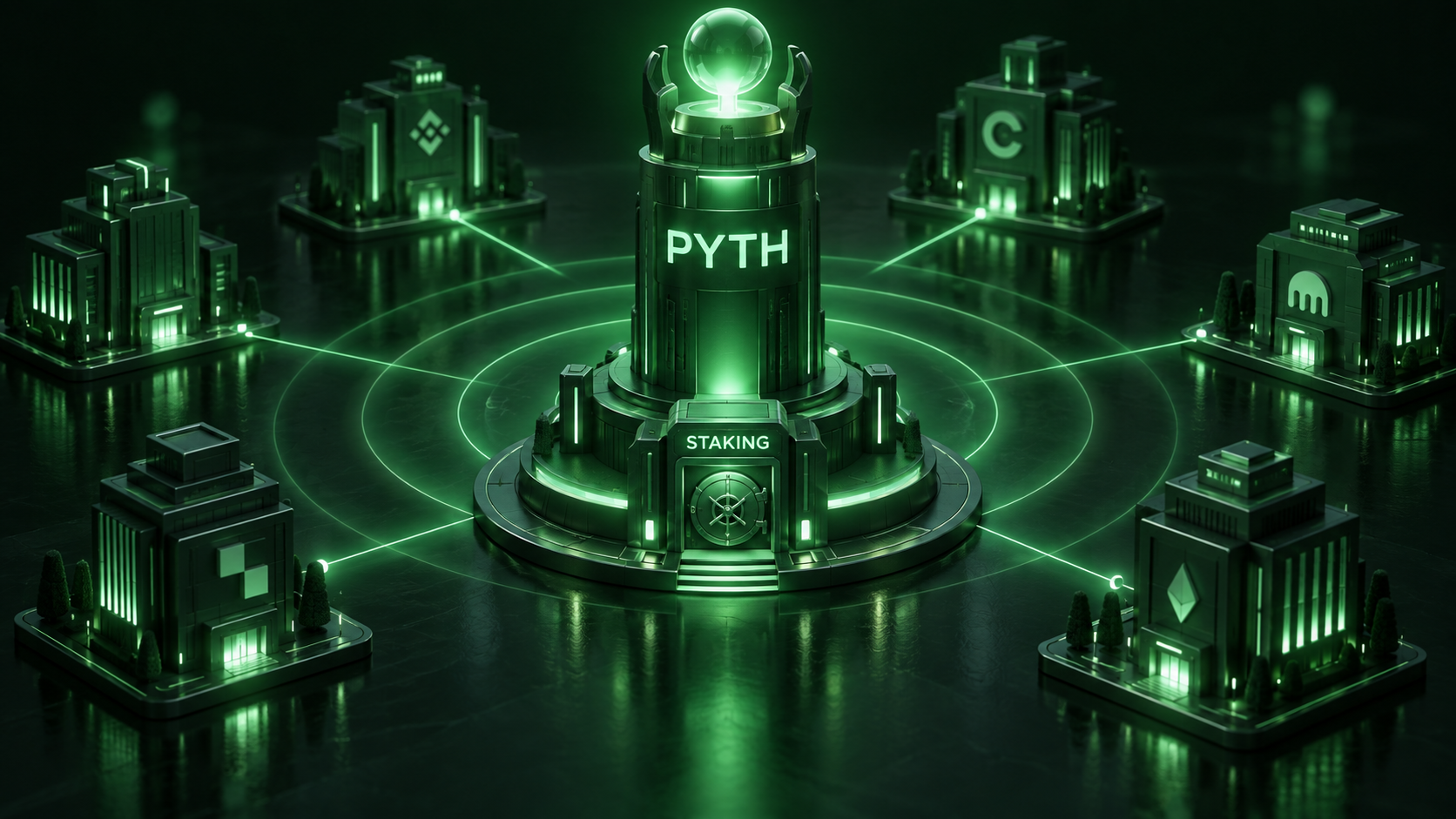
Pyth Network (PYTH) is a decentralized oracle that delivers real-time market prices to blockchains, using data supplied directly by the exchanges, market makers and trading firms that create those prices. PYTH is its governance and staking token, with a fixed maximum supply of 10 billion. As of October 1, 2026, PYTH trades near $0.077 with a market capitalization of about $610 million, according to CoinGecko.
The distinction that matters is where the numbers come from. Most oracles scrape prices from public sources and relay them. Pyth asks the firms quoting the market to sign and publish their own prices, which is why it became the default price source for so many on-chain perpetual exchanges.
How Pyth Turns Trading Desk Quotes Into On-Chain Prices
Pyth runs as a pipeline with four stages. Each one solves a specific problem that older oracle designs handled poorly.
- Publishers sign their own prices. More than 120 first-party publishers, including trading firms, market makers and traditional exchanges, stream prices for the assets they trade. Each quote carries a confidence interval that shows how certain the publisher is about the price.
- Pythnet aggregates them. Pythnet is Pyth's own appchain, built from a fork of Solana code. It combines the publisher quotes into one aggregate price and one aggregate confidence band several times per second, and it weights the result so a single outlier cannot drag the price.
- Wormhole carries the result across chains. Signed price updates are relayed through the Wormhole messaging protocol, which makes them verifiable on roughly 100 connected blockchains.
- Applications pull the price when they need it. A lending market or perpetual exchange fetches the latest signed update and posts it on-chain inside its own transaction, paying a small fee. Nothing is written to a chain until someone uses it.
That last step is the "pull" model, and it is Pyth's biggest design difference from push oracles that write updates to every chain on a fixed schedule. Pull delivery lets Pyth offer thousands of feeds (more than 3,000 by the project's September 2026 count) at sub-second freshness without paying gas on every chain for every tick. The mechanics, including who pays and what happens when nobody pulls, are covered in how Pyth's pull oracle works.
From a Jump Trading Project to the Price Layer
Pyth began inside Jump Trading, the Chicago trading firm, and grew outward from the Solana DeFi scene of 2021.
| Date | Milestone |
|---|---|
| April 2021 | Pyth announced as a first-party oracle for DeFi |
| August 2021 | Mainnet on Solana with 30+ crypto price feeds |
| August 2022 | Pythnet launches as a dedicated aggregation chain |
| 2022 to 2023 | Cross-chain expansion through Wormhole to EVM networks |
| July 2023 | Core contributors spin out of Jump as Douro Labs |
| November 20, 2023 | PYTH token, airdrop and on-chain governance go live |
| March 16, 2024 | PYTH reaches its all-time high of about $1.20 |
| August 2025 | U.S. Department of Commerce selects Pyth to publish GDP data on-chain |
| September 2025 | Pyth Pro subscription product launches for institutions |
| September 22, 2026 | Pyth named an external distributor of Nasdaq Basic equity data |
The airdrop sent 255 million PYTH to roughly 90,000 wallets that had used applications relying on Pyth prices, a reward for past usage rather than a farming campaign. The 2025 government deal, reported by CoinDesk, sent PYTH up close to 50% in a day and shifted how the market talks about the project: from a DeFi utility toward a distributor of financial data in general.
What the PYTH Token Does
PYTH carries three jobs. None of them is paying for price updates, which are settled in each chain's native gas token.
Governance through the Pyth DAO
Staked PYTH votes on proposals one token to one vote. The DAO decides update fees, which assets get listed, how rewards are split and how the treasury is spent. Elected councils handle day-to-day operations and price-feed management under a written constitution.
Oracle Integrity Staking
Publishers stake PYTH behind the data they supply, and any holder can delegate PYTH to a publisher's pool. Accurate publishing earns rewards for both; a publisher whose data harms a protocol can be slashed by up to 5% of its pool. Yields have ranged from roughly 1% to 8% depending on the pool. The step-by-step process and the difference between governance staking and integrity staking are covered in our guide on how to stake PYTH.
A claim on revenue through the PYTH Reserve
Since January 2026, the DAO has used a third of monthly protocol revenue to buy PYTH on the open market, a program The Block reported when it was approved. It is the first direct link between Pyth's business income and demand for the token.
Supply is the other half of the picture. About 7.875 billion PYTH (78.75%) is unlocked, and the final scheduled unlock of 2.125 billion arrives on May 19, 2027. Allocations, vesting cliffs and what past unlocks did to price are laid out in the PYTH tokenomics breakdown.
Beyond Price Feeds: Pyth's Product Line
Price feeds are the core, but Pyth now sells several products, each of which can send revenue to the DAO:
- Pyth Core: the free-to-integrate, pull-based price feeds used across DeFi.
- Pyth Pro: a paid subscription for institutions and professional apps, with millisecond-level updates across asset classes. It passed $1 million in annual recurring revenue within its first month.
- Pyth Lazer: ultra-low-latency, customizable feeds aimed at high-frequency trading apps.
- Entropy: an on-chain random number generator that games, NFT mints and lotteries call for provably fair outcomes.
- Express Relay: an auction system that lets protocols capture the value from liquidations instead of leaking it to bots.
Pyth Pro is where the ambition shows. The project argues that the $50 billion market-data industry is overdue for a cheaper distribution channel, and the Nasdaq and Commerce Department deals are its early evidence. How that pitch holds up is examined in Pyth Pro and the market data business.
Where Pyth Sits Among Oracles
Chainlink remains the largest oracle by value secured, with roughly $33 billion in total value secured against Pyth's roughly $3 billion in mid-2026 industry tallies. Pyth's stronghold is speed. Derivatives protocols that need a fresh price at the moment of a trade or liquidation favor pull feeds, which is why Pyth prices sit under many Solana perpetual venues such as Jupiter Perps and Drift, as well as trading apps on Ethereum layer 2s. Chainlink keeps the edge in lending markets that want an always-present on-chain price. The full comparison, with data sources, latency and security models side by side, is in Pyth vs Chainlink.
Risks Worth Weighing
Anyone trading PYTH should keep a few specific risks in view:
- Unlock overhang. The May 2027 cliff adds about 27% to circulating supply in one day. The May 2026 unlock was absorbed, but not painlessly.
- Revenue still small. Buybacks are funded by real income, yet that income is tiny next to a $600 million market cap.
- Oracle failure risk. A bad price can trigger wrongful liquidations. Integrity staking limits the damage but does not rule it out.
- Competition. Chainlink, RedStone and Chronicle all court the same trading protocols and institutions.
Where analysts think the token could go from here, with the assumptions behind each range, is set out in our PYTH price prediction.
Frequently Asked Questions
What is Pyth Network used for?
Pyth Network supplies real-time prices for crypto, equities, FX, commodities and ETFs to smart contracts. Lending markets use those prices to value collateral, and perpetual exchanges use them to settle trades and trigger liquidations. It also provides on-chain randomness through Entropy.
Who owns Pyth Network?
No single company owns Pyth Network; it is governed by the Pyth DAO, where staked PYTH holders vote. It was incubated by Jump Trading, and Douro Labs is now a core contributor. Data comes from more than 120 independent publishers.
Is PYTH on Solana or Ethereum?
PYTH is native to Solana as an SPL token, and bridged versions exist on EVM networks through Wormhole. Staking and governance run on Solana. The token sits in the Solana-compatible wallets compared in our guide to the best PYTH wallets.
How many PYTH tokens are there?
The maximum supply is 10 billion PYTH. About 7.875 billion are circulating as of October 2026, and the remaining 2.125 billion unlock on May 19, 2027.
What was PYTH's all-time high?
PYTH reached about $1.20 on March 16, 2024. As of October 2026 it trades more than 90% below that peak.
Does Pyth pay stakers from real revenue?
Partly. Integrity staking rewards come from the DAO's reward pool, while the PYTH Reserve uses a third of protocol revenue for monthly buybacks. Stakers benefit from the rewards directly and from the buybacks indirectly.
Why the Price Layer Matters
Pyth's bet is that the firms who make markets should also be the ones who publish prices, on-chain and off. That model already dominates fast-moving DeFi derivatives, and the Nasdaq and Commerce Department mandates show institutions are willing to use it outside crypto. The open question for token holders is whether subscription revenue grows fast enough to outweigh the 2027 unlock.
For traders, PYTH is a mid-cap infrastructure token that reacts sharply to partnership news and supply events, and it rewards anyone who tracks both.
You can hold PYTH on the LeveX spot market or trade its swings in either direction with PYTH perpetual futures. For more short explainers on the projects behind the tickers, visit Crypto in a Minute.