
Everyone's still writing about Polymarket's election success like it matters. It doesn't. The 2024 election was a proof of concept. What happened after is the actual story.
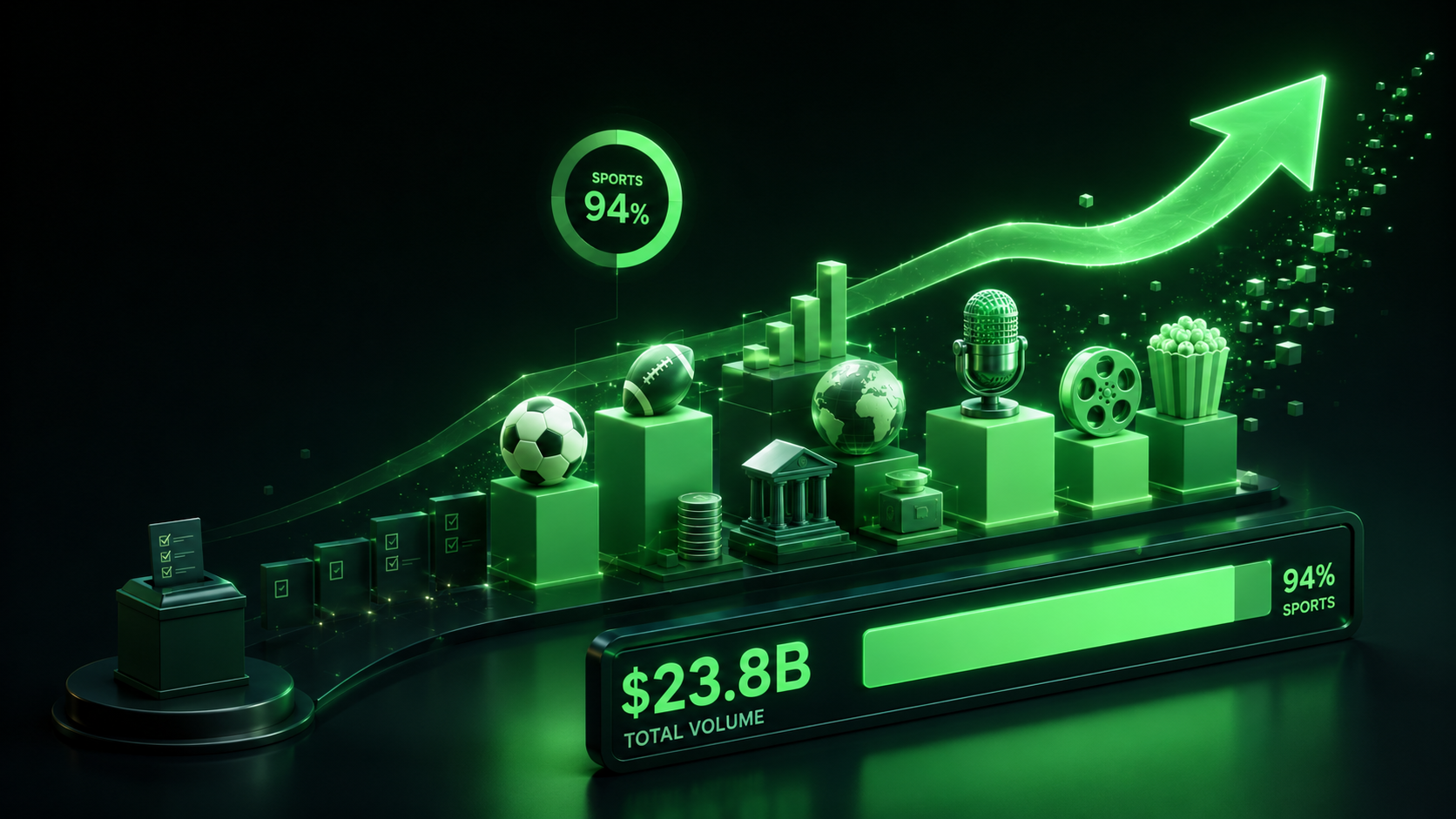
Kalshi processed $23.8 billion in 2025, up 1,100% from the year before. On January 12, prediction markets hit $700 million in a single day. Sports contracts, not political outcomes, drove 94% of that volume. NFL games. NBA matchups. College football playoffs. The election put prediction markets on the map, but sports is what's actually building the business.
ICE, the company that owns the New York Stock Exchange, dropped $2 billion into Polymarket at an $8 billion valuation. That's not speculation on political gambling. That's infrastructure investment.
The Numbers Nobody's Comparing
| Platform | 2025 Volume | YoY Growth | Key Driver |
|---|---|---|---|
| Kalshi | $23.8B | +1,100% | Sports (94% of peak days) |
| Polymarket | $20B+ | +400%+ | Politics → Sports transition |
| Combined weekly (Dec 2025) | $5.3B | Record | NFL/NBA playoffs |
Kalshi raised $1 billion at an $11 billion valuation in December. Paradigm led. Sequoia and a16z participated. These aren't crypto-native VCs gambling on a narrative. These are institutions that ran the numbers on sustainable betting demand and liked what they saw.
The CFTC approved Polymarket's return to U.S. markets in November 2025. They acquired a licensed derivatives exchange, restructured for compliance, and now operate as a regulated contract market. Robinhood, Webull, and PrizePicks all integrated Kalshi contracts. Google Finance started embedding prediction market odds.
Traditional finance isn't watching anymore. They're building.
Mindshare Markets: Trading Attention Itself
Here's what nobody's talking about. In November 2025, Polymarket partnered with Kaito to launch "verifiable mindshare markets." You can now bet on which crypto project captures the most social media discussion, with outcomes verified through zero-knowledge proofs.
Kaito called it "the start of a new category, where anyone, anywhere can predict mindshare, sentiment, and popularity for anything."
Read that again. They're not creating markets for events. They're creating markets for attention.
Traditional finance already prices attention indirectly. Super Bowl ads, influencer deals, media valuations. Mindshare markets make it explicit and liquid. A project gaining or losing buzz now has a real-time price signal. VCs can trade on it. Projects can hedge against it. Traders can speculate on it.
The data these markets produce might be worth more than the trading fees. Google embedding prediction odds into Finance demonstrates the point. The information is the product.
The LeveX Take: This Isn't a Token Play
Let's cut through the noise. Polymarket doesn't have a token. Kalshi doesn't have a token. The two platforms processing the most volume in this space have zero governance tokens, zero airdrops, zero tokenomics pages.
That tells you something important about where value actually accrues.
Prediction market growth benefits settlement infrastructure, not prediction market tokens. SOL demand increases as Solana-native platforms scale. Stablecoin velocity rises with every settled contract. Oracle infrastructure becomes more critical as markets expand beyond easily verifiable outcomes.
The tokens that pumped in 2021 with "prediction market" in their pitch? Most are down 90%+ and serve no function in the actual infrastructure stack. The base layer assets that power settlement? Those capture the growth.
Infrastructure winners:
- SOL: Kalshi launched tokenized prediction markets on Solana in December 2025. Solflare integrated native prediction market trading.
- Stablecoins: Every prediction market settles in USDC. Higher volume = higher velocity.
- Oracles: Mindshare calculations, complex resolutions, exotic outcomes all need robust oracle infrastructure.
Likely losers:
- Platform-specific governance tokens with no fee capture
- "Prediction market protocols" competing with zero-fee regulated platforms
- Anything requiring you to bet on which prediction market platform wins
Regulatory Momentum
The regulatory picture shifted faster than most expected.
The CFTC approved Polymarket's Amended Order of Designation in November 2025. A Tennessee federal judge paused state enforcement against Kalshi for sports contracts. DraftKings and FanDuel launched competing prediction products across 38 states.
Every contract category that survives regulatory scrutiny opens territory. Sports worked. Economics works. Entertainment works. The design space keeps expanding.
ICE's $2 billion investment wasn't a bet on regulatory arbitrage. It was due diligence concluding that prediction markets have a durable path forward as regulated financial products.
Positioning for Infrastructure Growth
Prediction markets transitioned from novelty to infrastructure in 2025. The volume, the funding rounds, the regulatory approvals, the Google Finance integration. The debate about whether prediction markets "work" ended.
The question now is which assets capture value from continued growth. Sports betting has sustainable demand. Attention markets create entirely new primitives. Data monetization might matter more than trading fees.
For traders, the play isn't picking winning markets. It's understanding how prediction market infrastructure growth affects assets you already hold. Trade SOL on LeveX for leveraged exposure to Solana ecosystem growth, or explore our Crypto in a Minute guides to understand the infrastructure layer these platforms are building on.