
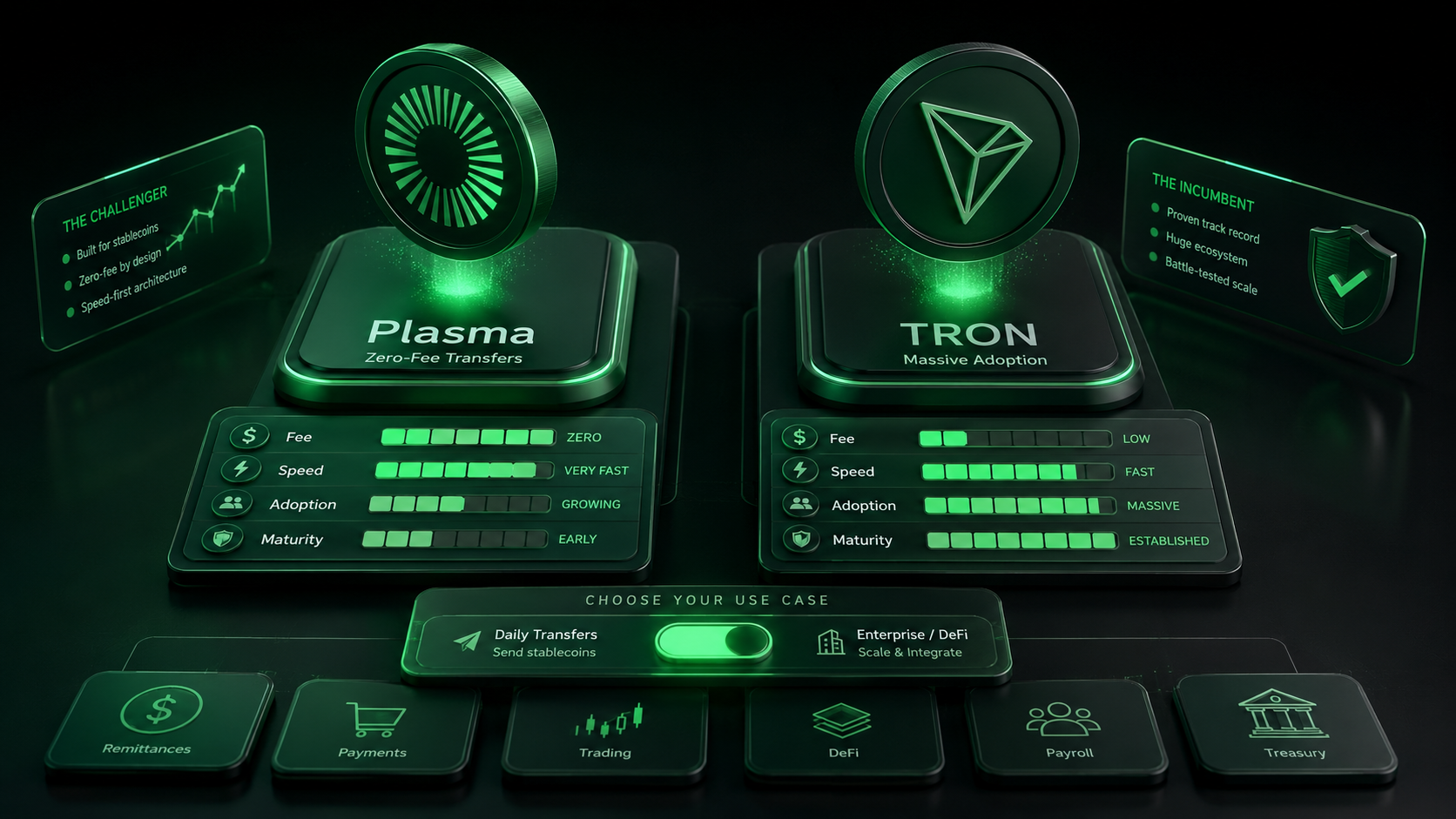
Plasma launched in September 2025 with a direct challenge to TRON's decade-long dominance in stablecoin transfers. While TRON carries over $80 billion in USDT and processes 56% of global retail stablecoin transactions, Plasma's zero-fee architecture attracted $5.6 billion in TVL within its first week.
The competition between these networks represents a fundamental question for stablecoin users: does an established ecosystem with proven reliability outweigh purpose-built infrastructure designed specifically for payments? This comparison examines fees, speed, adoption, and practical considerations for choosing between them.
The Fee Structure Battle
Fee economics drive stablecoin network selection, particularly for high-frequency transfers and remittances where costs compound quickly.
TRON Fee Mechanics
TRON uses an energy and bandwidth system that creates variable costs depending on wallet status and network conditions. According to TronSave's fee analysis, sending USDT on TRON typically costs:
- Non-empty wallets: ~13.5 TRX ($3-4 at current prices)
- Empty wallets: ~27.3 TRX ($6-8)
- With energy rental: As low as $0.81 per transfer
The August 2025 fee reduction cut energy unit prices by approximately 50%, dropping average fees from 2.47 TRX to 0.72 TRX for optimized users. However, most retail users still pay $1-4 per transfer without optimization techniques.
Plasma Fee Structure
Plasma eliminates fees for simple USDT transfers entirely through a protocol-managed paymaster system. Users send stablecoins without holding XPL tokens or paying gas fees. Complex operations like smart contract deployment still require XPL, but standard peer-to-peer payments cost nothing.
| Metric | TRON | Plasma |
|---|---|---|
| Simple USDT Transfer | $1-8 | $0 |
| Smart Contract Interaction | $1-15 | Requires XPL |
| Native Token Required | Yes (TRX) | No (for basic transfers) |
| Fee Optimization Available | Energy staking/rental | N/A (already free) |
For users making frequent small transfers, Plasma's zero-fee model provides clear cost advantages. TRON remains competitive for users who stake TRX or rent energy, but requires upfront capital commitment or additional complexity.
Network Performance Comparison
Both networks prioritize speed and throughput, but their architectures differ significantly.
TRON Performance
TRON processes approximately 2,000 transactions per second with 3-second block times. The network averaged 2.8 million daily active users in Q4 2025, with 78% transacting peer-to-peer. According to CoinDesk's Q4 2025 TRON report, the network maintained consistent uptime throughout the quarter despite processing hundreds of millions of monthly transactions.
Plasma Performance
Plasma uses PlasmaBFT consensus optimized specifically for stablecoin payments, achieving sub-second finality and thousands of TPS. The network processed over $5 billion in deposits within its first week, demonstrating capacity for institutional-scale volume. However, two network outages in June and August 2025 raised reliability concerns during the initial launch period.
Adoption and Ecosystem Maturity
Market position and integration depth significantly impact practical utility for stablecoin users.
TRON's Established Position
TRON dominates global stablecoin infrastructure with compelling metrics. The network hosts over $80 billion in USDT, representing approximately 51% of total global supply. Major exchanges including Binance default to TRC-20 for USDT withdrawals, branding it as the "low fee, high speed" option.
Regional adoption runs particularly strong in emerging markets. TRON-based stablecoins function as everyday payment rails in Latin America, Middle East, Africa, and Asia-Pacific regions. The network handles salary payments, import settlements, and informal savings in high-inflation economies where traditional banking proves inadequate.
Institutional integrations accelerated in 2025, including Revolut's in-app TRX staking for 65+ million users, Kalshi prediction market integration, and cross-chain connectivity via LayerZero.
Plasma's Emerging Ecosystem
Plasma launched with substantial institutional backing from Peter Thiel's Founders Fund, Tether, and Framework Ventures. The $75 million in funding and Tether's direct involvement provide strategic alignment with the largest stablecoin issuer.
Over 50 DeFi protocols launched on Plasma from day one, including Aave, Ethena, and Curve integrations. The network's EVM compatibility enables straightforward migration of existing Ethereum applications.
However, Plasma's ecosystem remains nascent compared to TRON's decade of development. Application diversity, merchant integrations, and geographic adoption require years to match TRON's footprint.
Use Case Considerations
Different user profiles favor different networks based on specific requirements.
Choose TRON When:
- Exchange compatibility matters most (widest support across platforms)
- You already hold TRX or can optimize fees through staking
- Reliability track record outweighs fee savings
- Your counterparties primarily use TRC-20 addresses
- You need access to TRON's broader DeFi ecosystem
Choose Plasma When:
- Fee elimination is critical (high-frequency micro-payments)
- You're building new stablecoin payment applications
- Tether integration and backing provides confidence
- EVM compatibility with Ethereum tooling matters
- You're willing to accept newer network risk for cost benefits
Investment Implications
The competition between TRON and Plasma creates distinct investment dynamics for their native tokens.
TRX Fundamentals
TRX benefits from established utility across the largest stablecoin network. Network fee revenue, staking demand, and ecosystem activity provide fundamental value drivers. However, Plasma's emergence as a zero-fee alternative could gradually erode TRON's fee-based revenue model if adoption scales.
XPL Fundamentals
XPL's value proposition depends on Plasma capturing meaningful stablecoin market share from TRON and other networks. The token's price trajectory remains volatile as markets assess whether zero-fee transfers can drive sufficient ecosystem activity to support XPL demand for complex transactions and staking.
Both tokens face the challenge that stablecoin users primarily want cheap, fast transfers rather than holding network tokens. TRON solves this through required TRX fees, while Plasma's model separates basic utility from token demand.
The Competitive Outlook
TRON's dominance faces its first serious purpose-built challenger in Plasma. The incumbent advantages of ecosystem maturity, exchange integration, and proven reliability provide significant moats. However, Plasma's zero-fee model addresses the fundamental friction that drives users to seek alternatives.
Short-term, TRON's established position likely withstands Plasma's challenge. The network's 2025 fee reductions demonstrate willingness to compete on cost, while its reliability and integration depth provide switching costs that take years to overcome.
Longer-term, the stablecoin infrastructure market may support multiple specialized networks serving different use cases. TRON's broader ecosystem appeal coexists with Plasma's payment-focused optimization, particularly as stablecoin adoption expands into new markets and applications.
Selecting Your Stablecoin Rail
The optimal choice between Plasma and TRON depends on individual priorities. TRON offers proven reliability, universal exchange support, and a mature ecosystem that has processed trillions in stablecoin volume. Plasma provides zero-fee transfers and purpose-built payment infrastructure backed by Tether's strategic investment.
For most users today, TRON's established position and integration depth make it the practical default. Plasma appeals to cost-sensitive applications, new payment platforms, and users willing to adopt emerging infrastructure for fee elimination. As both networks evolve, competition benefits stablecoin users through lower costs and improved services across the ecosystem.
Trade both networks' native tokens on LeveX with XPL spot trading, XPL perpetual contracts, or TRX trading pairs. Explore more blockchain comparisons in our Crypto in a Minute educational series.