
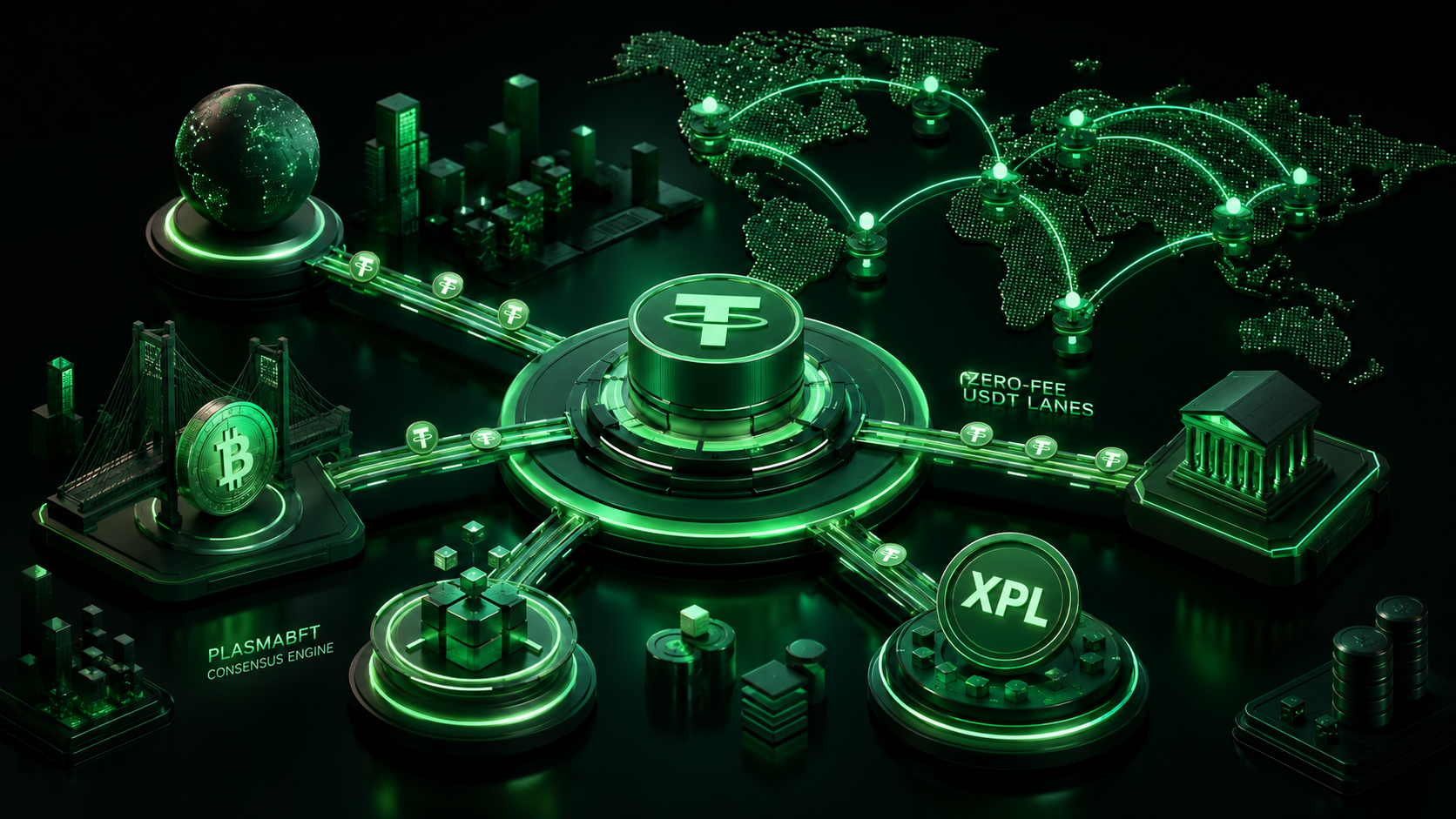
Sending USDT on most blockchains requires holding a separate token for gas fees. Plasma eliminates this friction entirely. Built from the ground up for stablecoin payments, this Layer 1 blockchain offers zero-fee USDT transfers, sub-second finality, and full Ethereum compatibility, positioning itself as dedicated infrastructure for the $250 billion stablecoin economy.
What is Plasma?
Plasma is a Layer 1 blockchain designed specifically for high-frequency stablecoin transactions. Unlike general-purpose chains that treat stablecoins as just another token, Plasma integrates stablecoin optimization directly into its consensus and execution layers.
The network launched its mainnet on September 25, 2025, attracting over $2 billion in stablecoin deposits within the first 24 hours. This rapid adoption demonstrated clear market demand for purpose-built payment infrastructure. Within one week, Plasma's total value locked reached $5.6 billion, approaching TRON's dominance in stablecoin settlement.
Core features distinguishing Plasma from general-purpose blockchains:
- Zero-fee USDT transfers through a protocol-level paymaster system
- Custom gas tokens allowing fees paid in USDT, BTC, or other whitelisted assets
- Sub-second finality via PlasmaBFT consensus
- Full EVM compatibility enabling seamless Ethereum smart contract deployment
- Trust-minimized Bitcoin bridge for native BTC integration
XPL serves as the native token powering the network, handling transaction fees for complex operations, validator staking rewards, and governance participation.
The Team Behind Plasma
Paul Faecks and Christian Angermayer co-founded Plasma in 2024. Faecks previously co-founded Alloy and brings derivatives expertise from his work with Deribit. Angermayer runs Apeiron Investment Group, contributing venture capital experience and strategic industry connections.
The leadership team assembled specialists from major financial and technology institutions. Murat Firat, Head of Product, founded BiLira (Turkey's largest crypto exchange and Lira-pegged stablecoin issuer). Adam Jacobs, Head of Global Payments, served as global head of payments at FTX before joining Canadian fintech firm Nuvei. Usmann Khan, Head of Protocol Security, ranks among the top performers on ImmuneFi's crypto bug bounty leaderboard.
Plasma secured backing from prominent investors including Peter Thiel's Founders Fund, Framework Ventures, and Tether/Bitfinex. Paolo Ardoino, Tether's CEO, personally invested in the project. Total funding exceeded $400 million across venture rounds and a public token sale that raised $373 million, seven times its $50 million target.
How PlasmaBFT Consensus Works
Plasma's performance comes from PlasmaBFT, a consensus mechanism derived from the Fast HotStuff Byzantine Fault Tolerant protocol. The system parallelizes block proposal, voting, and commitment into concurrent pipelines rather than processing each stage sequentially.
Traditional BFT protocols require three communication phases to reach consensus. PlasmaBFT uses a two-chain commit in common cases, reducing latency while maintaining security guarantees. The protocol achieves sub-second finality when the network operates normally, making it suitable for payment applications requiring immediate settlement.
| Feature | Plasma | Ethereum | TRON |
|---|---|---|---|
| USDT Transfer Fee | $0 | $3-50 | $0.30-1 |
| Finality Time | <1 second | ~15 minutes | ~3 seconds |
| Gas Token Required | No (for USDT) | Yes | Yes |
| EVM Compatible | Yes | Native | Partial |
The execution layer runs on Reth, a high-performance Ethereum client written in Rust. This architecture provides full EVM compatibility, allowing developers to deploy existing Ethereum-based smart contracts without modification using familiar tools like Hardhat, Foundry, and MetaMask.
Zero-Fee Stablecoin Transfers
The protocol's standout feature is its paymaster system that sponsors gas costs for USDT transfers. When users send stablecoins, the Plasma Foundation covers transaction fees from a pre-funded XPL allowance. This eliminates the traditional requirement to acquire native tokens before transacting.
The paymaster applies lightweight identity verification and rate limits to prevent abuse while maintaining a seamless user experience. Only standard transfer functions qualify for sponsorship. Complex operations like deploying contracts or interacting with DeFi protocols still require XPL for gas, ensuring validators receive adequate compensation and the network remains economically sustainable.
Beyond sponsored transfers, Plasma supports custom gas tokens. Users can pay fees in whitelisted assets like USDT or BTC instead of maintaining separate XPL balances. This flexibility removes a significant onboarding barrier for mainstream adoption, particularly for users unfamiliar with cryptocurrency wallet management.
Bitcoin Bridge and pBTC
Plasma integrates a trust-minimized Bitcoin bridge enabling BTC to flow directly into its EVM environment. When users deposit Bitcoin, a decentralized network of verifiers validates the transaction and mints pBTC, a token backed 1:1 by the deposited BTC.
This pBTC can then be used within Plasma's DeFi ecosystem, including collateral systems, lending protocols, and cross-asset trading. Withdrawals work in reverse: burning pBTC triggers release of the native Bitcoin through a threshold signature scheme. The bridge shares Plasma's validator set, maintaining security properties without requiring separate infrastructure.
The team plans to implement BitVM2 when available, further enhancing the bridge's capabilities for sophisticated cross-chain financial applications that leverage both Bitcoin's security and Ethereum's programmability.
XPL Tokenomics
XPL has a total supply of 10 billion tokens distributed across four primary allocations:
Ecosystem and Growth (40%): 4 billion tokens fund strategic initiatives, liquidity programs, and institutional partnerships. Only 8% (800 million) unlocked at launch, with the remainder vesting monthly over three years.
Team (25%): 2.5 billion tokens for founders, developers, and employees. Subject to a one-year cliff followed by two-year linear vesting.
Investors (25%): 2.5 billion tokens sold to venture firms and strategic backers. Same vesting schedule as team allocation.
Public Sale (10%): 1 billion tokens distributed to deposit campaign participants at $0.05 per token.
Validator rewards begin at 5% annual inflation, decreasing by 0.5% per year until reaching a 3% floor. Plasma implements soft slashing where misbehaving validators lose reward eligibility rather than their staked principal. Fee burning follows an EIP-1559 model, creating deflationary pressure as transaction volume increases.
Real-World Applications
Global Remittances: Zero-fee transfers make Plasma practical for cross-border payments where traditional fees consume significant portions of small transactions. Workers sending money home can transfer the full amount rather than losing 3-7% to intermediaries.
Merchant Payments: Plasma One, the network's stablecoin-native neobank, offers cards accepted at over 150 million merchants worldwide. Users spend directly from stablecoin balances while earning yields up to 10% on holdings.
DeFi Yield: Lending vaults on Plasma offer approximately 8-20% annual returns on stablecoin deposits, attracting liquidity from users seeking yield on dollar-denominated assets. The network launched with $2 billion in borrowing capacity available immediately.
Bitcoin DeFi: The pBTC bridge enables Bitcoin holders to access lending protocols without selling their BTC. Collateralized lending, liquidity provision, and programmable finance become accessible to Bitcoin's $1.7 trillion market cap.
Challenges and Considerations
Plasma's early momentum has faced headwinds since launch. XPL traded above $1.50 initially but declined over 90% to approximately $0.12 by January 2026. Token unlock pressure from team and investor allocations will continue affecting supply dynamics throughout 2026.
Network activity remains below theoretical capacity. While Plasma advertises 1,000+ TPS capability, block explorer data shows actual throughput around 15 TPS, reflecting the ecosystem's early development stage. Few DeFi applications have launched beyond basic lending vaults, limiting use cases that would drive sustained transaction volume.
Competition from established networks like TRON, which processed the majority of USDT transfers before Plasma's launch, presents ongoing challenges. Ethereum Layer 2 solutions and other stablecoin-focused projects also target similar market opportunities.
Trading XPL on LeveX
LeveX provides access to XPL through both spot trading for direct token ownership and futures contracts for leveraged exposure to price movements. The platform's competitive fee structure keeps trading costs low, with futures rates starting at 0.02% for makers.
For traders managing positions around volatile token unlocks or stablecoin adoption catalysts, Multi-Trade Mode enables up to 99 simultaneous long/short positions on the same pair with independent leverage and margin settings.
The Stablecoin Infrastructure Thesis
Plasma represents a bet that stablecoins need dedicated blockchain infrastructure rather than retrofitted general-purpose chains. The $250 billion stablecoin market processes trillions in annual volume, yet most transfers still occur on networks designed for other purposes. By optimizing every layer of the stack for dollar-denominated payments, Plasma offers a compelling alternative for high-frequency, low-value transfers.
The project's institutional backing from Tether and major venture funds provides both capital and strategic alignment with the dominant stablecoin issuer. Whether this translates to sustained adoption depends on ecosystem development, user acquisition, and execution against an ambitious technical roadmap including confidential payments and enhanced Bitcoin integration.
For traders exploring emerging blockchain infrastructure, understanding stablecoin mechanics and trading fundamentals provides essential context for evaluating projects like Plasma. Explore LeveX's Crypto in a Minute series for comprehensive guides on blockchain ecosystems and trading strategies.