
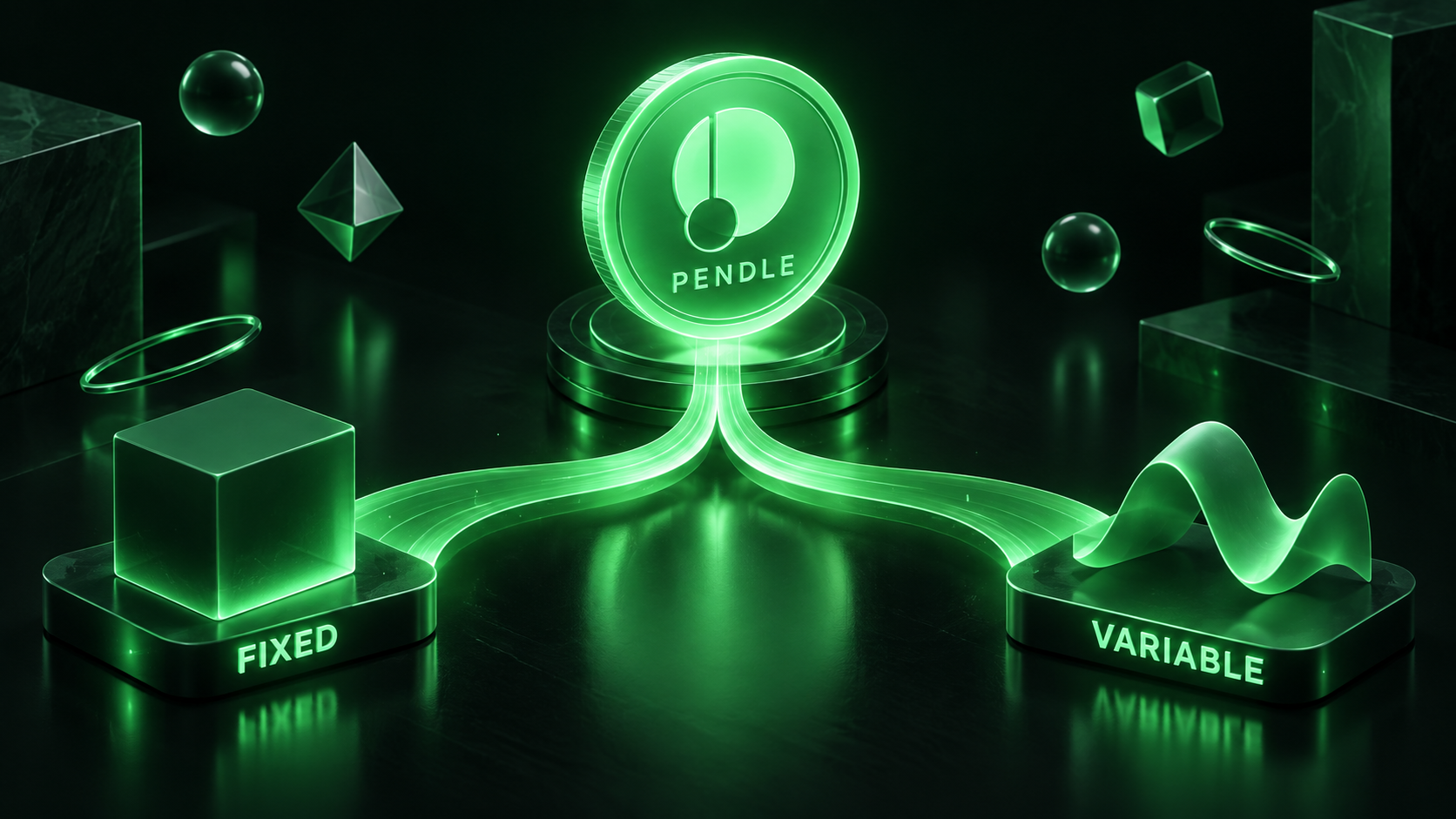
Pendle is a decentralized finance protocol that splits a yield-bearing token into two tradable parts: a Principal Token that redeems for the underlying asset on a fixed date, and a Yield Token that collects everything the asset earns until then. That split gives future yield a price, so traders can lock in a fixed rate, bet that a rate will rise, or buy a season of airdrop points at a discount. PENDLE is the protocol's token. Staked as sPENDLE it receives the bulk of protocol fees, and it trades on LeveX against USDT in both spot and perpetual markets.
The idea borrows from the bond market, where a bond can be stripped into its principal and its coupons and each piece trades on its own. Pendle applies the same treatment to staked ETH, synthetic dollars, restaking deposits and lending positions, on Ethereum and eight other networks, using an automated market maker built for assets that expire.
What Pendle actually does
Pendle launched on Ethereum in June 2021 and relaunched as Pendle V2 in November 2022 with a new AMM and a wrapper standard that lets almost any yield-bearing token enter the system. Three token types do the work.
SY, the Standardized Yield wrapper. Every yield-bearing asset gets the same interface, whether it is Lido's stETH, Ethena's sUSDe or an Aave deposit. Wrapping into SY is the first step of every Pendle market.
PT, the Principal Token. This is the claim on the underlying asset at maturity. One PT-stETH redeems for one stETH worth of value on the maturity date, whatever staking yields did in between. Because it pays no yield along the way, PT trades below the underlying, and that discount is the fixed rate.
YT, the Yield Token. This is the claim on all yield, points and rewards the asset generates until maturity. YT is cheap, because it is only the income stream, and it goes to zero at maturity once the last yield has been paid out.
Minting is symmetric: deposit one unit of SY and you receive one PT and one YT. Hold both and you own exactly what you deposited. Sell one and you have taken a view.
A Pendle market, step by step
The mechanics are easiest to see with numbers. Take a market on sUSDe, Ethena's yield-bearing synthetic dollar, with six months to maturity and an implied yield of 10 percent.
- Wrap and split. A depositor wraps 1,000 sUSDe into SY and mints 1,000 PT-sUSDe and 1,000 YT-sUSDe.
- Price the pieces. With a 10 percent implied rate and six months left, PT trades at roughly 0.953 sUSDe and YT at roughly 0.047. The two prices always add up to the value of the underlying.
- Take a side. A fixed-rate buyer pays 953 sUSDe for 1,000 PT and redeems 1,000 sUSDe at maturity, a locked return of about 4.9 percent for the half year, or roughly 10 percent annualized. A rate speculator pays 47 sUSDe for 1,000 YT and receives whatever those 1,000 sUSDe actually earn. If sUSDe yields 14 percent over the period, the YT collects about 68 sUSDe; if it yields 6 percent, about 30.
- Trade before maturity. Both tokens trade continuously on Pendle's AMM, so a PT holder can exit early at the market's current implied rate, and a YT holder can sell before the income has fully arrived.
- Mature. On the maturity date PT redeems one-for-one for the underlying and YT stops accruing. Positions left unredeemed keep earning, but that yield is redirected to the protocol treasury, so redeeming on time matters.
Every number in that example moves with the implied yield, which the market sets by trading. That is the whole point of the protocol. Pendle is a venue where the price of future yield is discovered, the way a rates desk prices a swap.
Where the yield comes from
Pendle generates no yield of its own. It tokenizes yield produced by other protocols, so the assets it lists tell you what the market is pricing at any moment.
| Yield source | Typical assets | What Pendle lets you do |
|---|---|---|
| Liquid staking | stETH from Lido, weETH and other LSTs | Fix an ETH staking rate for months, or lever the variable rate through YT |
| Synthetic dollars | sUSDe from Ethena | Turn a funding-rate-driven yield into a fixed one, or speculate on funding |
| Restaking and points | EigenLayer deposits, liquid restaking tokens | Buy a whole season of points and restaking rewards at a discount |
| Lending deposits | aTokens from Aave and other money markets | Lock a lending rate that would otherwise float every block |
| Tokenized treasuries and RWAs | Yield-bearing stablecoins, treasury tokens | Fixed onchain exposure to real-world rates |
| Perpetual funding | Boros Yield Units on BTC and ETH funding | Hedge or trade the funding a perp position pays |
Points deserve a mention because they drove much of Pendle's 2024 growth. When a protocol rewards depositors with points ahead of a token launch, the YT holder receives those points in proportion to the yield stream, for a fraction of the capital. Pendle became the leveraged venue for point farming, and the fee it takes on YT yield, points included, turned that activity into protocol revenue.
PENDLE and sPENDLE
PENDLE is the token that captures the fees. According to Pendle's fee documentation, the protocol keeps 5 percent of all yield and points accrued by every YT in existence, plus swap fees on PT trades that scale with time to maturity. Twenty percent of swap fees go to liquidity providers; the remainder, together with all YT fees, is split 80 percent to PENDLE buybacks, 10 percent to the treasury and 10 percent to operations.
Those buybacks flow to stakers. Since January 2026 the staking mechanism has been sPENDLE, a liquid staking token that replaced the older vePENDLE system of two-year locks. The Block reported the terms when it went live: no lockup, a 14-day withdrawal period or an instant exit for a 5 percent fee, a token that is transferable and usable as collateral elsewhere, and a loyalty multiplier of up to 4x for former vePENDLE lockers that declines over two years. Gauge voting, which used to decide where emissions went, gave way to an algorithmic emissions model the team expected to cut issuance by about 30 percent.
| sPENDLE at a glance | Detail |
|---|---|
| Live since | 20 January 2026 |
| Lockup | None. 14-day withdrawal, or instant exit for a 5 percent fee |
| Revenue share | Over 80 percent of protocol revenue, paid through PENDLE buybacks |
| Legacy vePENDLE | Snapshot on 29 January 2026; loyalty bonus up to 4x, fading over two years |
| Transferable | Yes, and usable as collateral in other protocols |
The supply side is mature. As of September 2026, CoinGecko shows about 172.9 million PENDLE circulating from a total of 281.5 million, a price near $2, and a market capitalization around $344 million against a fully diluted value near $560 million. Team and investor allocations finished vesting in September 2024, so new supply comes only from incentive emissions, which decayed 1.1 percent a week until April 2026 and now run at a terminal 2 percent a year. The all-time high was $7.50 in April 2024, at the peak of the points cycle.
Boros: funding rates as a market
In August 2025 Pendle opened a second product on Arbitrum. Boros lets traders buy and sell the funding rate of a perpetual futures contract through Yield Units, each representing the funding earned or paid on one unit of notional. A trader who is long a BTC perp and tired of paying funding can go long the matching Yield Unit, paying a fixed rate to receive the floating funding stream, which converts an unpredictable cost into a known one. A trader with a view on rates can simply long or short the rate itself.
Boros launched with BTC and ETH markets sourced from the largest centralized perp venue, with leverage capped at 1.2x and a $10 million open-interest cap per market, and it has since added Hyperliquid markets that settle hourly. Rate data arrives through Chainlink oracles. By 2026, OAK Research counted more than $2.8 billion in cumulative volume and $6.9 billion in notional open interest. The cross-venue funding spreads Boros trades are the same spreads a futures hedger watches when carrying a position through a weekend.
Scale, chains and the 2026 roadmap
Pendle's deposits rise and fall with the yield cycle. DefiLlama puts total value locked at about $1.2 billion as of September 2026, well below the peaks of the 2024 points season and the 2025 stablecoin-yield boom. The protocol runs on Ethereum, Arbitrum, BNB Chain, Base, Optimism, Sonic, HyperEVM, Mantle and Berachain, with Ethereum still holding the largest share of deposits.
The 2026 plan is called Citadels: KYC-compliant versions of Pendle's fixed-yield products for regulated institutions, Principal Tokens carried to Solana through Chainlink CCIP in partnership with Kamino, and Shariah-compliant yield structures aimed at Islamic finance. The institutional signals accumulated through the year. Pendle PTs became collateral in Aave's RWA-oriented markets, the token joined Grayscale's watchlist, and Pendle was named a launch partner on Converge, the institutional chain Ethena is building with Securitize, as Crypto Briefing reported in its coverage of the 2026 roadmap.
Frequently Asked Questions
What is the PENDLE token used for?
PENDLE is staked as sPENDLE to receive the protocol's fee revenue, which arrives as PENDLE bought back on the open market. It also carries governance rights and funds the incentives paid to liquidity providers in Pendle's markets. Holding PENDLE unstaked earns nothing; the revenue share requires staking.
Is Pendle safe to use?
Pendle's core contracts have operated since November 2022 without a protocol-level exploit, although Penpie, a third-party protocol built on top of Pendle, lost about $27 million to an attack in September 2024. The larger everyday risks are in the underlying assets, such as a synthetic dollar losing its peg, and in selling PT before maturity, when its price moves with the implied rate. Hold PT to maturity and the fixed return is a contract term rather than a market bet.
What is the difference between PT and YT?
PT is the principal: it redeems for the underlying asset at maturity and earns its return through the discount you bought it at. YT is the yield: it receives all interest, points and rewards the asset produces until maturity, then expires worthless. Buying PT is a fixed-rate position; buying YT is a leveraged bet that the variable rate will beat the market's implied rate.
What happens when a Pendle market matures?
At maturity PT becomes redeemable one-for-one for the underlying asset and YT stops accruing. Holders redeem through the Pendle app, and liquidity providers can withdraw their pool share. Positions left unredeemed continue to generate yield, but the protocol redirects that yield to its treasury, so there is no benefit to waiting.
Is PENDLE a good investment?
PENDLE gives direct exposure to the fees of a protocol whose revenue tracks how much yield DeFi is paying, so it behaves like a cyclical bet on onchain rates and point-farming activity. Supply is fully vested with a 2 percent terminal inflation rate, which limits dilution, but the token fell more than 70 percent from its April 2024 high as yields compressed. Size the position for that volatility, and treat the sPENDLE revenue share as the fundamental to track.
Why the price of yield is the trade
Every other DeFi primitive lets you earn yield. Pendle is the one that lets you price it, hedge it and trade it, which is why it became the venue of record for staking rates, synthetic-dollar income and point seasons. The 2026 shift to sPENDLE tied the token more directly to that activity, and Citadels is an attempt to sell the same fixed-yield instrument to institutions that could never touch a two-year lock.
For a trader, that makes PENDLE a clean way to express a view on DeFi yields without running the strategies yourself. When rates and points activity rise, Pendle's fees rise with them; when they compress, so does the token, and it has done both within the last two years.
PENDLE is listed on LeveX against USDT. Buy PENDLE on the spot market to hold the token, or trade PENDLE perpetual futures with leverage in either direction. More token guides like this one live in Crypto in a Minute.