
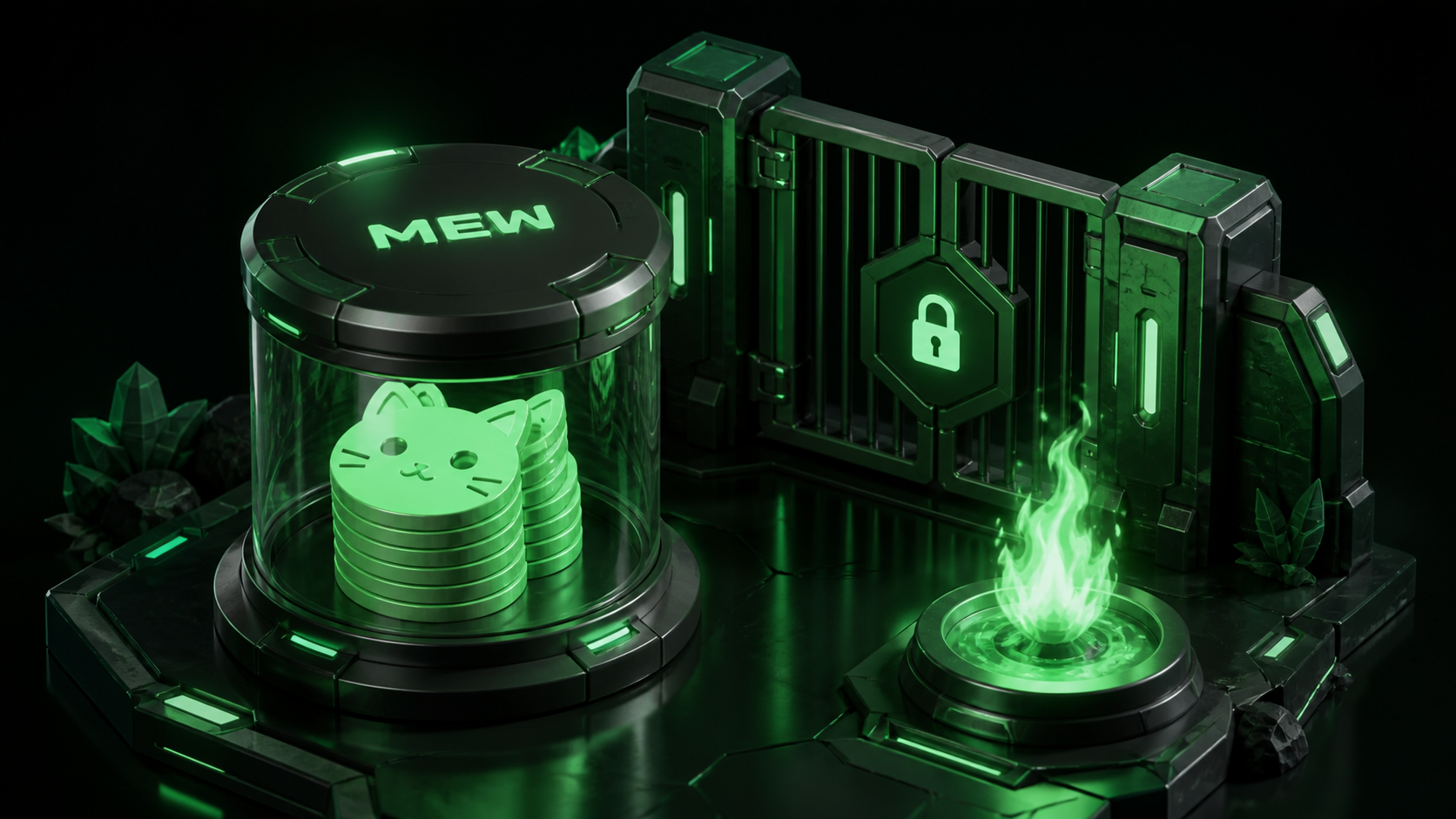
MEW has one of the simplest token structures in crypto: 88,888,888,888 tokens minted once on 25 March 2024, roughly 90% placed into a liquidity pool whose LP tokens were burned, 10% airdropped to Solana wallets, and nothing held back for the team. There is no vesting schedule, no emission curve, no treasury and no staking contract. Every token that will ever exist is already in circulation.
That design decides more about how Cat in a Dogs World trades than any chart pattern does, because it removes both the usual sources of sell pressure and the usual tools for creating demand.
How the Supply Was Split
The 90% that became liquidity
The bulk of the supply went straight into a Raydium pool paired with SOL, and the LP tokens representing that position were burned. Burning LP tokens destroys the claim on the pooled assets, so nobody, including the founders, can withdraw the liquidity. This is the on-chain version of a promise that the floor cannot be pulled out from under the market, and it is verifiable by anyone who inspects the MEW token account on Solscan.
The 10% that became the community
The remaining tenth went out as an airdrop to Solana community wallets in the days around launch. That distribution seeded thousands of holders at zero cost, which is what let MEW trend on social feeds fast enough to reach a $900 million market capitalization inside a week.
The zero that went to the team
No allocation was reserved for founders, advisers or private investors. The upside is that no scheduled unlock hangs over the chart. The downside is that the project has no treasury to fund development, so the animation partnership, the app and everything else in the roadmap must be financed outside the token.
What "Fixed Supply" Buys a Holder
Because circulating supply equals total supply equals max supply, MEW's market capitalization and its fully diluted valuation are the same number. That equivalence is rarer than it sounds. Most tokens trade at a market capitalization well below their FDV, which means today's holders are buying ahead of supply that has yet to hit the market.
| Metric | MEW |
|---|---|
| Total supply | 88,888,888,888 |
| Circulating supply | 88,888,888,888 |
| Market cap / FDV ratio | 1.0 |
| Future unlocks | None |
| Inflation rate | 0% |
The practical consequence: when MEW falls, it is because holders are selling into weaker demand, never because a vesting cliff released tokens onto the market. When it rises, no counterparty is waiting with a scheduled unlock to sell into the move. Price discovery is unusually clean.
The number itself is a piece of branding. Eight is treated as an auspicious digit across much of East Asia, where a large share of the early holder base sat, and repeating it eleven times is the kind of detail that gives a memecoin community something to point at.
The Cost of Having No Levers
A fixed supply with no mechanisms is a trade-off rather than a free win. Protocols use tokenomics to manufacture demand: staking locks supply and pays holders, burns reduce supply as usage grows, buybacks convert revenue into bid, and treasuries fund growth. MEW has none of these.
There is no yield to hold for, so the only reason to own MEW is the expectation that someone will value the brand more highly later. There is no burn, so activity on the token generates no supply reduction. There is no revenue, so nothing accrues to holders mechanically. That leaves attention and the intellectual property behind the character as the entire value proposition, which is why the animation and merchandise work matters far more here than it would for a protocol token.
It also means supply analysis alone tells you very little about direction. Anyone building a view on where the token goes next needs the demand side, which is what the MEW price forecast scenarios cover in detail.
Liquidity Depth Is the Number That Bites
The tokenomics fix supply but say nothing about tradability, and that gap is where most MEW traders get hurt. As of August 2026 the token turns over roughly $2 million a day across more than 50 venues tracked by CoinGecko, with two-percent order book depth on major pairs measured in the tens of thousands of dollars rather than the millions. A position that would be unremarkable in a large cap moves this market several percent on entry and again on exit.
Burned liquidity guarantees a pool exists. It does not guarantee that pool is deep. Traders sizing MEW positions should assume slippage on market orders and consider limit orders, and anyone using leverage should read up on margin mechanics before applying it to an asset this thin.
Frequently Asked Questions
Does MEW have a maximum supply?
Yes. The maximum supply is 88,888,888,888 MEW and it is already fully circulating. Minting authority was revoked at launch, so no additional tokens can be created.
Can the MEW team rug the liquidity?
No. The liquidity pool tokens were burned at launch, which permanently destroys the ability to withdraw the pooled assets. Anyone can verify this on-chain. This removes the rug-pull risk while leaving normal market risk fully intact.
Does MEW have staking or a burn mechanism?
MEW has neither. There is no native staking contract, no fee burn and no buyback. Holders earn nothing for holding, and supply does not shrink with usage.
What is the MEW contract address?
The MEW token contract on Solana begins with MEW1gQWJ, a vanity address generated so the ticker appears in the address itself. Always verify the full address on a block explorer before interacting with any pool or transfer, since memecoin tickers are commonly cloned.
Why the Supply Design Still Matters
MEW's token structure does exactly two things well: it makes dilution impossible and it makes liquidity removal impossible. In a category where both of those are routine failure modes, that is worth something, and it explains why the token survived a 97% drawdown without the holder base collapsing entirely.
What the structure cannot do is create demand. That job falls to the character, the animation partnership and whatever the community builds around them, which makes MEW a bet on brand rather than on token engineering. The project publishes its collaborations and merchandise work at mew.xyz for anyone tracking that side of the story.
Put the thesis to work on the MEW spot market, or trade both sides of the move with MEW futures on LeveX. More tokenomics breakdowns live in Crypto in a Minute.