
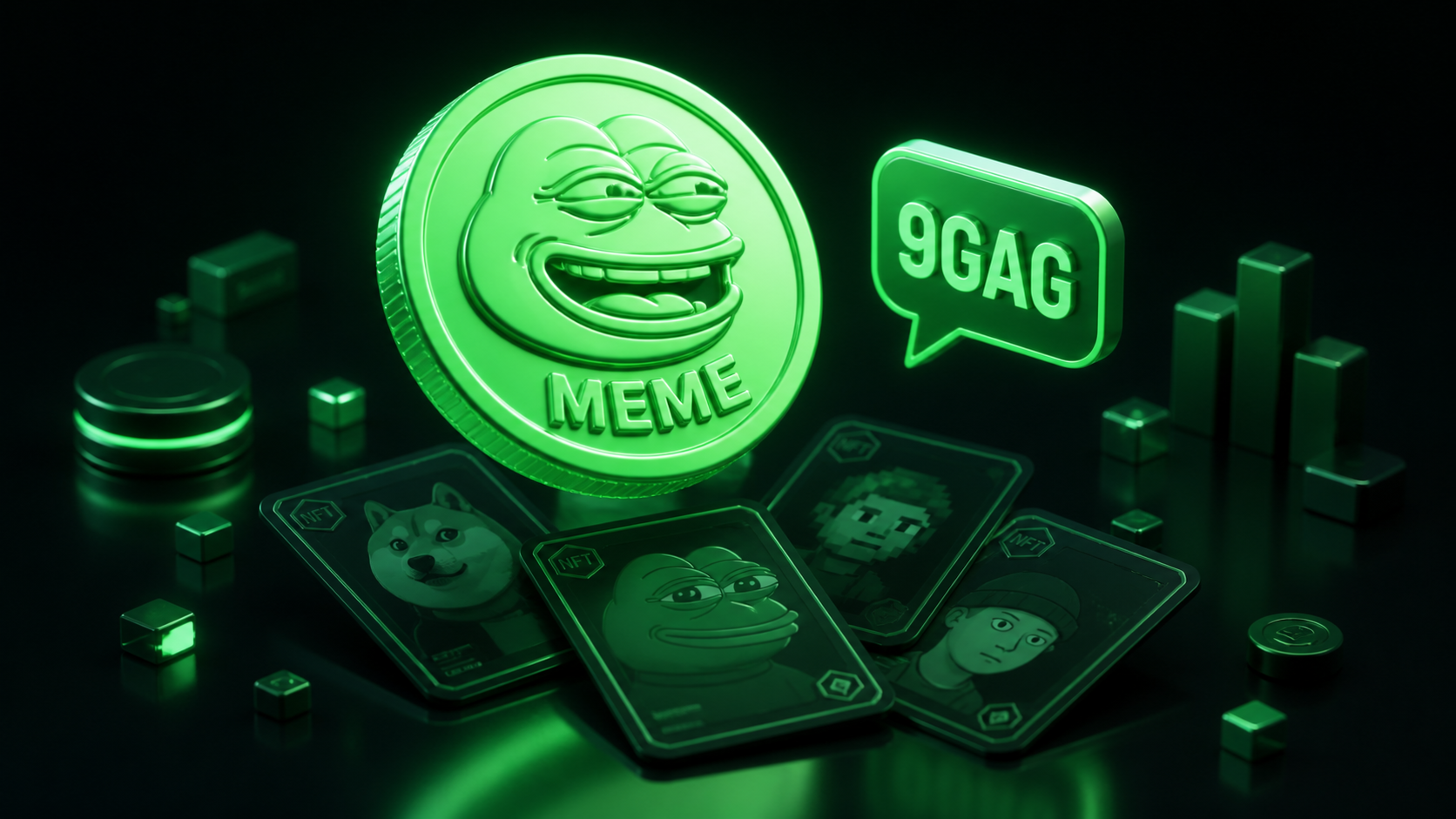
Memecoin (MEME) is an ERC-20 token on Ethereum issued by Memeland, the web3 studio built by the team behind the humour site 9GAG, and its own documentation states the token has no utility, no roadmap and no expectation of financial return. That declaration is the design. MEME went live on 3 November 2023 with a fixed supply of 69 billion tokens, most of it handed to people who had spent the previous year collecting Memeland NFTs and farming points inside a community built on internet jokes.
What makes the token worth understanding is the distribution machine behind it. Very few meme tokens launch with a media company, a 200 million-user audience and three established NFT collections already attached.
Where Memecoin Came From
9GAG has been one of the internet's largest humour platforms since 2008. In 2022 its founders spun up Memeland as a separate web3 venture studio, with the stated aim of turning an audience that already produced and shared memes into an on-chain community. The studio's early output was NFTs rather than tokens.
Three collections landed across 2022 and early 2023: YOU THE REAL MVP, The Potatoz and The Captainz. Holding any of them earned a place in what Memeland called the airdrop, and the studio layered a points system on top. The MEMEPOINTS dashboard handed out credit for quests, most of them social tasks such as posting about Memeland or following its accounts. Points accumulated for over a year with no confirmed conversion rate, which kept a large group of people engaged and speculating.
The token event itself came in two parts. A public Fire Sale priced tokens at $0.001 and sold out in roughly 40 minutes, grossing around $10 million inside the first hour. Claims for the airdrop and Fire Sale allocations opened on 3 November 2023, with exchange listings following the same morning. MEME reached its all-time high of $0.05632 on 4 March 2024, according to CoinGecko.
The 69 Billion Supply and Who Received It
The supply is fixed at 69 billion tokens, a number picked for the joke rather than any economic reason. Seven buckets divide it:
| Allocation | Share | Who it went to |
|---|---|---|
| Ecosystem | 30.00% | Community programmes, incentives, future distributions |
| Airdrop | 25.00% | NFT holders and MEMEPOINTS farmers |
| Contributors | 17.00% | Team and long-term builders |
| Investors | 12.00% | Early backers |
| Fire Sale | 11.00% | Public buyers at $0.001 per token |
| Advisory | 3.00% | Advisors |
| Exchange launchpool | 2.00% | Listing-day farming rewards |
Handing a quarter of the supply to holders and point farmers was the single largest structural decision in the design. It bought a wide, loud holder base on day one and it guaranteed heavy sell pressure from recipients whose cost basis was zero.
As of August 2026, roughly 64.18 billion of the 69 billion tokens are circulating, leaving around 4.8 billion still locked on a schedule that runs into 2027. Market cap sits at about 93% of fully diluted value, so the unlock overhang that weighs on younger tokens has mostly cleared here. The contract is verifiable on Etherscan, and because it settles on Ethereum, on-chain transfers carry gas costs that can exceed the value of a small position.
The Three NFT Collections Behind the Token
Memeland's NFTs are the reason MEME had a holder base before it had a price. Each collection sat at a different tier of the same membership ladder.
YOU THE REAL MVP
The smallest and earliest collection, 420 gold trophies inscribed with a mock-heroic motto. MVP holders sat at the top of every allocation table Memeland published. The collection still carries the highest floor of the three, around 1.5 ETH as of August 2026.
The Potatoz
A free-mint collection of 9,999 utility-enabled profile pictures, positioned as entry-level membership. Potatoz introduced a non-custodial staking system where owners kept the NFT in their own wallet while accruing rewards, which became the template for how Memeland measured loyalty. The floor sits near 0.048 ETH.
The Captainz
The 9,999-piece flagship, launched in early 2023 around a pirate-crew theme and priced far above the free Potatoz mint. Captainz carried the strongest airdrop weighting and priority access to whatever Memeland shipped next. Its floor trades around 0.068 ETH.
Anyone assessing MEME today should watch these three floors alongside the token chart. They are the cleanest available read on whether the community that received the airdrop is still present. Memeland maintains the collections and its wider project list on its official site.
What "No Utility" Actually Means for Holders
The whitepaper language is blunt: no functions, no utility, no intrinsic value, entertainment only. Read one way that is a legal shield, and it does real work in a market where regulators scrutinise implied promises. Read another way it is a positioning statement that tells buyers exactly what they are getting.
The practical consequences are specific. MEME captures no fees from any product. It confers no enforceable governance rights. There is no protocol revenue to model, no staking yield paid by a network, and no treasury obligated to buy tokens back. Valuation therefore has one input: how much attention Memeland and 9GAG can direct at the ticker.
That puts MEME in the same broad category as Pepe or any other pure attention asset, with one difference worth noting. Most meme tokens are launched anonymously and rely on organic virality. MEME sits downstream of a company with a distribution channel, a staff and a reputation to protect. That raises the floor on communication and lowers the odds of an abandoned contract, and it does nothing to change the fact that the token has no cash flows to fall back on when attention moves elsewhere.
MEME's Market Profile in August 2026
As of August 2026 MEME trades around $0.00049, with a market cap near $31 million, a rank in the low 600s and daily volume of roughly $7.6 million. The token sits about 99% below its March 2024 peak and only a few percent above the all-time low of $0.0004631 set on 28 May 2026.
Two features define how it behaves. Float is effectively complete, so price moves reflect current demand rather than a vesting calendar. Liquidity is concentrated on centralised venues, which makes exchange listing decisions unusually influential; one large US platform announced in August 2026 that it would retire its MEME perpetual contract, and the token sold off on the news.
For traders, that profile means thin books, fast reversals and a chart that responds to social catalysts far more than to anything resembling fundamentals. LeveX lists MEME on both spot and perpetual futures, so a position can be expressed long or short, and the difference between spot and futures trading matters here: leverage on a token this volatile compresses the distance to liquidation considerably.
Frequently Asked Questions
What is MEME coin used for?
MEME has no assigned function. Memeland's documentation states the token carries no utility, no roadmap and no promise of return, and no product in the Memeland ecosystem requires it to operate. It exists as a tradable expression of the Memeland community and a mechanism for distributing value to NFT holders.
Who created Memecoin (MEME)?
Memecoin was created by Memeland, a web3 venture studio founded in 2022 by the team behind 9GAG. 9GAG has run one of the internet's largest humour platforms since 2008, and Memeland was set up to bring that audience on-chain through NFT collections and, later, the MEME token.
How many MEME tokens are there?
The total and maximum supply is 69 billion MEME, and the number cannot increase. Around 64.18 billion were circulating as of August 2026, with roughly 4.8 billion still vesting on a schedule that extends into 2027.
Is MEME the same kind of asset as Dogecoin?
Both derive value from attention rather than cash flows, so they behave similarly in a market cycle. The structures differ: Dogecoin is a standalone proof-of-work network with an uncapped, inflating supply, while MEME is a fixed-supply ERC-20 token issued by a company with an existing media audience.
Why did MEME fall so far from its high?
A quarter of the supply was airdropped at zero cost basis, which produced persistent selling once the token listed. Beyond that, MEME has no revenue or yield to support a valuation floor, so the price tracks interest in Memeland. As NFT trading cooled through 2024 and 2025, and attention rotated to newer meme assets, that interest thinned and the price followed.
Where can I trade MEME?
MEME trades on centralised exchanges as an ERC-20 pair, most commonly against USDT. LeveX lists MEME-USDT on the spot market and a MEMEUSDT perpetual contract for leveraged positions, both accessible from a single account.
Why MEME Trades on Attention Alone
Memecoin is one of the cleaner experiments in crypto: take a large, real internet audience, attach a token with every fundamental stripped out, and see what the market pays for reach. The answer, three years in, is around $31 million. That number will keep moving with Memeland's ability to stay culturally relevant, because nothing else in the design supports it.
Anyone considering a position should treat it as a bet on that relevance and size it accordingly. The supply is fully known, the disclosure is unusually honest about what the token does, and the risk sits entirely in whether people keep caring. Volatility of this kind cuts both ways, and stop levels deserve as much thought as entries.
Ready to take a view? Buy MEME on the spot market or trade it with leverage through MEME perpetual futures on LeveX. For guides to other tokens, browse Crypto in a Minute.