

Greece has just decided that buying Ethereum and flipping it deserves a lighter tax bill than staking it and leaving it alone. Parliament passed the law on November 5, and the coverage so far has mostly stopped at the two headline rates. The interesting material sits in the gaps between them.
The Greek Crypto Tax, Line by Line
Everything below takes effect on January 1, 2027, with the ministry's guidance on transparency and audits still to come.
| Item | What the law does |
|---|---|
| Gains on disposal | 10% |
| Staking, lending, liquidity provision | 15%, treated as interest income |
| Annual net gains up to €500 | Exempt. Above that, the whole gain is taxed |
| Losses | Qualifying losses above €500 carry forward five years |
| Spending crypto on goods or services | Can count as a disposal |
| Crypto-to-crypto swaps | Ministry says no tax. Parliament's reviewers say the wording could catch them |
| Voluntary disclosure | 12 months without late-filing penalties or interest, with payment due within 60 days of filing |
Those details come from Decrypt and a CoinDesk report carried by FXStreet, and neither of those is the bill text, so treat the fine print as provisional until the implementing rules appear.
Three Places the Rules Will Bend Behavior
A cliff at €500
The exemption works like a trapdoor. A €500 gain costs nothing, and a €501 gain produces a €50.10 bill, which makes that extra euro of profit one of the most expensive in European finance. Anyone landing between €500 and roughly €556 ends the year with less money than someone who stopped at exactly €500. Small holders will work this out by about mid-December, and the last two weeks of every Greek tax year will feature a lot of carefully sized sells and loss-taking.
The wrapper could decide the rate
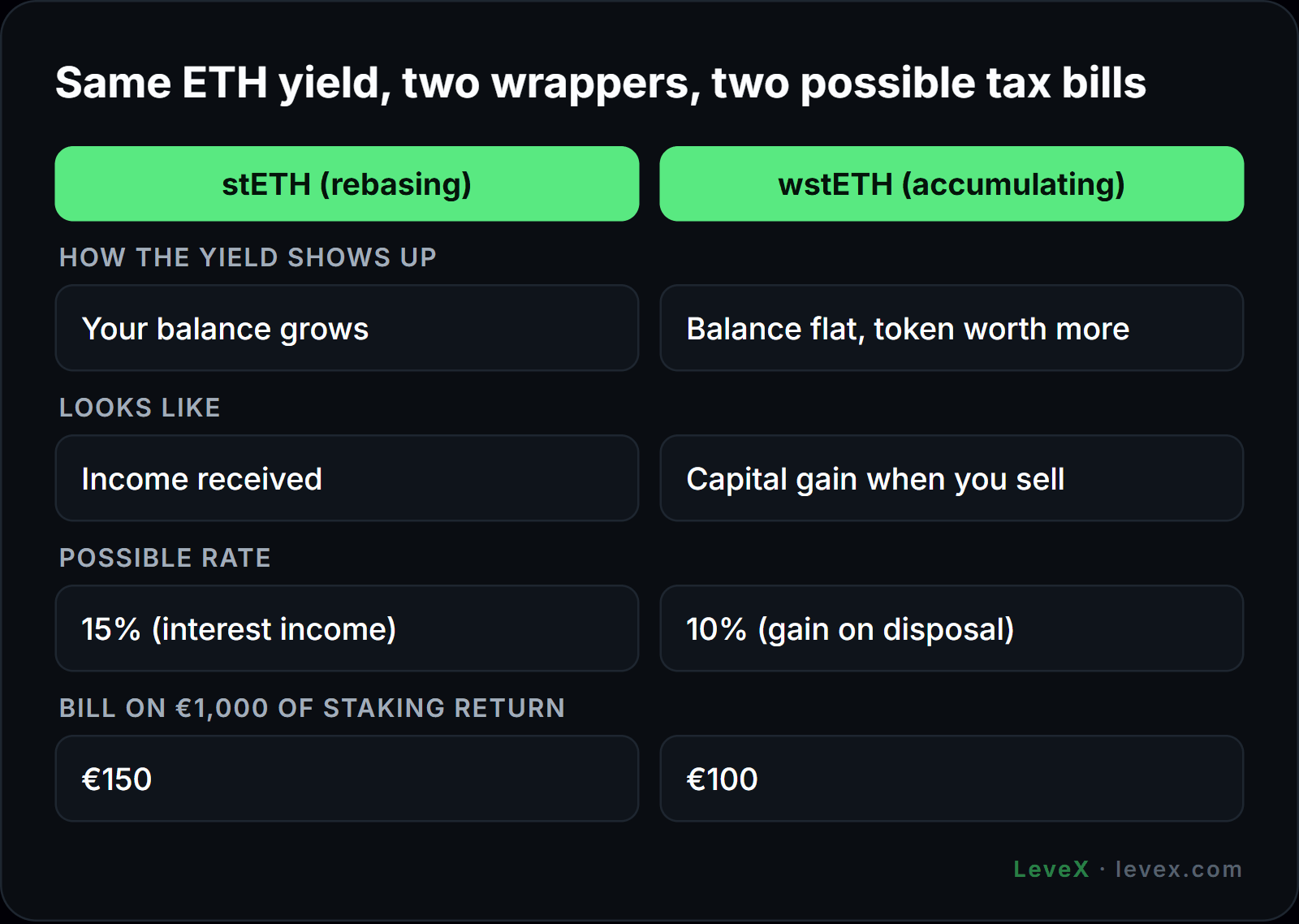
The ministry calls staking returns interest income, and the reporting we reviewed says nothing about liquid staking. That silence matters because the same ETH yield can arrive in two very different shapes. A rebasing token like stETH grows your balance, which looks a lot like income received. An accumulating wrapper like wstETH leaves your balance flat while each token becomes worth more, which looks a lot like a capital gain that only exists when you sell.
On €1,000 of staking return, that is the difference between a €150 bill and a €100 bill, decided by a contract design choice made years ago for DeFi compatibility. Liquidity pool fees that compound inside a position raise the same question. This is our reading of an open point, and anyone affected should wait for the ministry's guidance or ask a Greek tax adviser before acting on it.
Stablecoins become the waiting room, maybe
Parliament's Scientific Service flagged broad "for consideration" language that could sweep in token-to-token trades, and asked for an explicit exemption plus clearer rules for stablecoins and e-money tokens. Two very different worlds hang on that drafting fix. If ETH-to-USDT stays untaxed, a trader can rotate all year and meet the taxman once, at the euro off-ramp, with the whole gain arriving on one day. If the wording bites, an active trader owes a cost-basis calculation on every rotation, which is the kind of homework that sends people offshore.
Athens Admits It Can't See the Market
The most revealing line in the coverage is the government declining to estimate revenue, because officials say the market is hard to measure when so many Greeks use overseas platforms. Then look at the calendar. Under the EU's DAC8 directive, 2026 is the first reporting year and member states must exchange that data by September 30, 2027.
If the 12-month disclosure window runs through 2027, it closes around the moment Greece starts receiving account-level data from platforms elsewhere in the bloc. Every amnesty is a polite invitation to confess. This one looks timed to expire just as the paperwork lands.
The LeveX Take
The rate gap is a policy mistake, and it will be arbitraged within a year. Taxing yield above price gains rewards the behavior regulators usually describe as speculation and penalizes the closest thing crypto has to saving. Our bigger concern lies beyond Greece: "interest income" is a tidy classification that finance ministries elsewhere in Europe can lift wholesale, and a template that passes without a fight tends to travel. If it spreads, on-chain yield products will be redesigned around tax treatment, and demand should drift toward accumulating wrappers and away from anything that pays out visibly.
Traders face a quieter version of the same problem, which is that the date a position closes now carries a price. Coverage of the law is silent on derivatives, so nobody can yet say how a perp's realized result will be handled. Multi-Trade is useful in that kind of fog for a specific reason: a trader holding a core ETHUSDT long can open a separate short on the same contract to cut net exposure into a year-end, and leave the original position's entry and stops alone. Any leg that closes still books its own result, and a hedge carries its own risk and fees, so treat this as exposure management with no tax outcome attached.
What Greek Crypto Tax Guidance Has to Settle
Greece cut its rate from the 15% floated in June to 10%, and that concession is what most people will remember. The real policy will be written in the coming weeks by whoever drafts the guidance on swaps and staking wrappers, in a document far fewer people will read.
For those positioning around ETH as the staking debate moves through Europe, LeveX offers ETH spot and perpetual futures trading, with all the risk that entails. The Crypto in a Minute series explains staking, wrappers and cost basis in short reads.