
The Electrum Bug That Punishes Impatient Bitcoiners
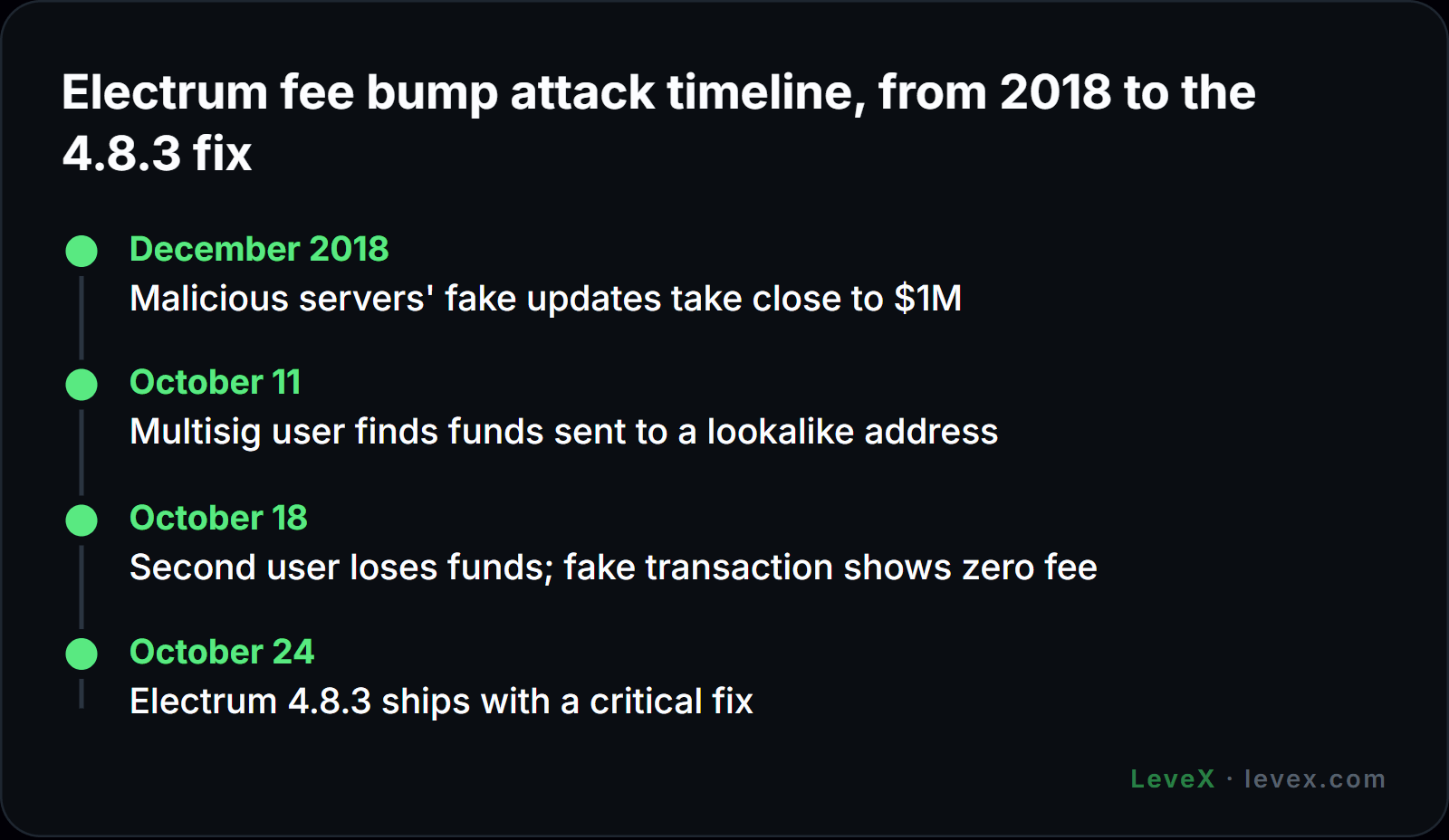
On October 11, an Electrum user opened their transaction history and found a payment that did not match the one they had sent. The wallet was a two-of-three multisig secured by two Trezor devices, which is about as careful a setup as a bitcoin holder can build, and the original transaction had 31 inputs and a single output. Nearly all of the money had gone to an address that shared its last four characters with the intended recipient. A week later a second user lost funds the same way, and on October 24 the Electrum team shipped version 4.8.3 with a fix it called critical, urging every user to upgrade.
Most coverage filed this under "update your wallet" and moved on. That advice is correct and incomplete, because the attack never touches anyone's private keys. It turns one of the most ordinary actions in Bitcoin, speeding up a stuck payment, into the moment a user signs their coins away.
How a Fee Bump Became a Signature Trap
Electrum is a light wallet. Instead of downloading the blockchain, it asks a server for its history and hands that server its transactions to broadcast. Confirmed transactions get checked through Simple Payment Verification, while unconfirmed ones are taken largely on the server's word, and the documentation has always said as much. The attack lives in that gap:
- A malicious server receives the user's signed transaction and quietly declines to broadcast it.
- The server feeds the wallet a substitute transaction spending the same coins to an attacker address chosen to match the real recipient's final characters.
- The substitute carries invalid signatures, which should have been a giveaway, but every version before 4.8.3 displayed it in history without checking them.
- The payment now appears stuck. In the October 18 case the fake transaction carried a zero fee, which is about as clear an invitation to press the fee-bump button as a wallet can show.
- The user chooses Replace-by-Fee, and the wallet builds and signs a real, valid replacement of the transaction on screen, paying the attacker with a higher fee attached for good measure.
Step five is the elegant part, if you can admire a mugging. The attacker needs no keys, no malware and no phishing page, only a user in a hurry. The hardware devices in the first case did exactly what they were built to do, which is sign what their owner approved.
The fix in commit 90fe308 makes Electrum verify signatures on unconfirmed transactions that spend the wallet's own inputs. Incoming unconfirmed payments sit outside the new check, so a pending deposit in your history remains a server's claim until a block confirms it.
Why the Modern Fee Market Widens the Target
Replace-by-Fee used to be an opt-in curiosity that only power users touched. Bitcoin Core switched full RBF on by default in version 28, and fee bumping is now a routine button in most wallets. That normalization is what gives this attack its reach, because a stuck transaction no longer looks suspicious to anyone. It looks like a busy afternoon.
Then consider when people actually bump Bitcoin fees. They do it on volatile days, when a deposit to an exchange needs to land before a margin call or a breakout. Bitcoin slipped below $80,000 on October 26 as traders cut exposure ahead of the Fed's October 28 decision, which is precisely the kind of session where a stuck transfer feels intolerable and nobody reads all 62 characters of an address twice. The attack design leans on urgency, and urgency is the one resource traders reliably have in surplus.
Anyone who remembers December 2018, when malicious Electrum servers pushed fake update prompts and walked off with close to $1 million, will recognize the pattern. The weak point then and now is the server the wallet trusts by default.
| Transaction type | Checked before 4.8.3 | Checked in 4.8.3 |
|---|---|---|
| Confirmed, any direction | Yes, via SPV | Yes, via SPV |
| Unconfirmed, spending your coins | No | Yes, signatures verified |
| Unconfirmed, incoming to you | No | No, still the server's claim |
The developers have not disclosed total losses, how many servers took part, or whether other victims exist. Both confirmed cases used the same lookalike-suffix trick, which points to a single operator refining one method, at least so far.
The LeveX Take
The quiet lesson of this bug is that the screen itself was the attack surface. Every number a wallet shows you is a claim made by somebody's server, and Electrum's fix amounted to replacing trust with verification for one category of claim. Traders should apply that same standard to every place their capital sits, and that includes the venue where they post margin. LeveX publishes Proof of Reserves built on a Merkle tree, so any user can check that their own balance is included in the attested total rather than taking a dashboard figure on faith. The principle is identical to Electrum's patch: a balance you can verify outranks any balance you are merely shown.
There is a second, more practical idea hiding in the attack's timing. The victims most exposed to a fee-bump trap are the ones forced to move coins under pressure, so the cheapest defense is structural: keep enough collateral on your trading venue that a volatile session never requires an emergency on-chain transfer. A trader who sizes positions so that no single day demands a rushed deposit has removed the exact moment this exploit was built to catch.
Slower Hands Keep More Bitcoin
Upgrade Electrum to 4.8.3 from the official site, and until then treat any stuck payment as a reason to stop and check rather than to bump. Read the full destination address and amount on the hardware wallet's own screen before approving any replacement, connect to your own server or a trusted one if you run the software heavily, and treat unconfirmed incoming payments as rumors until they confirm. None of that is exotic. It simply asks you to be slowest at the moment the attacker needs you fastest.
If you would rather keep your trading capital where you can verify it, you can trade BTC on LeveX spot or perpetual futures, and the Crypto in a Minute series explains wallets, fees and mempools in short reads.