
DePIN Revenue Reality: Why Only Cash-Generating Projects Survive
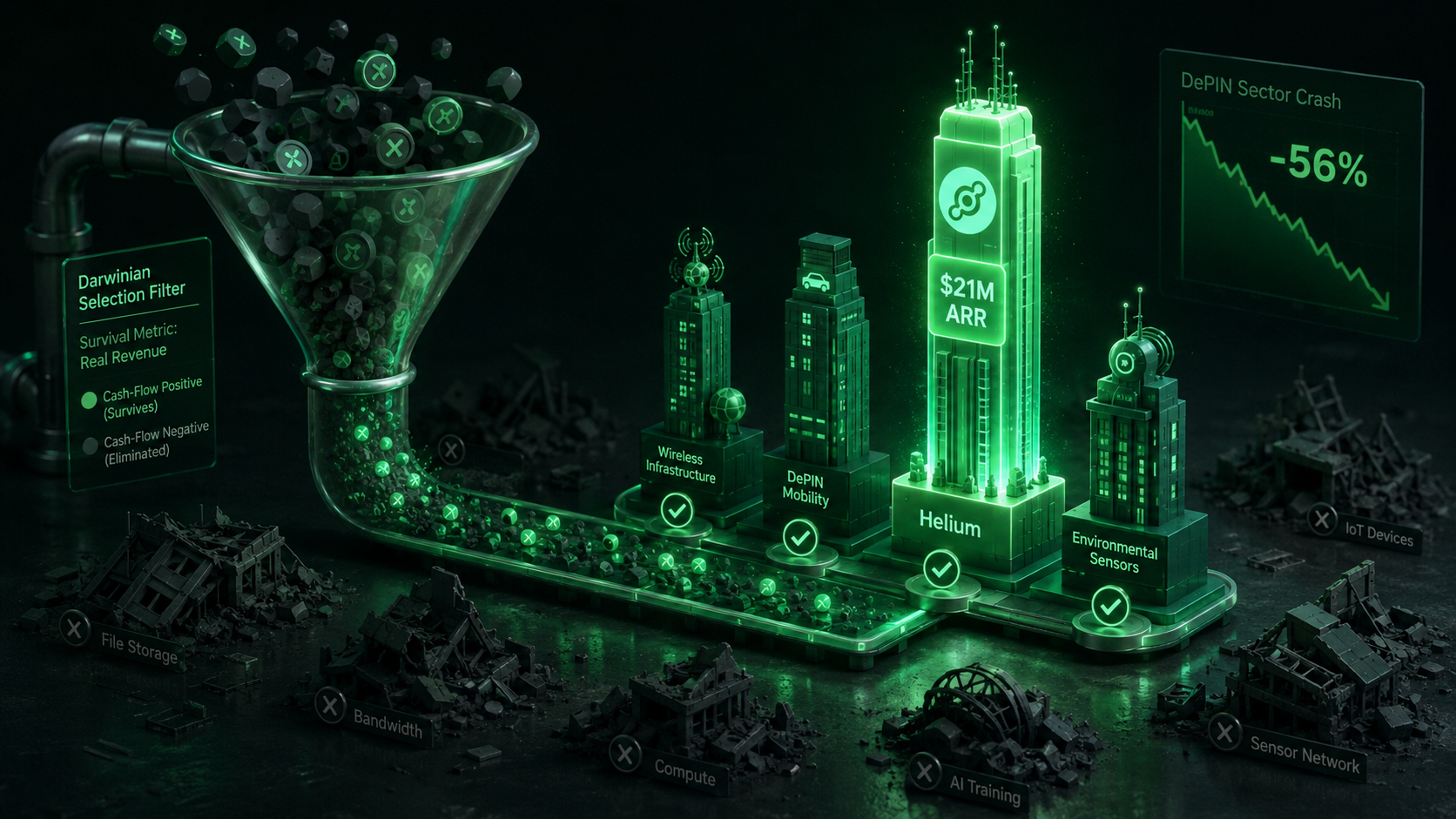
The DePIN sector lost 56% of its value in 2025. Most coverage frames this as failure. The data tells a different story: Darwinian selection is working exactly as it should, separating projects with real revenue from those running on token emissions and promises.
Helium recorded its first deflationary month in October 2025, meaning token burns from actual user payments exceeded new emissions. That milestone matters more than any price chart because it proves something rare in crypto: a decentralized network generating enough real demand to sustain itself without perpetual inflation.
The Revenue Leaders Emerging from the Wreckage
While the broader DePIN market cap contracted, a handful of projects demonstrated genuine unit economics. According to DePIN Pulse data, Helium Mobile reached $21 million in annualized recurring revenue by December 2025, with daily revenue hitting $60,666.
The numbers behind Helium's turnaround:
| Metric | December 2025 | Year-over-Year Change |
|---|---|---|
| Registered Users | 622,000 | +255% |
| Active Hotspots | 121,000 | +45% |
| 30-Day ARR | $21M | First time profitable |
| Data Transferred Q2 | 2,721 TB | +138.5% QoQ |
Render Network followed a similar trajectory, processing 1.49 million frames in July 2025 and burning 207,900 USDC in fees. The annualized revenue reached $6.8 million, growing 144% quarter-over-quarter in Q3. Unlike projects promising future utility, Render delivers GPU compute to paying customers today.
What Separates Survivors from Casualties
The contrast between winners and losers reveals a brutal but clarifying pattern. Projects generating revenue from actual infrastructure usage are stabilizing. Projects dependent on token emissions to attract participation are collapsing.
Grass, once hyped as the "data backbone of AI," exemplifies the casualty profile. The bandwidth-sharing project attracted speculation without converting it to sustainable economics. When token incentives dried up, so did participation. Messari's Q1 2025 sector report noted that 60% of active DePIN tokens have scheduled emission reductions within 18 months, meaning projects without real revenue will face existential pressure.
Helium's path illustrates the alternative. The SEC dismissed its investigation into Nova Labs in April 2025, removing regulatory overhang. More importantly, partnerships with AT&T, T-Mobile, and Telefónica created genuine B2B demand. Traditional carriers now offload traffic onto Helium's network, paying real fees that burn tokens rather than just shuffling them between wallets.
Why Revenue Matters More Than Node Counts
Early DePIN metrics focused on vanity numbers: hotspots deployed, nodes online, theoretical capacity. These statistics attracted capital but revealed nothing about sustainability. The 2025 correction forced a reckoning.
The new evaluation framework centers on replacement metrics: what percentage of traditional infrastructure does the protocol actually displace? Helium Mobile's $20 unlimited plans compete directly with legacy carriers. Users pay for service, not speculation on future token value. That distinction determines which projects survive the next bull and bear cycle.
Filecoin demonstrates similar dynamics in storage. With 2.1 exbibytes of secured data and clients including Cornell University and the Smithsonian, the network generates fees from entities that need reliable storage, not crypto-native users farming airdrops.
The Delphi Digital AI + DePIN 2025 report emphasized that usage-backed revenue significantly lowers yield volatility compared to emission-dependent protocols. For traders, this translates to fundamentals worth analyzing rather than narratives worth timing.
The LeveX Take
DePIN's 56% drawdown cleared the field of projects that couldn't generate sustainable economics. What remains are protocols proving that decentralized infrastructure can compete on cost and service quality with centralized alternatives.
The investment thesis simplifies: ignore node counts and focus on revenue trajectory. Helium's path from bleeding $400,000 weekly in mobile subsidies to achieving net deflation shows the template. Render's consistent GPU revenue growth amid AI demand demonstrates the same principle in compute.
For Solana ecosystem exposure, both Helium and Render migrated to Solana for performance optimization, making SOL an indirect play on DePIN's revenue leaders. Direct token exposure requires evaluating whether individual projects have crossed the sustainability threshold or remain dependent on emissions.
Trading the DePIN Maturation
The sector's evolution from hype to fundamentals creates distinct opportunities. Projects demonstrating revenue growth while the broader market discounts the category offer asymmetric setups. The pattern resembles how DeFi protocols with proven fee generation outperformed during the last cycle's consolidation phase.
Position sizing matters given the sector's volatility. Using futures contracts allows exposure management without full capital commitment, while spot positions suit longer conviction holds on ecosystem leaders.
The key filter: can you identify the project's actual customers and revenue sources? If the answer requires speculation about future adoption rather than current payments, the risk profile increases substantially.
Beyond the Hype Cycle
DePIN's 2025 correction separated infrastructure projects from token speculation experiments. The survivors, led by Helium and Render, demonstrate that decentralized networks can generate real revenue by providing services people actually pay for.
The sector's projected growth to $3.5 trillion by 2028 depends entirely on whether more projects achieve this transition. For traders, that means tracking revenue metrics rather than market cap rankings, focusing on protocols where burns exceed emissions rather than those promising future utility.
Explore DePIN ecosystem tokens through LeveX's spot and futures markets, or browse our Crypto in a Minute guides for deeper dives into blockchain infrastructure categories.