
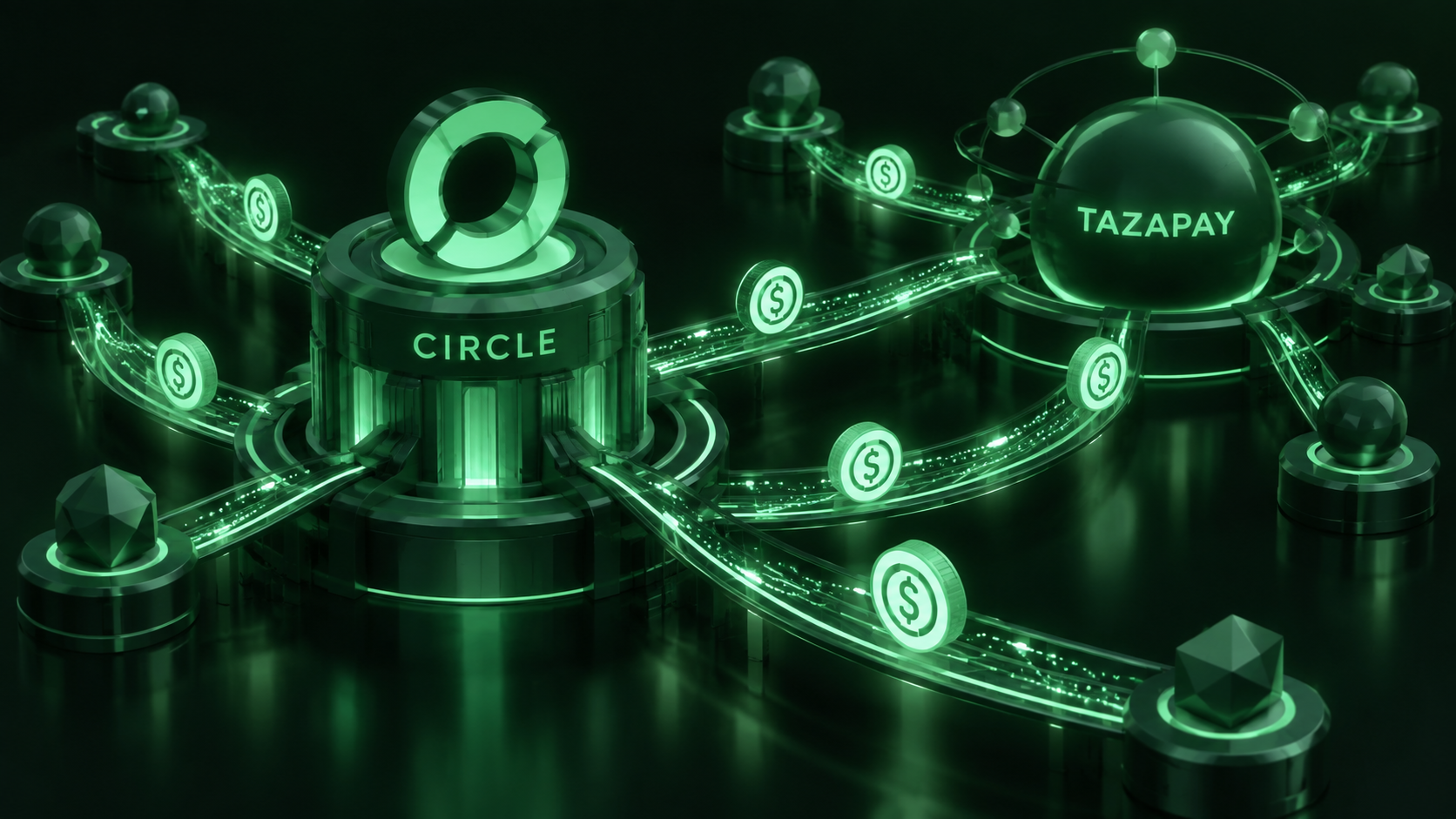
Circle makes money by holding other people's dollars and collecting the interest. Roughly sixty cents of every dollar it earns that way goes straight back out the door to the platforms that put USDC in front of users, which means the company's largest cost line and its distribution strategy are the same thing. On September 8 it agreed to spend $400 million of its own stock to start owning that channel instead of renting it.
The target is Tazapay, a Singapore business-to-business payments firm that moves upward of $25 billion a year across 100 markets, with about 60% of that volume already settling in stablecoins. CoinDesk reported the transaction is all stock and expected to close in 2027 pending regulatory approval, making it Circle's first major acquisition since its June 2025 listing.
Most of the coverage filed this under "stablecoin issuer expands into Asia." The interesting version starts with Circle's income statement.
The Sixty-Cent Problem
Circle's public filings make the economics uncomfortably legible. In the fourth quarter of 2025 the company booked $733 million in revenue and reserve income, then paid out $460.6 million of it in distribution and transaction costs, about 63 cents on the dollar. Across the full year that line reached $1.66 billion.
| Period | Revenue and reserve income | Distribution costs | Share paid out |
|---|---|---|---|
| Q4 2025 | $733M | $460.6M | 63% |
| Q2 2026 | $701M | $412M | 59% |
The bulk of it flows to one distribution partner whose contract entitles it to all of the reserve interest on USDC sitting on its own platform and half the interest earned anywhere else. That single relationship cost Circle roughly $1.4 billion in 2025. Every incremental dollar of USDC that arrives through somebody else's app carries a toll, and the toll scales perfectly with success. Growth that arrives through partners buys market share at a permanent 50% to 100% haircut on the yield it generates.
Circle's own reporting metric tells the story better than any narrative. Revenue less distribution costs, the number management points analysts toward, held a 39% margin while revenue grew 64%. Scale has been showing up in the top line and stopping there. For a business built on the idea that stablecoin adoption compounds, watching the margin refuse to move for a year is the sort of thing that eventually produces a $400 million shopping trip.
What $25 Billion of Rails Actually Buys
Very little of what Circle is paying for is code. Tazapay's asset is a permission structure: money transmitter licenses, local bank relationships, and payout rails in markets where a US company has no standing to settle payables without local approval. That gets assembled regulator by regulator over years, and the deal gives Circle immediate reach across APAC, Southeast Asia and South Asia rather than in 2031.
The 60% stablecoin share of Tazapay's existing volume is the tell. Circle is acquiring a channel where its product has already won the settlement layer and where the reserve income arrives without a revenue share attached. Buying $25 billion of annual flow at $400 million values the rails at about 1.6% of the volume crossing them, which looks cheap for something that would otherwise take a decade and a compliance department to replicate.
There is also a quieter benefit around the timing of the payment. Paying in stock spends an asset the public market has already repriced, keeps cash on the balance sheet, and hands Tazapay's owners a stake in the outcome. Whether that reads as confidence or as a discreet admission about valuation depends entirely on where the stock trades in 2027.
The Rate Hedge Nobody Called a Rate Hedge
Reserve income is a function of what short-term Treasuries pay on the float, which makes Circle a levered bet on the front end of the yield curve wearing a crypto costume. Every cut compresses the revenue line directly, and the Federal Reserve's path has been the single most-asked question about the company since it went public. A B2B payments business earns fees on volume, and volume does not care what the policy rate is.
Read that way, the deal is a diversification story wearing an expansion story's press release. Circle is using equity to buy an earnings stream that is uncorrelated to the thing everyone is worried about.
The LeveX Take
Stablecoin competition has moved from issuance to distribution, and that shift changes who wins. Minting a dollar token is close to free and technically solved. Getting it accepted in a Jakarta payables run or a Nairobi payout batch is expensive, licensed, and slow, and it is the only part of the business with a defensible moat. Issuers that own their last mile will out-earn issuers that rent it, regardless of whose token has more supply outstanding.
The knock-on for crypto markets is subtler and worth sitting with. Stablecoin supply growth has been treated for years as a clean proxy for crypto liquidity, on the reasonable assumption that new tokens land on exchanges as dry powder. Float that lives inside a cross-border payables business behaves nothing like that. It clears, it leaves, and it never touches a spot order book. As commerce-driven issuance grows as a share of the total, headline supply charts will keep going up while the money they represent is busy paying an invoice in Manila. Anyone using aggregate stablecoin supply as a liquidity signal is going to get quietly worse information over the next two years.
For traders, the awkward part is that the cleanest expression of this thesis is equity in a company whose deal does not close until 2027. That is the exact shape of position Futures Credit exists to support: a directional view where the risk is being early rather than being wrong. It absorbs losses up to the credit value while leaving profits intact and covers a share of trading and funding fees, which is what makes a slow thesis survivable on a leveraged book. The catch worth knowing beforehand is that it pairs with real funds and expires the instant you move money out of the futures account, so it belongs on a position you intend to leave alone.
Why 2027 Matters More Than This Week
The number that will settle whether this deal worked is the one Circle has been unable to move. If revenue less distribution costs is still pinned near 39% when Tazapay's volume is consolidated, the acquisition bought geography and nothing else. If it starts climbing, Circle will have proven that a stablecoin issuer can escape the toll booth, and every other issuer will start shopping for payment companies within a quarter.
Watch the Q4 2026 and Q1 2027 filings for that margin line, and watch whether a second issuer announces a payments acquisition before this one closes. The second event would confirm the thesis faster than any regulatory approval.
If you want exposure to the settlement layer while all of this plays out, LeveX lists the assets that clear on it, with spot and futures markets running around the clock. Our explainer on how USDC and USDT differ covers the collateral side, stablecoin float economics covers the money side, and the Crypto in a Minute series unpacks the rest.