

US spot Bitcoin ETFs lost $1.28 billion last week, enough to wipe out the entire year's net inflow and produce a round of headlines that read like an obituary. The arithmetic behind those headlines is far less dramatic, and the number that should be bothering traders got a fraction of the airtime.
What "Erasing 2026" Actually Erased
According to SoSoValue figures compiled by Coinpaprika, the funds entered the week with about $368 million of net inflows for the year and left it with about $914 million of net outflows. Thursday and Friday did most of the damage at $430.2 million and $411.9 million. BlackRock's IBIT alone shed around $403 million on Friday, roughly 88% of that day's gross redemptions, while Fidelity's FBTC took in $42.8 million on the same day, which is an odd thing to happen during a stampede.
Now size it. Spot Bitcoin ETFs collected $56.6 billion of net inflows in their first two years, so a $914 million deficit for 2026 hands back about 1.6% of that. The week's outflow came to roughly 1.3% of the $95.9 billion these 12 funds still hold.
The year itself has been a round trip: $5.4 billion out in the first half, close to $5.8 billion back between July and October, then one bad week. Round trips make excellent headlines when the starting line happens to be zero.
Price tells the same story. Bitcoin closed its last four completed weeks down 3.3%, 2.0%, 2.4% and 2.3%, per Cryptoticker's weekly tally, and was on course for a fifth red week as of Sunday at around $75,800. Anyone who sat through June 2022 remembers what capitulation feels like, with whole days lost to a single liquidation cascade and nobody answering the group chat. This selloff has the rhythm of a metronome.
Stablecoin Supply Is the Louder Signal
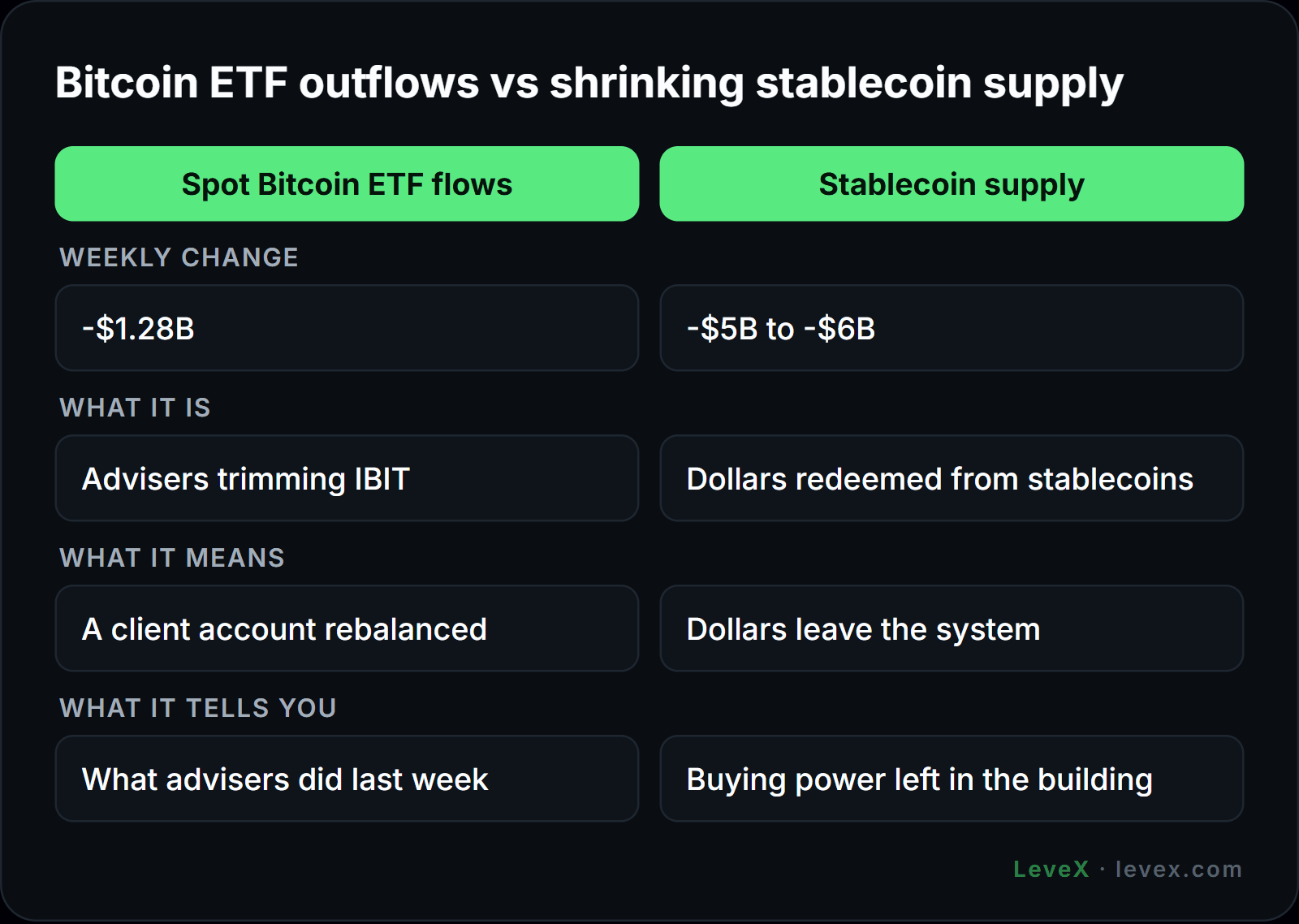
While everyone refreshed the ETF flow tables, the pool of dollars that actually sits inside crypto shrank by roughly four times as much. DefiLlama and Sentora data cited by 24/7 Wall St. put the weekly decline at somewhere between $5 billion and $6 billion, depending on how each tracker counts.
| Measure, week to Nov. 6 | Change | Relative size |
|---|---|---|
| Spot Bitcoin ETF flows | -$1.28B | about 1.3% of $95.9B in assets |
| Spot Ether ETF flows | -$365.3M | about 2.8% of $12.84B in assets |
| Stablecoin supply (DefiLlama) | -$4.99B | 1.7% of $298.24B |
| Stablecoin supply (Sentora) | -$6.02B | leaves $293.69B outstanding |
Some of that is lumpy. Sky's USDS dropped from $6.48 billion to $5.59 billion in a single day, which looks more like one large holder than a mood. The USDC figures are harder to wave away: on Ethereum, a month of minting and burning netted out at -$3.1 billion, with net outflows on 23 of 31 days.
I find that second number more unsettling than anything in the ETF data. An adviser trimming IBIT is rebalancing a client's retirement account. A dollar redeemed from a stablecoin has left the system altogether, so it can no longer serve as margin, DeFi collateral or the bid under the next dip, and stablecoin contraction has a habit of arriving before the price damage is finished rather than after it.
ETF flows tell you what advisers did last week. Stablecoin supply tells you how much buying power is left in the building.
The LeveX Take
The ETF cohort does matter, though its influence runs in a direction the outflow headlines miss. In mid-October, estimates put the average spot ETF buyer's cost basis between $81,722 and $82,000. Wednesday's post-midterm rally topped out at $81,131, and the 50-day average sits near $81,800. So the bounce died less than $600 below the break-even of the most-watched buyers in crypto, right under a major moving average.
Our read is that these holders are better understood as overhead supply than as a falling knife. Those estimates are a few weeks old and shift with every redemption, but the behavior is one every cycle veteran has seen: people who spent five weeks under water treat "back to even" as a sell signal. With the 200-day average near $73,200 below and Friday's low of $74,722 already close to it, we expect a $73,000 to $82,000 range to hold until stablecoin supply stops falling, and we would fade strength toward the top of it faster than we would panic at the bottom.
A range like that is cheap to describe and expensive to sit through, because nobody can say which week it ends and funding gets paid the whole time. Futures Credit earned through LeveX Quests speaks to that exact cost. It pairs with real margin, covers up to half of trading and funding fees, and absorbs losses up to its own value while profits stay with the trader. It buys some room against an early wick, and position size should still assume the credit runs out.
What Would Change the Read on Bitcoin ETF Flows
The funniest part of this selloff is that the group everyone is watching has barely left, and the group nobody quotes has been quietly walking out for a month. Three things would make us rethink the range: October US inflation data on Tuesday, November 10, if it moves rate expectations hard in either direction; a weekly close above $82,000, which would mean the break-even sellers got absorbed; and a stablecoin print back above the $298 billion seen a week earlier, the cleanest sign that fresh dollars have returned.
Crypto trading carries real risk, and a range can break without warning. You can trade Bitcoin on LeveX through spot or perpetual futures, and the Crypto in a Minute series covers ETF flows, funding and cost basis in short reads.