

Bitcoin's difficulty adjustment is the only major network statistic that is set entirely by the past, which is worth remembering every time a jump gets reported as fresh news about miner confidence. On October 16, at block 971,712, difficulty rose 5.92% to 140.58 trillion, its highest level since early March and the tenth upward adjustment of 2026, according to TokenPost. Most coverage read the move as strength. By the time it printed, the conditions it measured had already started to fade.
What the 5.92% Actually Measured
The retarget works on a fixed rhythm, and the rhythm explains the lag:
- Every 2,016 blocks, roughly two weeks, the protocol checks how long those blocks took to mine against the 10-minute target.
- If blocks came faster, more hashrate must have joined, so difficulty rises by the same proportion. If they came slower, it falls.
- The new difficulty then holds, unchanged, for the next 2,016 blocks, whatever happens to price or power costs in the meantime.
- Only at the end of that next window does the network learn whether it overshot.
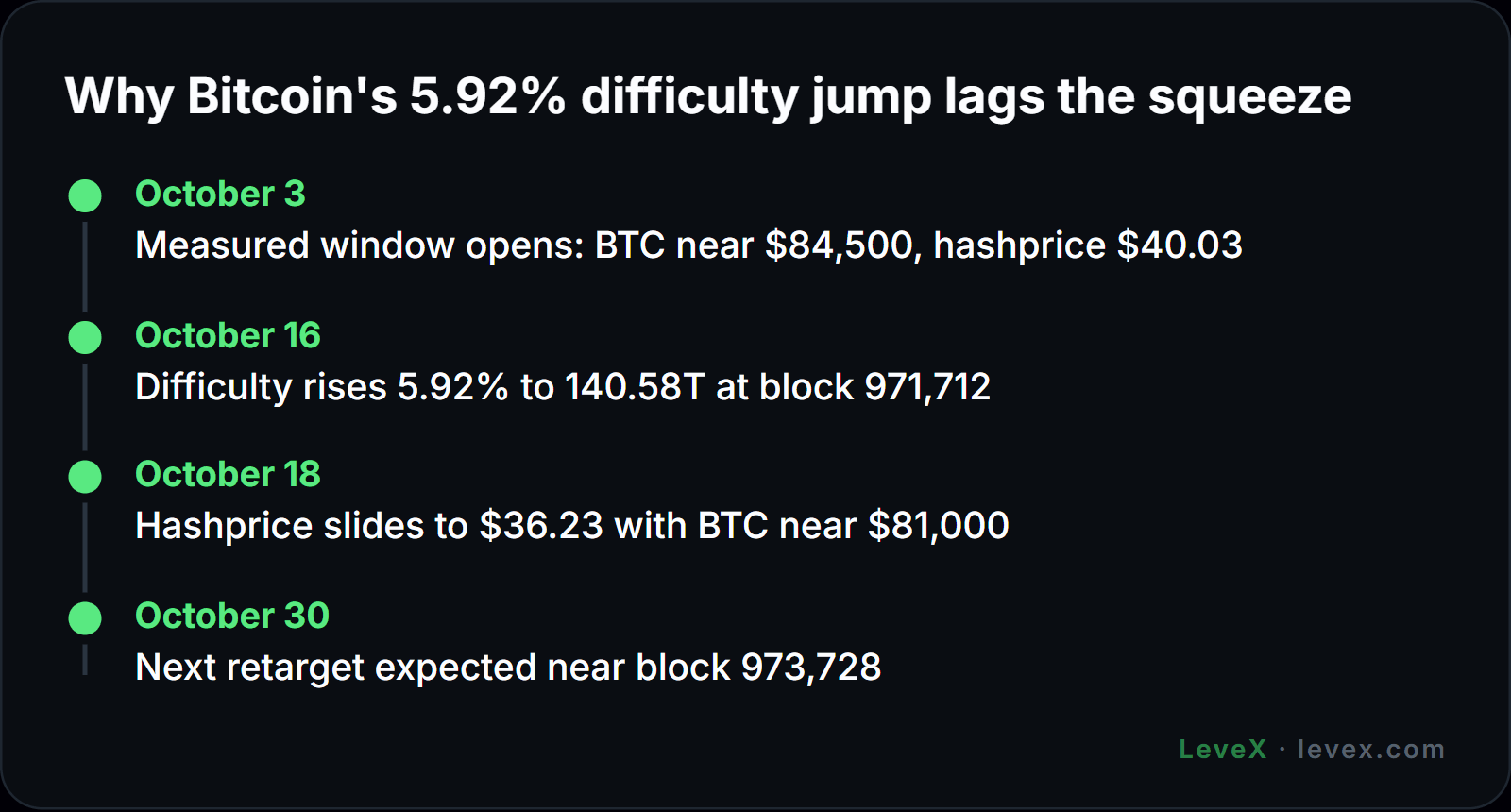
So the October 16 adjustment was a summary of hashrate between roughly October 3 and October 16. That period opened with Bitcoin near $84,500, and miners kept switching on machines through it. The jump says those machines were profitable enough to plug in at early-October prices. It says very little about whether they still are at $81,000.
The Squeeze Arrived After the Measurement
Hashprice, the dollar revenue a miner earns per petahash per day, is the number that answers that question, and it moved hard in two weeks. CryptoTicker's tracking puts it at $40.03 on October 3 and $36.23 on October 18:
| October 3 | October 18 | |
|---|---|---|
| Bitcoin price | about $84,500 | about $81,000 |
| Difficulty | about 132.7T | 140.58T |
| Hashprice (per PH/s per day) | $40.03 | $36.23 |
| Daily issuance value (450 BTC) | about $38.0M | about $36.5M |
That is a 9.5% pay cut in a fortnight, and less than half of it came from the price. The rest is difficulty, which means the industry's own expansion is now eating into the margin of every machine on the network, including the new ones that caused the adjustment. Mining has always had this quality of a crowded restaurant where every new table makes the food slightly worse for everyone already seated.
The hashrate itself appears to be responding. Daily estimates on mempool.space slid from about 1,084 EH/s to 943 EH/s across the week to October 18, a 13% drop. Daily readings are noisy because they are inferred from block times, and a run of unlucky blocks can fake a decline, so one week proves nothing. It does fit the pattern of older rigs going dark at a lower hashprice.
Why Nobody Agrees on October 30
The next retarget lands around block 973,728, expected near October 30, and the published estimates are all over the map: TokenPost projected a 2.05% rise, CryptoTicker an estimate of -0.45%, and other trackers have shown figures above 6%. Early in an epoch, these projections extrapolate from a few hundred blocks, so a handful of fast or slow blocks swings them by several points.
The spread is a reminder that difficulty forecasts are weather reports issued from a single cloud.
Where the Pressure Actually Lands
Miners produce about 450 BTC a day in new issuance, worth roughly $36.5 million at current prices, and their cost base (power contracts, hosting, debt service) is denominated in dollars. When hashprice falls, a larger share of each day's coins has to be sold to cover the same bills, and smaller operators without treasury reserves have the least room to wait. Back in August, when we wrote about Bitcoin's falling difficulty and mining cost floor, difficulty sat at 126.23 trillion. It is now about 11% higher, while the price has gone nowhere particularly encouraging, so the cost of producing a coin has climbed back up underneath the market.
For readers who want the full mechanics of how blocks are found and rewarded, our complete guide to Bitcoin mining walks through it from hash to payout.
The LeveX Take
The market treats a big upward adjustment as a sign that miners are healthy, and that reading has the causality backwards for anyone trading the next two weeks. The 5.92% increase locked in a higher cost of production for the whole network through the end of October, at a lower price than the one that justified it. Miners who expanded in early October now face the same 2,016-block wait as everyone else before the protocol offers any relief, and that wait is when marginal operators tend to sell coins they would have preferred to hold. The timing also stacks awkwardly: the next retarget falls in the same week as the Fed's late-October decision and the Glamsterdam fork on Ethereum's Hoodi testnet, so miner supply and macro headlines can hit together.
None of that makes a precise call on direction possible, because miner selling arrives in irregular bursts and a strong week of fees or a price bounce can erase the squeeze entirely. That is exactly the situation Futures Credit suits. Credit earned through Quests pairs with real margin, absorbs losses up to its value while leaving profits intact and covers up to half of trading and funding fees, which gives a position on BTC room to sit through two weeks of uneven supply without being shaken out by the first ugly candle. The edge in a lagging-indicator market comes from staying in the trade until the lag resolves, and the credit buys time more than it buys conviction.
Reading Difficulty Forward
Difficulty will keep getting reported as a scoreboard, because a record number makes a better headline than a lagging one. The more useful habit is to read each adjustment as the bill for the last two weeks and ask whether the current price can pay it. On October 30, the network will tell us how many miners decided it could not.
Traders can position on Bitcoin through LeveX spot or perpetual futures, and the Crypto in a Minute series explains hashrate, halvings and other network basics in a few minutes each.