
AGI Tokenomics: Supply, Allocation, and Vesting Through 2027
Update, October 2026: LeveX no longer lists Delysium (AGI) for spot or futures trading, so the LeveX trading links in this article have been removed.
Delysium's AGI token was designed with a heavy treasury allocation, a hard supply cap, and a vesting schedule that extends two years past most comparable AI token launches. Understanding how those three choices interact with the AI agent narrative is the difference between treating AGI as a momentum trade and treating it as a position with measurable supply dynamics.
Total Supply and the Three-Billion Cap
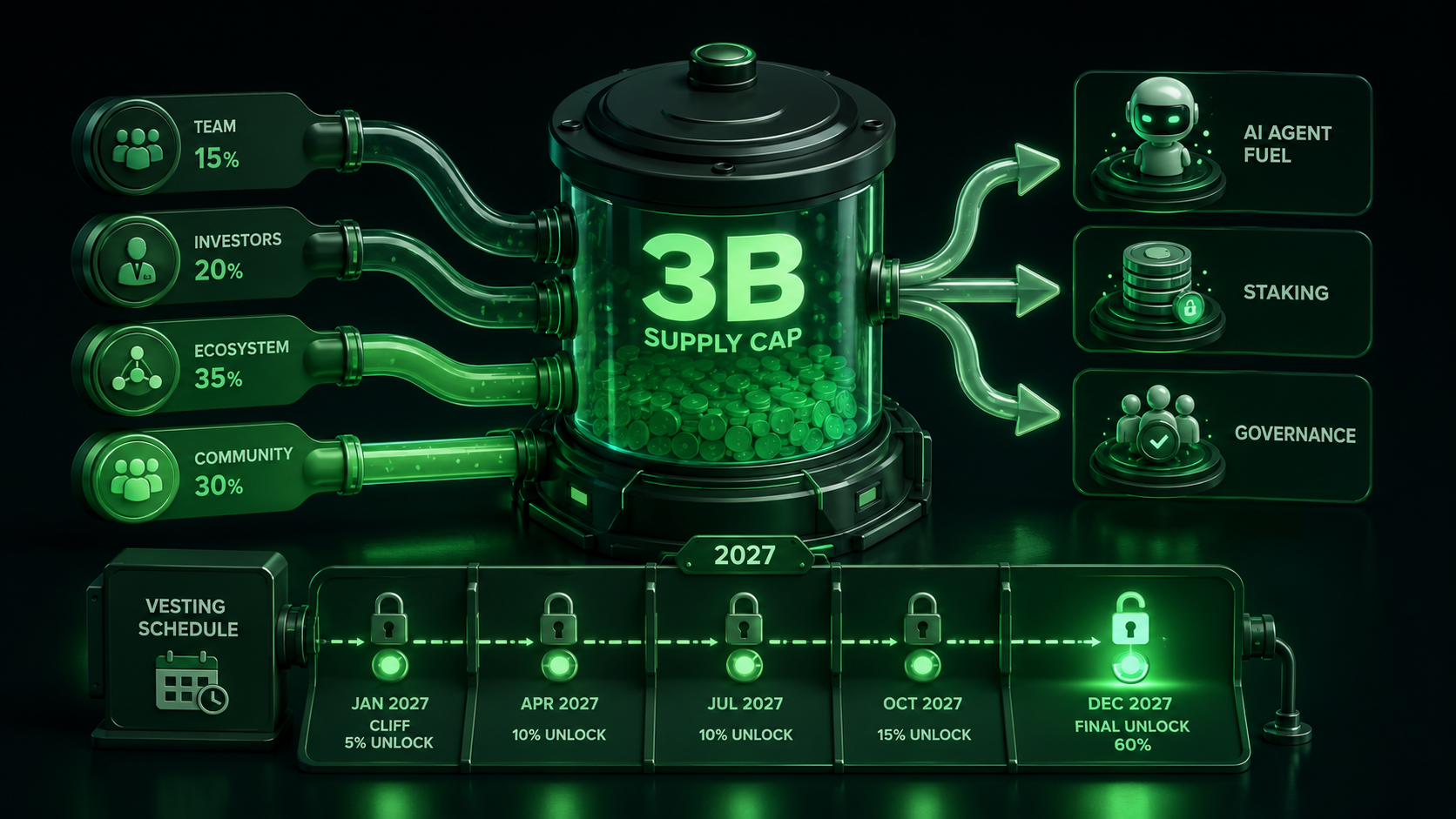
AGI launched with a fixed maximum supply of 3,000,000,000 tokens. No inflation mechanism exists, so the cap is permanent. As of mid-2026, approximately 2,499,462,275 tokens are circulating, representing 83.32% of total supply, per CoinGecko data. The remaining 16.68% releases through scheduled unlocks running into 2027, after which circulating supply equals total supply and emission goes to zero.
The cap matters for a specific reason: most AI-themed tokens issued in 2024 and 2025 came with either uncapped supply or aggressive inflation tied to agent rewards. Those mechanisms create persistent sell pressure that can swamp narrative demand. AGI's fixed cap means once vesting completes, supply growth stops. The value question becomes purely about demand-side adoption rather than absorbing perpetual issuance.
Token Allocation Breakdown
The distribution of total supply across stakeholder categories tells you who controls AGI flows and what incentives shaped the design:
| Category | Share | Total Tokens | Purpose |
|---|---|---|---|
| Treasury | 57% | 1,710,000,000 | Ecosystem grants, development funding, long-term operations |
| Team | 20% | 600,000,000 | Core contributors with multi-year vesting |
| Private Sale | 10% | 300,000,000 | Early seed and pre-seed investors |
| Strategic Sale | 10% | 300,000,000 | Strategic partners, VCs, and platform integrators |
| Market Maker | 2% | 60,000,000 | Liquidity provision across centralized and decentralized venues |
| Airdrop / Community | 1% | 30,000,000 | Retroactive rewards and community programs |
The Treasury share is the headline number. At 57%, it's significantly higher than typical token launches where founders and investors usually claim 40-50% combined. Delysium's allocation pushes that combined founder-and-investor share to 40% while reserving the majority for ecosystem deployment. Whether the treasury is well-managed determines whether that design choice pays off. Tokenomist's full vesting tracker shows the historical release pattern.
The 1% airdrop allocation is notably small. Projects that prioritize airdrops as a user acquisition channel typically reserve 5-15% for community drops. Delysium's lean airdrop reflects a strategic decision to build the user base through Lucy product adoption rather than mercenary farmers, which is consistent with the 1.4 million wallets already connected through actual product usage rather than airdrop campaigns.
Vesting Schedule and Unlock Mechanics
Most of the AGI vesting follows a cliff-then-linear release structure. Team and investor allocations typically have a one-year cliff followed by 24-36 months of monthly unlocks. Treasury releases tend to be programmatic with discretionary acceleration for specific ecosystem grants.
The next material unlocks of 2026 are concentrated in monthly tranches, each releasing approximately 0.5-1.5% of total supply. Historical data shows AGI underperforms the AI token basket by 3-7% in the week leading into known unlock dates and recovers within 14-21 days as the absorbed supply finds long-term holders. This pattern creates a tradeable cycle for active managers and a known headwind for passive holders.
The schedule fully completes in 2027, after which AGI becomes a fully-circulating asset with no ongoing emission. That transition point matters strategically. Tokens with persistent vesting have a structural ceiling on multiple expansion because each unlock dilutes whoever held through the period. Once vesting ends, the token can re-rate based on adoption metrics alone. Patient capital that accumulates during the late-vesting phase often outperforms momentum buyers chasing post-completion narratives.
How Tokenomics Drive AGI's Value Capture
Three utility vectors give AGI demand independent of speculation. Staking is the first: holders lock AGI into the Delysium Multiverse Operator system, earning rewards over flexible 1-12 month periods. Stakers help govern game-world operations and receive boosted yields based on prior platform engagement and DMA holdings. Active staking removes supply from circulation, with rewards vesting 60 days post-completion to discourage immediate dumps.
Governance is the second. AGI holders vote on Delysium protocol parameters, treasury deployment priorities, and roadmap decisions. As the YKILY Network expands, governance scope likely grows to include settlement parameters, agent onboarding standards, and integration priorities. Concentrated voting power in early holders means governance currently flows through the team and major backers, but the treasury share enables progressive decentralization if the team chooses that path.
Settlement utility is the third and most speculative. The YKILY Network is designed for AGI-denominated transactions between AI agents. If autonomous agents proliferate and choose YKILY as their payment rail, every transaction creates marginal AGI demand for gas and settlement. The mechanism resembles how ETH captures value from Ethereum transaction volume, except scaled to machine-to-machine commerce rather than human-driven activity. Whether this utility materializes at scale is the central question for the long-term AGI price thesis.
What AGI Tokenomics Mean for Holders
AGI's tokenomics design favors patient capital. The treasury-heavy allocation, hard supply cap, and time-bound vesting schedule combine to create a structural setup where the largest variable in long-term value is utility adoption rather than supply absorption. Holders who size positions to ride out 2026-2027 unlock cycles position themselves to benefit from the post-vesting re-rate, assuming the AI agent infrastructure thesis plays out as Delysium has architected.
The risks are clear. Treasury mismanagement, slower-than-expected YKILY adoption, or rotation away from the AI agent narrative would all weaken the value capture thesis regardless of how clean the tokenomics look on paper. Tracking treasury deployment quarterly, monitoring developer activity on YKILY, and benchmarking AGI's relative performance against the AI token basket provides the signal-rich framework for assessing whether the design is delivering.
Trade AGI on spot markets or open leveraged positions through AGI perpetual futures on LeveX. Browse Crypto in a Minute for more token tokenomics breakdowns.