
Update, October 2026: LeveX no longer lists Delysium (AGI) for spot or futures trading, so the LeveX trading links in this article have been removed.
Delysium started as an AAA blockchain game and pivoted into something more ambitious: a network where autonomous AI agents can transact, collaborate, and govern themselves on chain. The AGI token powers that network, with a fixed three-billion supply and a roadmap pointing toward an open AI agent economy where bots pay each other for compute, data, and API access without humans in the loop.
What Delysium Builds
Delysium operates two interconnected products that together form the foundation of its AI agent infrastructure. Lucy is the consumer-facing AI agent: a Web3 operating system that turns multi-step blockchain workflows into conversational tasks. Connect a wallet, ask Lucy to bridge tokens, check yields, or swap assets, and the agent executes through a modular skill architecture rather than forcing manual interaction with each protocol.
The deeper layer is the YKILY Network, short for "You Know I Love You." It's a permissionless settlement and communication infrastructure designed for agent-to-agent transactions at machine speed. Where Lucy is one agent that humans talk to, YKILY is the substrate where millions of agents will eventually talk to one another, pay one another, and coordinate without human intervention.
Lucy has accumulated over 1.4 million connected wallets, which gives the platform real distribution heading into the agent economy thesis. Most AI-focused crypto projects have technology and no users, or users and no technology. Delysium has both, which is the foundation that makes the broader YKILY infrastructure viable rather than speculative.
The AGI Token's Role
AGI is an ERC-20 token on Ethereum with a hard cap of 3,000,000,000 tokens. Roughly 83% of supply is already in circulation as of mid-2026, with the full unlock schedule extending through 2027. The token serves three primary functions: staking collateral, governance voting, and settlement currency for transactions within the YKILY Network.
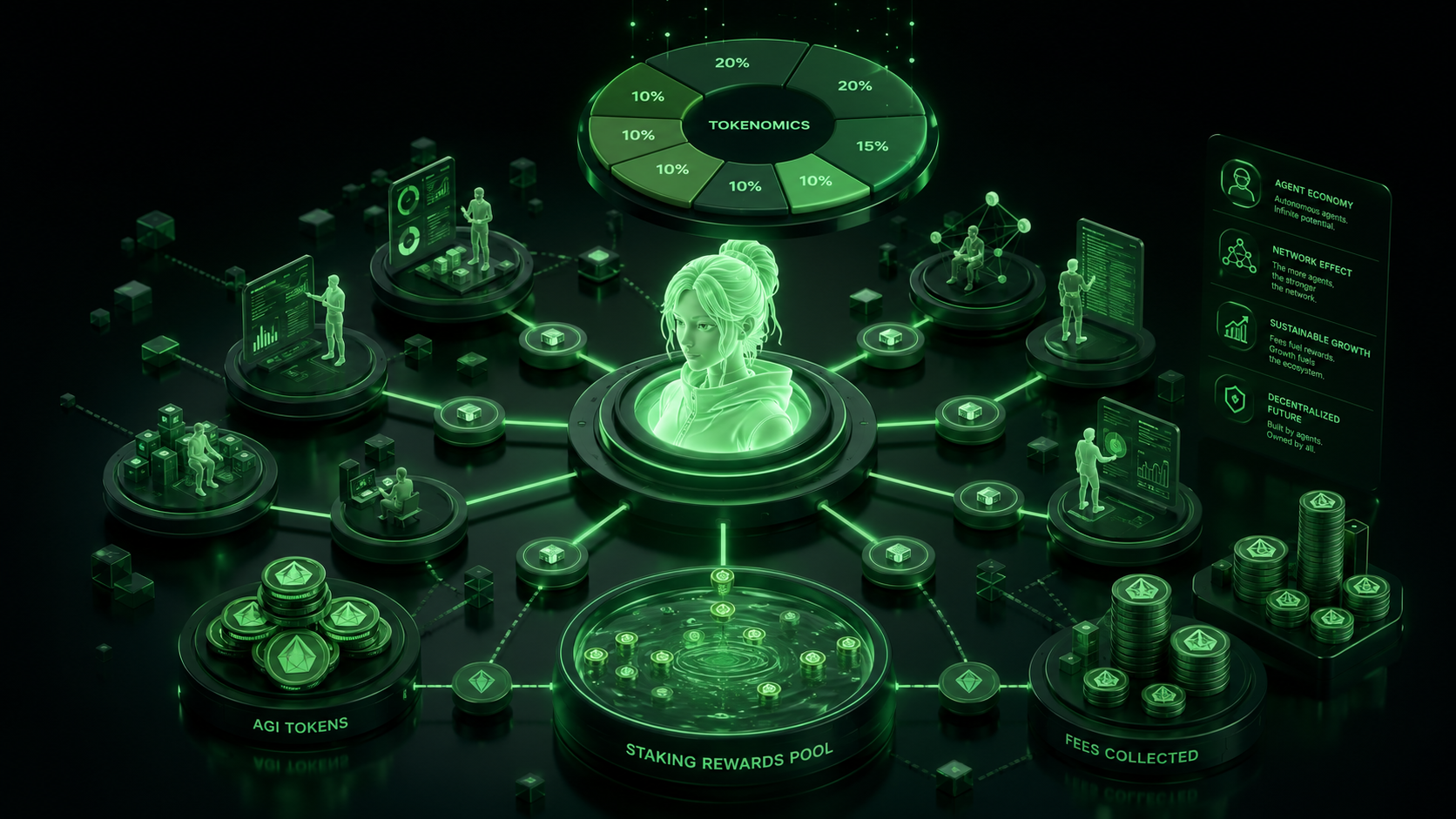
Token allocation breaks down as follows:
| Allocation | Share | Purpose |
|---|---|---|
| Treasury | 57% | Ecosystem growth, development, long-term sustainability |
| Team | 20% | Core contributors with vesting |
| Private Sale | 10% | Early investors |
| Strategic Sale | 10% | Strategic partners |
| Market Maker | 2% | Liquidity support |
| Airdrop / Community | 1% | Community rewards |
The Treasury share is heavy by design. Delysium positions ecosystem funding as the engine that will bootstrap third-party agent developers onto YKILY, the same way early Solana ecosystem grants funded the validators and dApps that later attracted users. Whether that thesis holds depends on agent adoption following the roadmap, but the capital is allocated for the long game rather than founder enrichment.
Lucy and the YKILY Network
Lucy as the Consumer Agent
Lucy combines a conversational interface with executable Web3 skills. A user can ask Lucy to swap tokens, check portfolio balances, hunt for yield opportunities, or interact with DeFi protocols, and the agent handles the routing across underlying chains. The modular skill architecture means new capabilities get added without re-architecting the core agent. A skills marketplace launched in April 2026, letting third-party developers build and monetize their own Lucy skills.
YKILY as the Agent Settlement Layer
YKILY handles the part that humans rarely see: how one autonomous agent pays another for data, compute, or service calls. This is the infrastructure thesis behind Delysium's pivot. As AI agents proliferate across Web2 and Web3, the question of how they transact among themselves becomes the chokepoint. Delysium's bet is that crypto rails are the only natural fit because they support machine-speed settlement, programmable permissions, and global access without bank intermediaries.
The t54.ai partnership integrated the x402 protocol into YKILY in late 2025, giving agents on the network a standard way to handle internet-native payments using HTTP 402 status codes. That integration is the kind of plumbing decision that makes the agent economy thesis real rather than aspirational.
From Gaming Roots to AI Infrastructure
Delysium's origin matters because it explains the network effects. The project launched in 2022 as an AI-powered AAA gaming ecosystem, building Multiverse Operators (DMOs) who help manage virtual worlds and earn AGI rewards through staking. That game-first approach pulled in over a million wallets before AI agents became a crypto narrative.
The 2023 pivot reframed the same infrastructure for a broader market. The DMO system became staking infrastructure for the AI agent network. Lucy emerged as the consumer interface. YKILY became the settlement layer. The user base built during the gaming era became the early adopter pool for the agent economy. Strategic backers including Y Combinator, Galaxy Interactive, Republic Crypto, Polygon, and Antalpha Ventures provided the capital and connections to make the transition work.
Microsoft and Google partnerships from 2023-2024 gave Delysium early access to Web3 product testing inside both companies' cloud ecosystems. Those partnerships positioned the project as the bridge between mainstream AI infrastructure and decentralized agent economics, which is increasingly where the most credible AI crypto projects sit.
Why AGI Matters in 2026
Three structural shifts pull capital toward AI agent infrastructure. Autonomous agents are moving from research demos to commercial deployment, with major AI labs shipping agent products that need payment rails. Regulators in the US and EU are engaging with stablecoin and on-chain payment frameworks that make machine-to-machine settlement viable. And multi-chain expansion is becoming table stakes for AI projects, since agents need to operate wherever their counterparties live.
Delysium addresses all three. The Lucy + YKILY stack covers both the consumer and infrastructure ends of the agent economy. Multi-chain integration with BNB Chain, Base, and Solana is on the active roadmap, expanding AGI's accessibility beyond Ethereum. And the existing user base means the network has something most pre-revenue AI tokens don't: real usage and a feedback loop with builders.
The comparison set matters. ai16z and Virtuals Protocol are the most-cited peers in the AI agent token narrative. Each takes a different angle: ai16z focuses on the DAO governance framework for AI agents, Virtuals focuses on the agent creation marketplace, and Delysium focuses on the underlying settlement and operating system layer. The thesis for AGI specifically is that infrastructure tokens accrue value when the agents above them generate transaction volume, which only happens if the underlying network is permissionless and standards-based.
Frequently Asked Questions about Delysium
What is the AGI token used for?
AGI is the native token of the Delysium ecosystem. It functions as staking collateral for the Delysium Multiverse Operator system, as governance currency for network decisions, and as the settlement asset for transactions within the YKILY Network. Holders can also stake AGI directly to earn rewards.
Is Delysium the same as SingularityNET (AGIX)?
No. SingularityNET uses the ticker AGIX. Delysium uses the ticker AGI and is a separate project building AI agent infrastructure. The two get confused because of the shared terminology, but they have different teams, tokenomics, and product focus.
How is Delysium different from other AI crypto projects?
Most AI tokens fall into one of three categories: agent creation platforms, compute marketplaces, or governance DAOs. Delysium spans two layers at once, Lucy as the consumer agent and YKILY as the agent-to-agent settlement network. An established user base from the gaming era combined with active infrastructure development distinguishes it from pure-narrative AI tokens.
Can I stake AGI to earn rewards?
Yes. Delysium offers single-token AGI staking with flexible lock periods from one to twelve months, plus DMO-based staking that ties rewards to the operator system. Both methods generate AGI rewards that vest over 60 days after the staking period ends. Real-time price data and trading history is available on CoinGecko's AGI page.
How Delysium Fits Into the AI Agent Economy
Delysium occupies a specific position in the AI crypto space: it builds both the consumer-facing agent and the infrastructure that agents need to transact among themselves. That dual-layer architecture is uncommon, and it gives AGI a value capture story that depends on actual usage rather than narrative speculation. The 1.4 million wallets connected to Lucy represent something most AI tokens lack: a real user base feeding back into product development.
The roadmap through 2026 and 2027 will determine whether the AI agent economy thesis plays out. Multi-chain expansion, the Lucy Skills Marketplace, and continued YKILY infrastructure work are the operational signals worth tracking. If autonomous AI agents become commercially viable and need a neutral settlement layer to pay one another, AGI is positioned to capture that flow. If the agent economy stays theoretical, the token will trade on narrative cycles like other AI-themed assets.
Trade AGI on spot markets or open positions through AGI perpetual futures on LeveX. Browse the full Crypto in a Minute library for more token guides covering the AI agent ecosystem and beyond.