
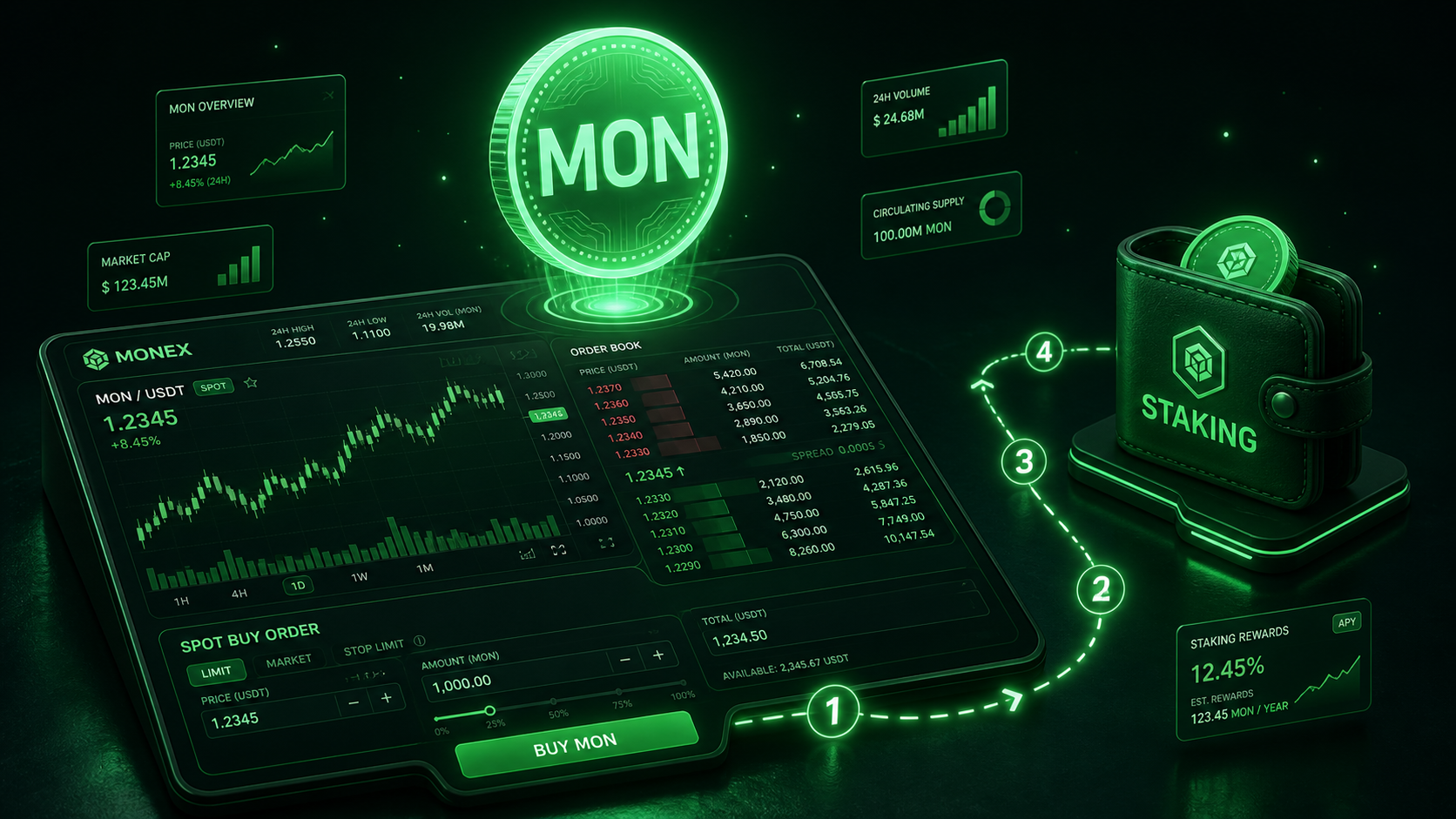
You can buy MON on LeveX in two ways: on the spot market, where you own the tokens outright and can withdraw them to a self-custody wallet, or through perpetual futures, where you take leveraged exposure to price in either direction without holding the asset. Both markets are live, both settle in USDT, and both are reachable from a single LeveX account.
This guide covers the exact steps for each, plus the practical details that decide which one suits your purpose.
What Is Monad?
Monad is a layer 1 blockchain that runs Ethereum smart contracts without modification while executing many of them simultaneously, targeting 10,000 transactions per second with roughly 800 millisecond finality. Mainnet launched on 24 November 2025. MON is the network's native token, used to pay gas and to secure the chain through delegated staking.
The technical distinction is worth understanding before buying. Most high-throughput chains asked developers to abandon the Ethereum toolchain and learn something new. Monad kept the EVM intact and rebuilt consensus, networking, execution scheduling, and state storage underneath it, which is how Monad's parallel execution engine delivers speed while any existing Solidity contract deploys unchanged.
Two facts shape MON as a trading instrument. First, the MON supply and unlock schedule puts roughly 47 billion tokens behind a cliff that expires in November 2026, so scheduled supply expansion runs for years. Second, the network has real usage rather than only a specification, with total value locked around $408 million by May 2026 across the applications building on Monad.
Buying MON on the Spot Market
Spot purchases give you the tokens themselves. Use this route if you want to hold MON, withdraw it, stake it, or use it on-chain.
- Create and verify your account. Register on LeveX and complete verification. This takes a few minutes and unlocks deposits and withdrawals.
- Fund your account. Deposit crypto from another wallet or exchange, or use the Buy Crypto on-ramp to fund with a card or bank transfer. USDT is the quote currency for the MON pair.
- Open the MON market. Navigate to the MON/USDT spot pair, or find it through the markets overview.
- Choose your order type. A market order fills immediately at the best available price. A limit order fills only at the price you set, which is the better choice for a token with MON's volatility if you have a target entry in mind.
- Enter the amount and confirm. Review the total cost including fees, then place the order. Placing your first spot trade walks through the interface in detail if this is new to you.
- Decide where the tokens live. Leave them on LeveX if you plan to trade the position, or withdraw to self-custody if you plan to hold. The wallet options for storing MON are the standard EVM set, since Monad uses ordinary Ethereum addresses.
One thing worth knowing after you buy: MON held in a self-custody wallet can be delegated to a Monad validator for roughly 13% annualized. Exchange balances cannot be delegated, so staking MON requires the withdrawal step first.
Trading MON Perpetual Futures
Perpetual contracts track MON's price without an expiry date and allow both long and short positions with leverage. Use this route for directional trading, hedging a spot holding, or taking a short view.
- Move funds to your futures wallet. Use the internal transfer between spot and futures wallets. Transfers are instant and free.
- Open the MON contract. Go to MON perpetual futures and review the contract details, including the current funding rate and available leverage tiers.
- Set leverage deliberately. Higher leverage shrinks the price move needed to liquidate you. If you have not sized a leveraged position before, read margin and leverage before choosing a multiplier.
- Pick a direction and place the order. Long profits from price increases, short from decreases. Opening a futures position covers the order entry flow.
- Set exits at the same time as entry. Attach a stop loss and take profit when you open the position rather than after. This is the single habit that separates traders who survive volatility from those who do not.
- Monitor funding. Perpetuals charge or pay funding fees periodically depending on which side is crowded, which matters for positions held over days rather than hours.
Leveraged MON positions demand a view on where the token is heading and why. The MON price outlook through the unlock period sets out the ranges analysts are working with and the variables that decide them, which is a more useful input than a chart pattern.
Why Trade MON on LeveX
Spot and perpetual markets sit in one account, so you can hold MON, hedge it with a short, and move collateral between the two without withdrawing anywhere. That matters for a token with scheduled unlock events, where the ability to hedge a long-term holding without selling it is worth having.
Multi-Trade mode allows several independent positions on the same contract, each with its own leverage, margin, stop loss, and target. Traders running a core long alongside tactical shorts around unlock dates can do it in one place instead of splitting across accounts. The Multi-Trade guide explains how the positions are isolated from each other.
Fees follow a published tier structure that improves with volume and VIP level, and LeveX publishes 1:1 Proof of Reserves through a Merkle tree so balances are verifiable rather than asserted.
MON Buying Questions
What is the minimum amount of MON I can buy on LeveX?
Spot minimums are set by order value in USDT rather than by token count, so the practical minimum is a small USDT amount visible in the order entry panel. Futures minimums depend on the contract's minimum order size and your chosen leverage.
Can I buy MON with a credit card?
Yes. The Buy Crypto on-ramp lets you fund your account with a card or bank transfer, typically into USDT, which you then use to buy MON on the spot market. Availability of specific payment methods depends on your region.
Is MON available for both spot and futures trading?
Yes. MON trades as a spot pair against USDT and as a USDT-margined perpetual contract. Both are accessible from the same LeveX account, and funds move between spot and futures wallets instantly with no fee.
Choosing Between Holding and Trading MON
The choice between spot and futures comes down to what you want from the position. Spot suits a multi-year view on Monad converting its execution advantage into durable network activity, and it is the only route if you intend to stake or use MON on-chain. Futures suit shorter horizons, hedging, and any view that requires being short.
Whichever you choose, size the position for a token that has scheduled supply increases ahead of it and a short trading history. The comparison between Monad and Solana is a useful reference point for what a mature version of this asset class looks like and how far MON still has to travel.
Ready to start? Open the MON spot market to buy and hold, or the MON perpetual contract for leveraged exposure. For background on other assets, Crypto in a Minute has the full guide library.