
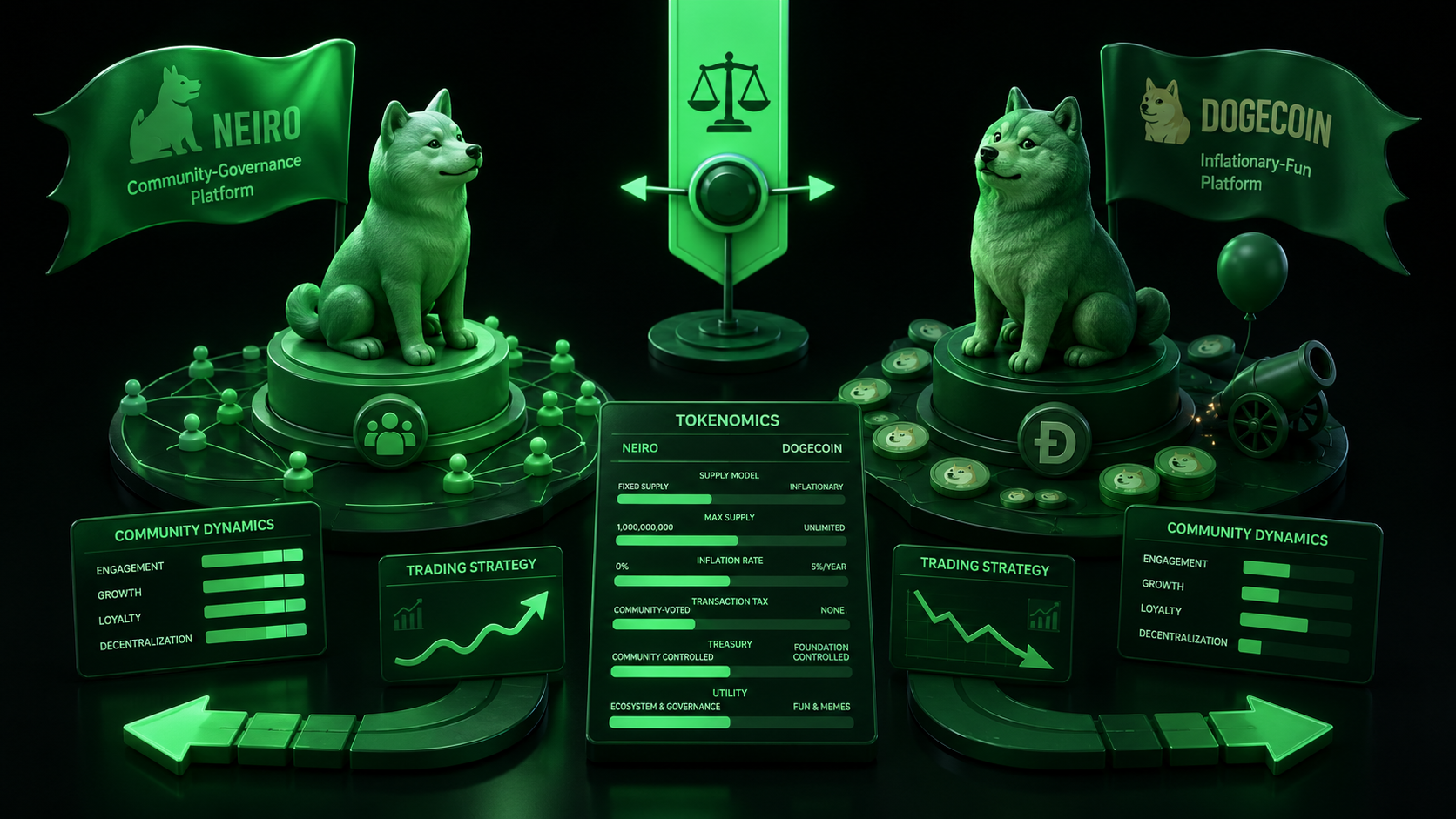
When meme coins captured the cryptocurrency spotlight, they did so with distinct personalities and purposes. NEIRO, the modern ERC-20 tribute to Kabosu's successor dog, represents a decentralized community-first approach to crypto culture. Dogecoin, the original joke coin from 2013, evolved into something more substantial while maintaining its whimsical roots. These two tokens share the "meme coin" label but diverge significantly in execution, tokenomics, and market trajectory. Understanding their differences matters whether you're evaluating long-term holds or analyzing trading opportunities through spot or futures markets.
From Doge to NEIRO: The Origin Stories
Dogecoin emerged in December 2013 as a parody of Bitcoin's serious tone and the broader crypto boom. Its creator, Jackson Palmer, wanted to mock the wild speculation plaguing early cryptocurrency. The irony: Dogecoin would eventually demonstrate genuine utility and community power. The coin adopted the Shiba Inu meme as its mascot, paired with broken English ("such coin," "very amaze"), and built an unexpectedly resilient following that would sustain it through bull and bear markets for over a decade.
NEIRO's origin story follows a different arc. Launching as an ERC-20 token on Ethereum, it was inspired by Neiro, the Shiba Inu that succeeded the famous Kabosu as the dog behind the iconic meme. When the original NEIRO developer abandoned the project, something remarkable happened: the community assumed ownership rather than letting it die. This community takeover represented a philosophical moment. NEIRO became truly decentralized through necessity, with token holders collectively stewarding its direction.
The contrast is striking. Dogecoin began as satire but attracted serious developers and became a legitimate payment network. NEIRO started with anonymous launch mechanics but evolved into grassroots community governance. Both origin stories resonate with crypto enthusiasts who value decentralization, yet they achieved it through opposite paths.
Tokenomics: Inflation Versus Scarcity
NEIRO operates with a fixed supply of 420.69 billion tokens, a number chosen deliberately to reflect meme culture's irreverent spirit. Its token structure includes 0% transaction tax and fully renounced ownership, meaning no developer holds backdoor control. This creates a truly decentralized asset where changes require community consensus rather than unilateral decisions from founders.
Dogecoin employs an inflationary model that many in crypto view with skepticism. Approximately 5.256 billion new DOGE enter circulation annually, representing controlled but ongoing inflation. This differs from Bitcoin's fixed 21-million-coin cap or Ethereum's dynamic supply. Dogecoin's inflationary nature was intentional: Palmer wanted to prevent hoarding and encourage spending. In practice, this inflation has become negligible as a percentage of the growing total supply, though it ensures Dogecoin can never be truly scarce in the way Bitcoin maximalists envision.
For traders and investors, these tokenomics tell different stories. NEIRO's fixed supply creates potential scarcity value, assuming adoption grows. Dogecoin's inflation actually supports its use-case philosophy: if it's meant for payments and transactions, inflation discourages hoarding and provides ongoing rewards for network participants. The market has responded differently to each model. Bitcoin's scarcity drives demand, Dogecoin's inflation hasn't prevented significant price appreciation, and NEIRO's fixed supply hasn't guaranteed growth given its smaller market footprint.
Market Position and Scale
The market cap gap between these tokens reveals their different trajectories. Dogecoin maintains a multi-billion dollar valuation, having peaked well above $80 billion during bull markets. Its sustained presence in exchange listings and trading pairs reflects institutional and retail recognition. NEIRO, by contrast, peaked at approximately $1.18 billion in market capitalization during November 2024 but has since contracted to roughly $30 million. This dramatic difference reflects both its youth and the broader altcoin market cycles.
This disparity exists because Dogecoin benefited from early adoption, sustained community building, and multiple celebrity endorsements (most notably from Elon Musk). Its payment integrations (from Tesla's brief acceptance period to ongoing merchant adoption) demonstrate real-world utility beyond speculation. NEIRO remains primarily speculative, with value derived almost entirely from community sentiment and potential future developments.
For traders evaluating risk profiles, Dogecoin represents the "safer" meme coin play: larger liquidity, longer track record, and more predictable price action relative to total volatility. NEIRO appeals to those pursuing higher-risk, higher-reward scenarios. Current pricing shows NEIRO trading around $0.00007, with limited daily volume compared to Dogecoin's established trading infrastructure across major exchanges.
Community Dynamics and Decentralization
Dogecoin's community emerged organically and persists through genuine engagement rather than forced governance structures. Its subreddit, tip economy (using the DogeBot), and meme-sharing culture created network effects that sustained interest across two market cycles. The community didn't need token governance because participation required minimal barriers. You could embrace Doge simply by holding it, trading it, or spreading its philosophy.
NEIRO's community operates under different constraints and advantages. The forced decentralization (ownership renounced, no founder control) means change proposals require actual community coordination rather than top-down decisions. This creates higher participation friction but potentially greater legitimacy in governance decisions. Early NEIRO holders functioned as stewards rather than speculators, though market contraction has tested community commitment.
Both communities value the "for the people" narrative central to cryptocurrency ideology. Dogecoin proved this philosophy could sustain for years without VC backing or venture prestige. NEIRO's community takeover demonstrated that decentralization can emerge from crisis. Where Dogecoin benefits from network effects accumulated over a decade, NEIRO benefits from first-mover advantage in the Kabosu-successor meme space, though how valuable that niche proves remains uncertain.
Use Cases and Adoption
Dogecoin's use case evolution illustrates meme coins' potential sophistication. While born as satire, it developed genuine payment-processing integrations, mining infrastructure (merged with Litecoin), and merchant adoption. You can theoretically purchase real goods with Dogecoin, use it as a tipping mechanism, or transfer value internationally with minimal friction. This functional utility separated it from pure speculation coins.
NEIRO currently lacks comparable adoption infrastructure. Its Ethereum base gives it access to DeFi protocols and layer-2 solutions, but no major merchant integrations exist. Its use case remains almost entirely speculative. Value derives from holder community sentiment, potential future announcements, and trading activity on decentralized exchanges.
This distinction matters for different trading perspectives. Dogecoin's payment use case provides a floor of fundamental utility; even if speculation subsides, Doge maintains transaction value. NEIRO's value depends on sustained interest in the meme coin category and its specific Neiro connection. For spot trading NEIRO, this means higher volatility but also potentially higher returns in bull markets. For futures positions, the leverage magnifies both direction and risk.
Comparing Other Major Tokens in the Crypto Space
To contextualize both meme coins within broader crypto markets: Bitcoin remains the foundational store-of-value narrative, Ethereum provides the smart contract infrastructure enabling tokens like NEIRO, and PEPE emerged as another ERC-20 meme token pursuing similar community-driven positioning. Dogecoin itself deserves recognition as the original meme-to-legitimacy success story, while NEIRO pursues a different path through forced decentralization rather than organic development.
Trading Considerations: Which Fits Your Strategy
Dogecoin suits longer-term accumulation strategies, range-trading around established support levels, and traders comfortable with 2-3 year holding periods. Its relative stability (compared to microcaps like NEIRO) and multiple exchange listings make it accessible for dollar-cost averaging. For larger positions, Dogecoin's liquidity prevents significant slippage.
NEIRO attracts momentum traders, those pursuing breakout strategies, and investors betting on renewed interest in community-governed tokens. Its lower market cap means larger percentage moves on modest volume. For those exploring NEIRO futures trading, leverage amplifies both profit and loss potential. Recent price action suggests NEIRO holders are either long-term believers in eventual recovery or traders opportunistically playing support levels.
The NEIRO price prediction article provides additional technical analysis if you're planning positions, though meme coins resist traditional forecasting given their sentiment-driven nature.
Comparison Table: Quick Reference
| Factor | NEIRO | Dogecoin |
|---|---|---|
| Launch Year | 2024 | 2013 |
| Blockchain | Ethereum (ERC-20) | Proof-of-Work (merged with Litecoin) |
| Total Supply | 420.69 billion (fixed) | Unlimited (inflationary ~5.25B annually) |
| Market Cap | ~$30 million | $25+ billion |
| Current Price | ~$0.00007 | $0.15-0.30 (varies by cycle) |
| Peak Market Cap | ~$1.18B (Nov 2024) | $90B+ (bull markets) |
| Governance | Community-led (dev abandoned) | Community-organic (no formal DAO) |
| Use Cases | Primarily speculative | Payments, tipping, mining rewards |
| Tax Structure | 0% transaction tax | No transaction tax |
| Merchant Adoption | Minimal | Established integrations |
The Decentralization Paradox
An interesting dynamic emerges when comparing these tokens: NEIRO achieved technical decentralization through abandonment, while Dogecoin achieved practical decentralization through community adoption despite potential founder influence. Which represents "more decentralized" cryptocurrency depends on your definition. NEIRO's renounced ownership and fixed supply create immutability that code-enforces decentralization. Dogecoin's developer community and volunteer-run infrastructure create decentralization through consensus rather than smart contracts.
This paradox matters for assessing long-term viability. Immutability (NEIRO's approach) prevents bad actors from modifying token contracts but also prevents legitimate improvements. Organic community governance (Dogecoin's approach) allows adaptation but requires trust in community judgment. Over ten years, Dogecoin's approach proved sufficient; NEIRO's approach remains untested across full market cycles.
Why Meme Coins Persistently Matter
Both tokens challenge the notion that cryptocurrency requires serious use cases to maintain value. Dogecoin's decade-plus survival suggests community belief can sustain asset value independent of founders. NEIRO's community takeover and recovery from abandonment suggests decentralization mechanisms work even in crisis scenarios. For retail traders and investors seeking alternatives to traditional finance, these tokens demonstrate that cryptocurrency enables value creation around shared memes, inside jokes, and community membership.
This doesn't mean meme coins are reliable investments or suited for conservative portfolios. Rather, they represent a genuine category where supply/demand dynamics, cultural relevance, and community strength directly impact price. Both NEIRO and Dogecoin have holders who view them as meaningful assets worth serious capital allocation.
Trading and Investing Paths Forward
Dogecoin remains the meme coin with established infrastructure, proven staying power, and multiple integration points across the broader crypto ecosystem. Its inflationary tokenomics that once concerned maximalists have proven essentially irrelevant. DOGE persists despite inflation because community belief sustains it.
NEIRO represents a newer experiment with decentralized governance and fixed supply. Its lower market cap and trading volume create both opportunity and risk. For traders seeking exposure, both tokens are accessible through major exchanges; NEIRO specifically offers spot and futures trading opportunities for directional plays and leverage strategies.
Why NEIRO vs Dogecoin Matters
The broader significance lies in how each token answered a question about cryptocurrency's future. Dogecoin proved that jokes could outlast serious cryptocurrencies if backed by genuine community. NEIRO is testing whether abandoned projects can survive through pure community takeover. Understanding their differences illuminates fundamental questions about decentralization, tokenomics, and what actually sustains cryptocurrency value.
Whether you're accumulating Dogecoin for its established utility or exploring NEIRO's community governance, understanding each token's philosophy shapes better trading decisions. For active traders, spot trading NEIRO-USDT provides direct exposure for longer-term holds, while NEIRO futures on LeveX enable directional bets with controlled risk. Check out Crypto in a Minute for ongoing market analysis and position yourself within the broader meme coin ecosystem reshaping crypto culture.