
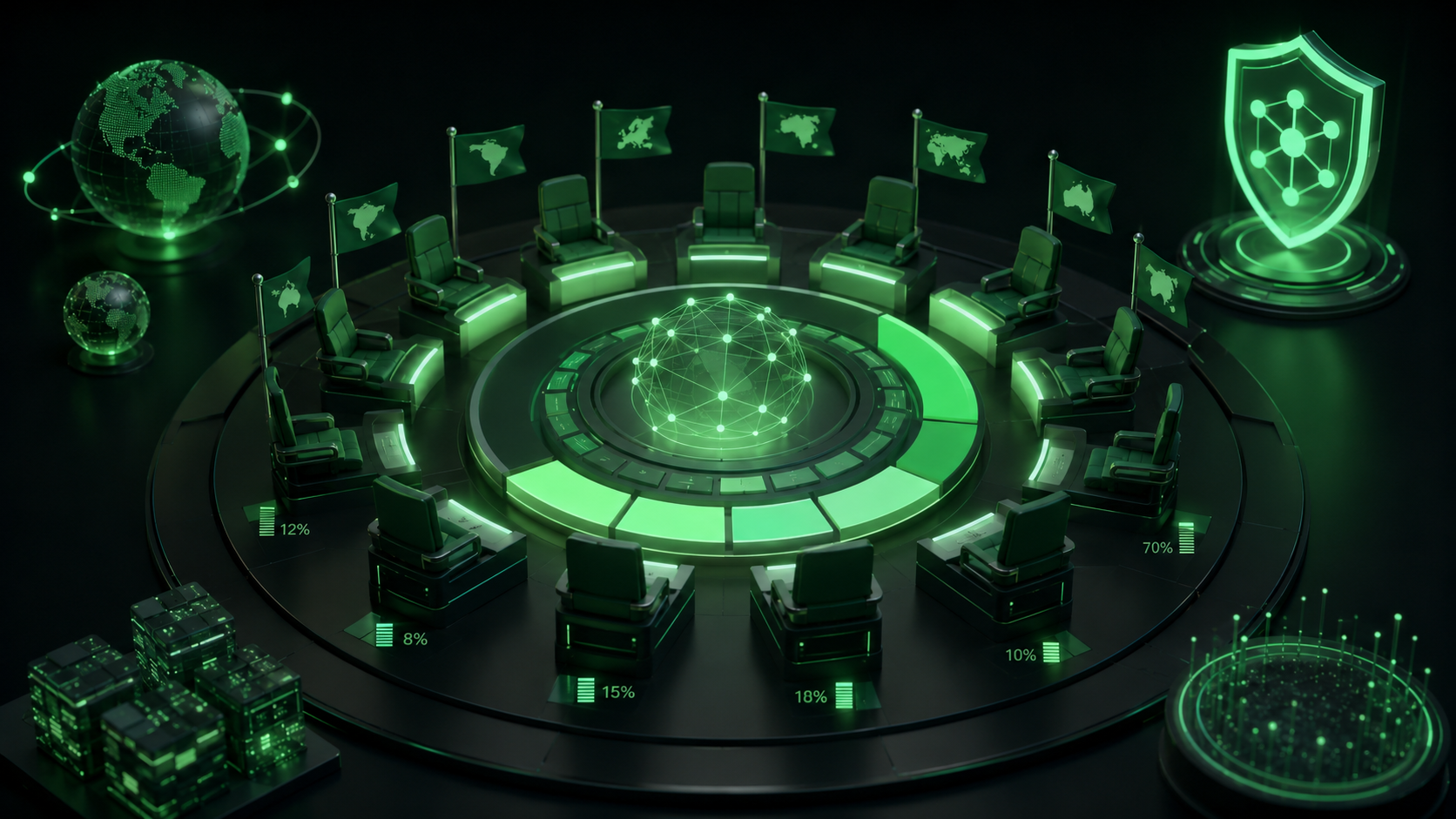
Most blockchains let anonymous participants run nodes and vote on protocol changes. Hedera took a radically different path, establishing a governing council of multinational corporations, universities, and technology leaders that collectively manage network operations. This structure, inspired by Visa's original 1968 governance model, creates accountability rarely found in decentralized systems while raising questions about what "decentralization" truly means.
What Is the Hedera Council?
The Hedera Council (formerly called the Hedera Governing Council) is a body of up to 39 global organizations responsible for operating network nodes, managing the HBAR treasury, and steering strategic development. Each member holds equal voting rights regardless of company size or industry influence.
As of 2025, the council includes 31 members spanning technology, finance, telecommunications, energy, and academia. Notable participants include Google, IBM, Dell, Boeing, Standard Bank, Deutsche Telekom, LG Electronics, Chainlink Labs, and Ubisoft. Academic institutions like the London School of Economics and University College London provide research perspectives alongside corporate members. According to Messari's network analysis, the geographic distribution includes nodes across every continent except Antarctica.
The diversity aims to prevent any single industry or geography from dominating decisions. Members span North America, Europe, Asia-Pacific, Africa, and South America, creating what Hedera calls "collusion-proof governance" through distributed oversight.
Council Responsibilities
Members accept two primary obligations when joining the council:
Network Node Operation: Each council member runs a consensus node that validates transactions and writes to the network. This permissioned approach ensures that only vetted organizations manage critical infrastructure, protecting against malicious actors attempting to compromise network integrity. Nodes are distributed across multiple continents and cloud providers for geographic resilience.
Governance Participation: Members contribute expertise to decisions affecting software updates, network pricing, treasury allocation, and regulatory compliance. Specialized committees handle specific domains:
| Committee | Focus Area |
|---|---|
| Technical Steering & Product | Network functionality, stability, security |
| Treasury Management & Coin Economics | HBAR allocation, pricing structures |
| Legal & Regulatory | Compliance frameworks, policy engagement |
| Membership | Recruitment, selection criteria, retention |
How Governance Decisions Work
The council operates through a limited liability company (LLC) agreement that defines voting thresholds for different decision types. According to Hedera's official governance documentation, major decisions require member consent at varying levels based on impact.
Routine operational matters proceed with simple majority approval. Significant changes to network parameters or treasury policies typically require supermajority consent. Modifications to the total HBAR supply, capped at 50 billion tokens, require unanimous agreement from all council members.
The Hedera Improvement Proposals (HIPs) process allows anyone to suggest protocol changes. Community members draft proposals, discuss them publicly on GitHub, and refine specifications through open feedback. However, material changes ultimately require council review and voting before implementation, balancing community input with accountable decision-making.
Term Limits and Rotation
Unlike permanent board seats at traditional corporations, council membership carries strict term limits. Members serve three-year terms with a maximum of two consecutive terms permitted. After stepping away, former members may rejoin following a three-year waiting period.
This rotation mechanism prevents entrenchment while allowing continuity. Swirlds, the company that developed the hashgraph algorithm, maintains a permanent seat but holds equal voting weight with other members. Recent additions include:
- Blockchain for Energy (June 2025): Energy consortium focused on sustainability reporting
- COFRA Holding: 182-year-old family business with supply chain tokenization interests
- Arrow Electronics: Global technology distributor building supply chain solutions
- Chainlink Labs: Oracle infrastructure provider connecting smart contracts to real-world data
Treasury Management
The council oversees allocation of the 50 billion total HBAR supply. Treasury reports published quarterly detail how tokens flow to different purposes, including network operations and governance compensation, ecosystem development grants through the Hedera Foundation, purchase agreements from regulated token sales, and open-source development incentives.
Transparency around treasury management distinguishes Hedera from projects where token allocation remains opaque. Public reporting allows stakeholders to track how resources support network growth and whether allocation aligns with stated priorities.
The Decentralization Debate
Critics argue that council governance contradicts blockchain's decentralization ethos. Nodes run exclusively by approved members means ordinary users cannot participate in consensus. Corporate control, even when distributed across 31+ organizations, differs fundamentally from truly permissionless networks where anyone can validate transactions.
Supporters counter that permissioned validation provides enterprise-grade accountability. When Boeing or Standard Bank operates a node, their corporate reputation stakes on network reliability. Anonymous validators lack comparable skin in the game. For institutional adoption, knowing exactly who maintains network infrastructure may matter more than theoretical openness.
Hedera's roadmap includes three phases of decentralization. The current permissioned model represents phase one. Future phases will invite additional node operators beyond council members and eventually transition to fully permissionless participation once security and economic incentives mature sufficiently.
Why It Matters for HBAR
Council composition directly affects HBAR's investment thesis. Each new member announcement signals enterprise validation and potentially new use cases being developed on the network.
The presence of financial institutions like DBS Bank, Shinhan Bank, and Standard Bank suggests serious exploration of tokenization and cross-border payment applications. Technology giants like Google and IBM bring credibility that smaller projects struggle to match. Gaming company Ubisoft hints at entertainment and digital asset applications.
From a hashgraph versus blockchain perspective, the council model represents a deliberate architectural choice. Hedera trades pure decentralization for governance clarity, regulatory friendliness, and enterprise comfort. Whether this trade-off proves wise depends on which market segments drive blockchain adoption over the coming decade.
Joining the Council
Organizations interested in council membership must meet predetermined criteria approved by existing members. Evaluation considers industry leadership, technical expertise, geographic diversity, and alignment with Hedera's mission. Prospective members require majority approval from current council members.
The council recently introduced Strategic Partner and Community Partner categories for organizations seeking formal ecosystem participation without full membership obligations. These tiers expand engagement opportunities while maintaining governance integrity.
Implications for Enterprise Adoption
The council structure addresses specific enterprise concerns that permissionless networks struggle to satisfy. Regulated industries require knowing who operates infrastructure handling sensitive transactions. Compliance teams need clear accountability chains when incidents occur. Procurement processes demand identifiable counterparties rather than anonymous collectives.
Hedera's governance provides these assurances while maintaining network openness for application development. Anyone can build on Hedera, deploy smart contracts, or create tokens. The permissioned layer applies only to consensus node operation, not platform access.
A Different Vision of Decentralization
Hedera's council model won't satisfy blockchain purists who view any permissioning as fundamentally compromised. Yet for enterprises evaluating distributed ledger adoption, the governance structure provides exactly the accountability and stability their risk frameworks require.
Whether this corporate-friendly approach captures the enterprise market while competitors race toward maximum decentralization will significantly impact HBAR's trajectory. The council members betting their reputations on Hedera's success represent a unique governance experiment in public networks.
Trade HBAR on spot markets or futures contracts on LeveX. Explore our Crypto in a Minute guides to understand more about how blockchain governance structures affect long-term network value.