
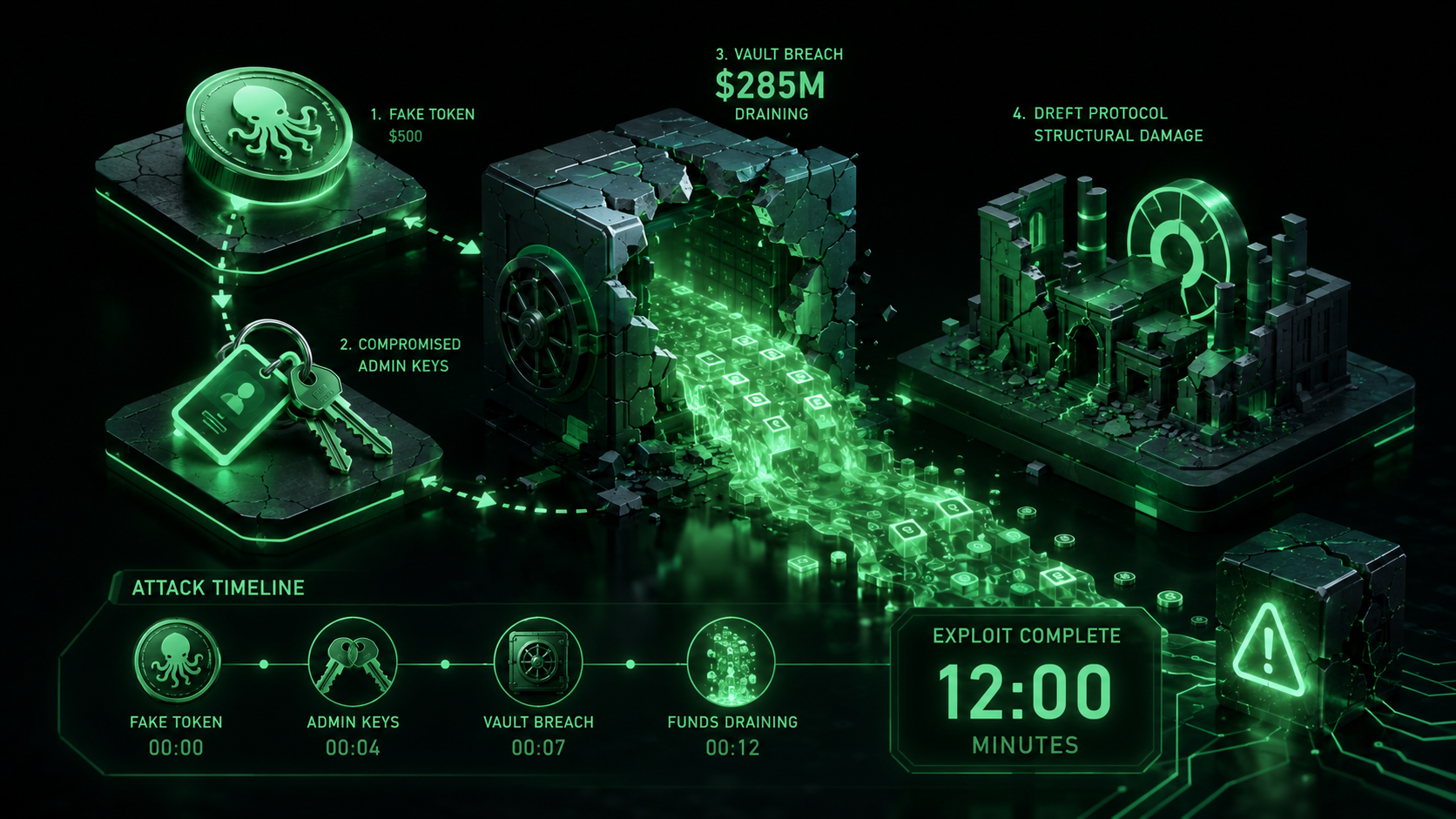
On April 1, 2026, an attacker spent twelve minutes emptying Drift Protocol. By the time the multisig signers realized what was happening, $285 million in user assets had moved across 31 withdrawals, making it the largest DeFi exploit of the year and the second-largest in Solana's history. The cruel joke, and the part nobody in crypto finds funny, is that the entire heist was bankrolled by a $500 liquidity seed the attacker planted weeks earlier.
The Anatomy of a Patient Attack
Most DeFi exploits get written about as if they happened in an instant. Drift happened over roughly three months, most of it invisible. According to TRM Labs and Elliptic, the operation is attributed to DPRK-linked actors, consistent with techniques observed in previous North Korean operations against crypto infrastructure.
Here's how it worked, broken into its three component layers:
Layer 1: Manufacture a fake asset. The attacker created a token called CarbonVote Token (CVT), minted 750 million units, and seeded a Raydium liquidity pool with about $500. They then wash-traded it for weeks to build a credible price history near $1 per token. This is the patient part. Price histories are how oracles decide what an asset is worth, and a few months of consistent wash trading is indistinguishable from organic liquidity from the outside.
Layer 2: Get the oracle to notice. Drift's market feed relied on Switchboard, which picked up the artificial CVT price once it had enough trading history to register as a legitimate asset. The oracle worked exactly as designed, and that's precisely the problem. Price feeds are trust systems pretending to be objective measurements, and trust systems can always be gamed by participants patient enough to perform legitimacy for long enough.
Layer 3: Burn through the last line of defense. On April 1, the attacker used a compromised admin key to list CVT as a valid market on Drift and simultaneously raised withdrawal limits to levels that effectively eliminated them. Then they deposited hundreds of millions of CVT tokens (worth exactly $500 of real liquidity) as collateral, used that inflated position to borrow against real assets, and withdrew USDC, JLP, and other legitimate tokens across 31 transactions in 12 minutes.
What Actually Broke
The smart contracts worked. The oracle worked. The multisig worked, at least in the sense that the signatures it required were valid. Every component of Drift's security stack performed its stated function, and the protocol still lost $285 million.
The failure was in the assumptions each layer made about the other layers. The oracle assumed the liquidity it was reading from Raydium was real economic activity. The governance process assumed admin keys wouldn't be compromised. The withdrawal limits assumed the admin who could modify them wouldn't suddenly decide to modify them at 3 AM on a Tuesday. And nowhere in the stack was there a timelock, the simple "wait 24 hours before executing this action" guardrail that would have given the rest of the team time to notice something was wrong and intervene.
Timelocks are not a complex or expensive technology. They're about 50 lines of code that any competent Solidity or Rust developer can write in an afternoon. The reason Drift didn't have them on critical admin actions is the same reason most DeFi protocols don't: they slow down development and make emergency responses harder. Right up until the moment you need them, they look like friction. The moment after, they look like the only thing that might have saved you.
The LeveX Take
The Drift exploit is the cleanest case study to date for a question the DeFi industry keeps dodging: what does "trustless" actually mean when every layer of your stack relies on assumptions about the other layers? A smart contract audit wouldn't have caught this. A bug bounty wouldn't have caught this. The attack was a governance-and-social-engineering operation dressed up in DeFi clothes, and those vectors are almost completely outside the scope of what "DeFi security" typically covers.
For traders, the practical takeaway is harder than "avoid unaudited protocols." Drift had been audited, had established governance, and still saw its TVL collapse from roughly $550 million to under $250 million within 24 hours of the hack. That's its own lesson about how fast confidence evaporates. The useful distinction is between protocols where the security model is transparent and verifiable, and protocols where users are trusting that nothing has gone wrong behind the scenes. LeveX publishes 1:1 Proof of Reserves via Merkle Tree, with BTC reserves at 111%, ETH at 149%, and USDT at 160%, meaning every user can independently verify that their deposits are backed by real assets in cold storage. This goes beyond the tired DeFi-vs-CeFi framing. It speaks directly to the specific failure mode Drift illustrated: when verification happens elsewhere, users are trusting the verifiers, and verifiers can be compromised.
What Protocols Will Actually Change
Expect the post-mortem wave on Drift to drive a few specific changes across Solana DeFi: mandatory timelocks on admin functions at major protocols, stricter oracle whitelisting (no new markets without independent liquidity proof), and more aggressive withdrawal rate limits that can't be modified by admin keys in real time. These are the boring, unglamorous fixes that would have stopped the attack entirely.
The harder question is whether DeFi users will actually demand these changes or drift back to the protocols with the best yields. History suggests the second, which is exactly why the third Drift-style exploit is probably already in the wash-trading stage right now, waiting for its moment.
Trade on a transparent exchange with verifiable reserves. Explore spot and futures markets on LeveX, or browse the Crypto in a Minute token catalog.