

The most telling detail in Google's crypto custody launch sits in a changelog, a few lines below the headline. On October 1, weeks before anyone wrote about the product, Google quietly added rules that let its policy engine read Bitcoin transaction amounts, classify destination address types and detect change outputs. That is the kind of feature you only build after a bank's compliance team has asked, in writing, how it is supposed to stop a junior trader from sweeping a wallet to the wrong address.
A Custody Product That Already Has a Customer
The service is called Google Multi-Party Compute, and it is in private preview with commercial availability targeted for early 2027, according to Finance Magnates. Google refreshed its documentation on October 26, two days before an MPC symposium in New York with speakers from Morgan Stanley, Citi and Wells Fargo. Several financial institutions are testing it, unnamed. No pricing has been published.
The customer that is named is Alphabet itself, which uses the system to secure its own digital assets on Ethereum and Solana. Google has not said what those assets are or what they are worth, which is a very Google way to announce that one of the largest companies on earth holds crypto.
How the Key Gets Split
A single private key is a single point of failure. Whoever holds it can move the funds, and whoever steals it can do the same. The industry has spent a decade trying to remove that point, and the three main approaches trade different risks against each other.
| Approach | How signing works | What an outsider can see | Where it breaks |
|---|---|---|---|
| Single key (often in an HSM) | One key signs everything | A normal single-signature address | Theft or loss of that one key |
| Onchain multisig | Several full keys each sign; the chain checks the count | The signing policy, published on the chain | The interface signers use to approve |
| MPC | Key shares jointly compute one signature; the full key never exists | A normal single-signature address | The coordination software and policy engine |
MPC is the approach Google picked. Each party holds a share of the key, and a predefined number of shares must cooperate to produce a signature, while the complete key is never assembled anywhere. Unlock Blockchain describes a bank splitting shares between its own hardware, Google Cloud and a third provider, with a policy engine checking each request against transfer limits and approved destinations before anyone signs.
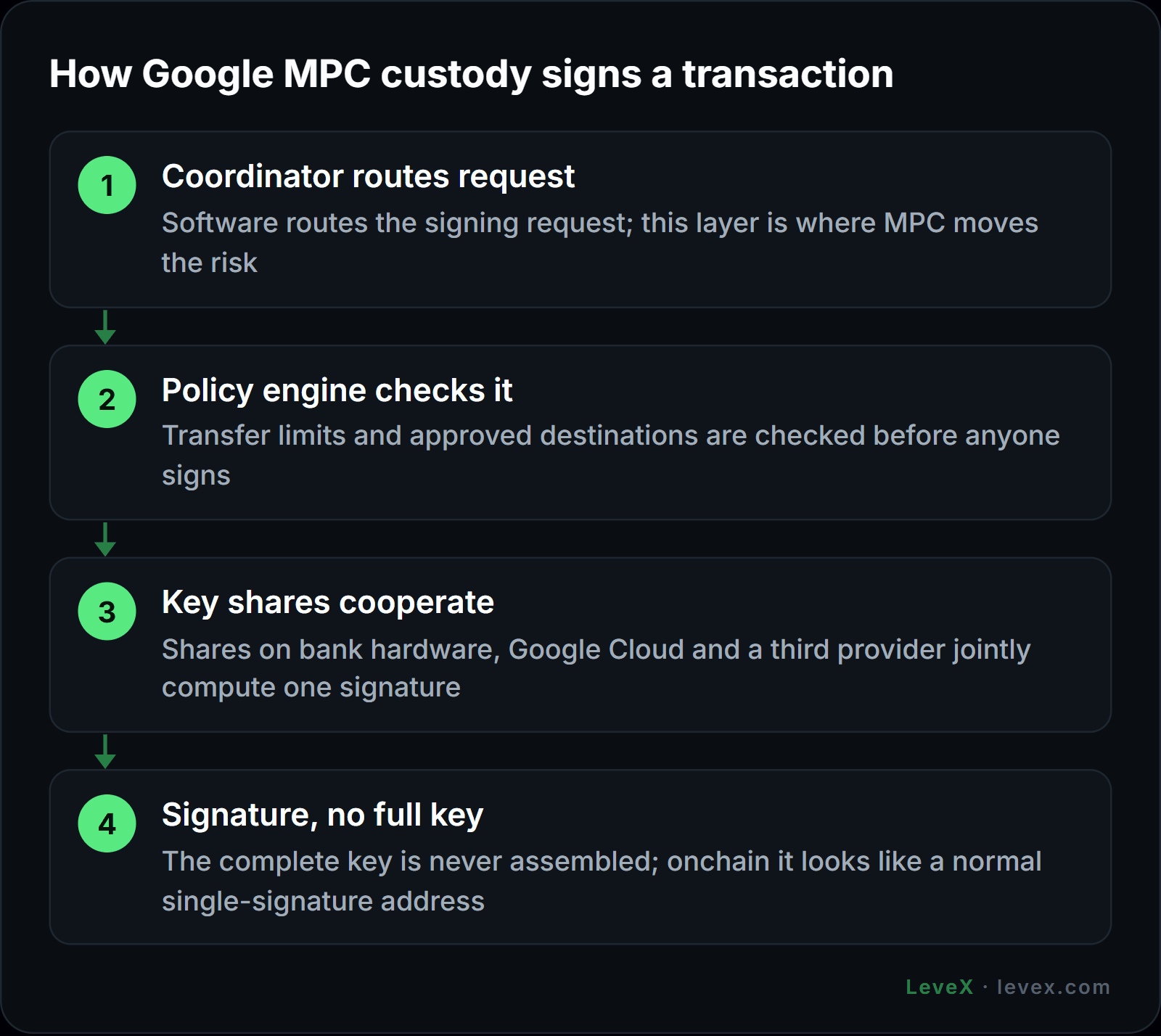
The table's last column is where most coverage went quiet. MPC removes the stolen-key problem and moves the risk into software, specifically the coordinator that routes signing requests and the policy engine that decides which requests are allowed. The largest exchange theft on record, in February 2025, left the cryptography fully intact: attackers compromised the interface that signers used to approve a multisig transaction, so the signers approved a payload that looked routine and was anything but. Key splitting does nothing for a signer who has been shown the wrong transaction.
That is why the October 1 Bitcoin rules matter more than the press release. Detecting change outputs and destination types is the policy layer doing the job a tired human approver tends to skip.
The trade nobody advertises
An MPC wallet looks identical to an ordinary single-key wallet onchain. A multisig publishes its rules for anyone to read; an MPC setup keeps them inside the provider's system. For the institution, that is privacy and lower fees. For everyone dealing with the institution, it means the security arrangement is invisible and has to be taken on trust, or proven some other way.
The LeveX Take
The story the market should care about is concentration. When a bank holds one share, Google holds one and a third provider holds the last, the bank has escaped dependence on any single key and picked up a dependence on Google Cloud's uptime, Google's policy software and Google's interpretation of whatever regulation applies next year. That is a reasonable trade for a bank that already runs on Google infrastructure. It also means a large slice of institutional crypto could one day share a single upstream vendor, and anyone who remembers the day a cloud region outage froze half the internet's dashboards should find that more interesting than the cryptography.
The invisibility point extends to exchanges too. If custody arrangements across the industry move to MPC, the onchain clues that observers once used to judge how a custodian secured its coins mostly disappear, which leaves direct verification of balances as the meaningful check. LeveX publishes Proof of Reserves through a Merkle tree, so any user can confirm their own balance is included in reserves that, on the September 30 snapshot, stood at 112% for BTC, 132% for ETH and 105% for USDT. As the signing layer gets harder to see from outside, the reserve layer is the part a trader can still check personally, and it is worth checking at any venue before size goes in.
What Early 2027 Will Answer
Three details will tell traders whether this becomes infrastructure or stays a showcase. The first is pricing, since custody margins are thin and a cloud giant that undercuts the specialists could reshape who holds institutional coins. The second is the testers, because a named global bank moving client assets would matter far more than Alphabet guarding its own. The third is which chains and signature schemes make the general-availability list, since Bitcoin policy rules are already live and the rest is still a preview.
BTC and ETH both trade on LeveX spot and futures markets, and for plain-language explainers on wallets, keys and custody, browse Crypto in a Minute.